Art as witness and agent: the impact of social change on the visual imagery of the 1920s and 1930s
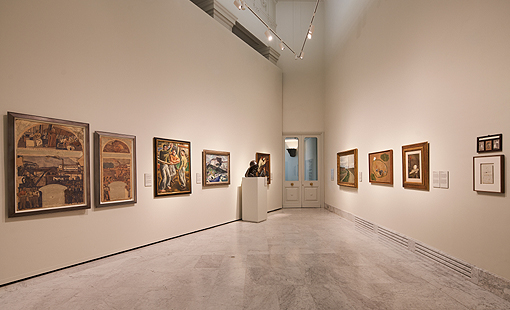
The first section in the exhibition 'Allegories of What is to Come' —entitled Landscape. Progress and Society— explains the historical context of the project to extend the bank's Cibeles offices in the 1930s. Visitors can see a range of artworks and other items, including the film The Ploughmen of Extremadura (1937) (produced by the Ministry of Agriculture) and aerial photographs taken by Jean Moral. They depict a range of locations in mainland Spain and the people who lived and worked there: farmers, asphalt layers, fishermen, working women, etc.
Displayed alongside the figures in the stained glass panels by Maumejean Hermanos, S.A., they offer an opportunity to explore the relationship between art, work and nation building. The exhibition provides a vision of the Spain of the 1920s and 1930s, a scene of modernism, conflict and transformation. It shows how art was capable of transcending mere representation, becoming both a witness and an agent of the social change that was to leave such a deep imprint of the visual imagery of the time.
Seven of the works in this section come from the Banco de España Collection. In chronological order, these are: Landscape (Old Road in Vilanova), 1890, by Ramón Casas i Carbó; Fisherman, 1903, by Mateo Inurria; In the Tavern. Zarauz, 1910, by Joaquín Sorolla y Bastida; Nocturne, ca. 1927, by Benjamín Palencia; Fuenterrabía Landscape, 1927, by Daniel Vázquez Díaz; The Asphalt Layers of the Puerta del Sol, 1930, by José Gutiérrez Solana; and A Rural Family, 1935, by Joaquim Sunyer. A number of other pieces have been especially loaned for the exhibition by the regional Government of Catalonia , the Museu Nacional d’Art de Catalunya, the Museo de Bellas Artes de Bilbao and the Museo Nacional Centro de Arte Reina Sofía, whom we would like to thank for their cooperation and generosity.
Another item from the bank's collection on display is Alfonso de Olivares’ Paris. The 1927 oil painting hangs in the section entitled An Administered Modernity, which looks at the material and functional design for the enlargement project, directed by Navarrese architect José Yárnoz Larrosa. In his design, Yárnoz sought to embody some of the values of modernism, combining architecture, function and representation.
His decision to use the visual language of Art Deco was a crucial feature in his successful blend of functionality and monumentality.
As well as being a painter, Alfonso de Olivares also took a keen interest in architecture and interior design. He was captivated by the new taste for Art Deco, with its emphasis on rational elegance, light and metal. This fascination is reflected in París, in which the artist uses red and white lines on a black background to delineate a nocturnal architecture. It is reminiscent of the light-filled scenes that were so characteristic of Parisian modernism in the period following the 1925 International Exhibition of Modern Decorative and Industrial Arts, the first great showcase and launchpad for the modernist movement.
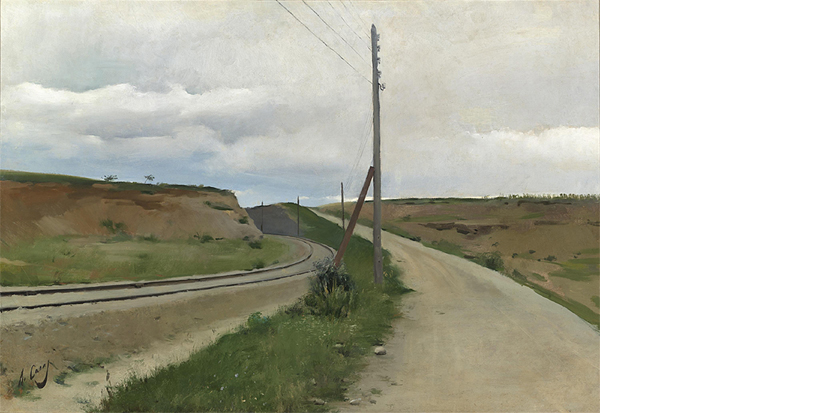
Landscape (Old Road in Vilanova), 1890, by Ramón Casas i Carbó
This painting depicts a rural scene transformed by the arrival of progress and modernity. Ramón Casas i Carbó (Barcelona, 1866 - 1932) was a key figure in the late nineteenth-century revival of Catalan painting. Here, he shows a Mediterranean landscape with low scrub across which an old cart track runs parallel to a railway and telegraph lines. The stark material depiction is a far cry from the idealistic evocation so typical of the landscape genre, giving the picture the appearance of an almost topographical record. In Casas i Carbó’s landscape, nature is no longer the dominant force; the future has burst in, subtly but inevitably, forging a path for itself 'with shovel teeth', as Isabel Tejeda writes.
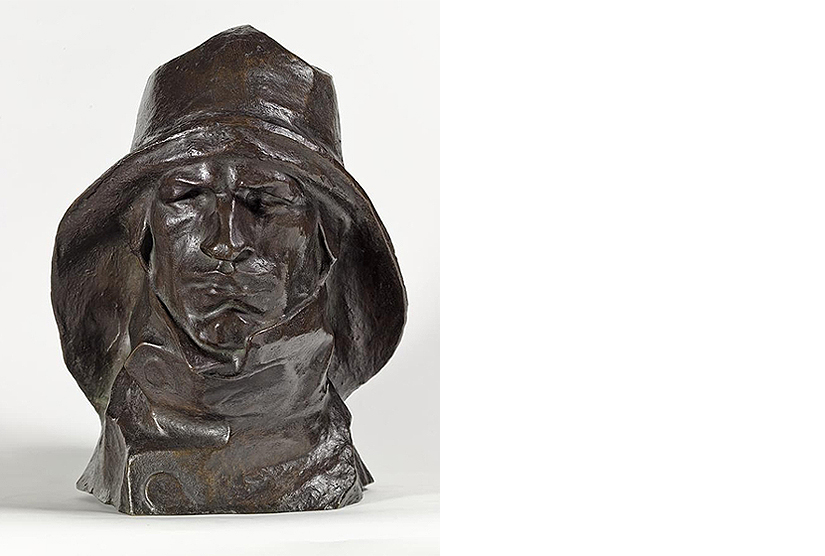
Fisherman, 1903, by Mateo Inurria
This poetic vision of a fisherman is one of a group of allegorical sculptures by Mateo Inurria (Córdoba, 1867 — Madrid, 1924), designed for a monument to Alfonso XII to be erected in the Retiro Park in Madrid. Inurria's oeuvre is strongly rooted in the nineteenth century, but the pronounced expressiveness of the features and the stony hardness of the cap lend the figure a subdued power that reflects a certain change in style characteristic of the mid-to-latter stages of the artist’s career. As Álvaro Perdices explains, the work 'reflects the social purpose of public sculpture', elevating the 'fisherman, an anonymous man of the people, into a paragon of the collective memory'. 'In this gesture,' Perdices adds, 'one also perceives the influence of the early-20th-century regenerationist movement, which sought to affirm the symbolic value of labour and the maritime professions in shaping Spanish national identity'.
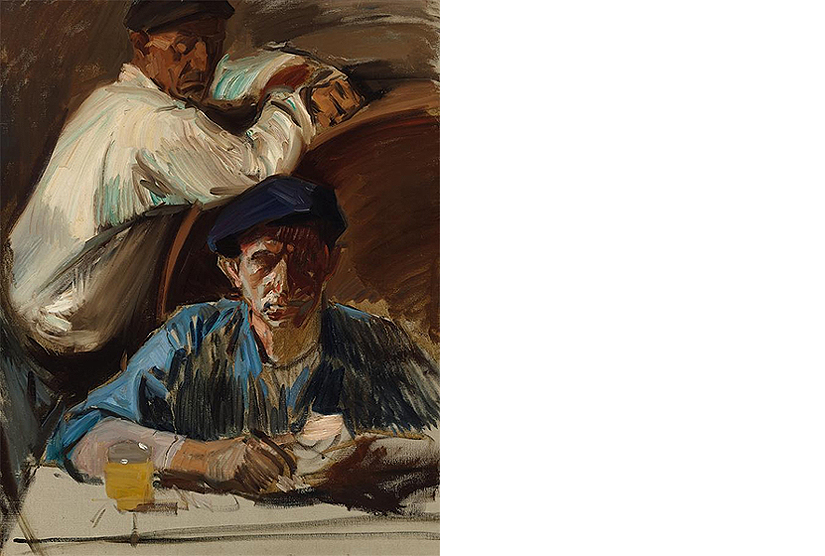
In the Tavern. Zarauz, 1910, by Joaquín Sorolla y Bastida
Throughout his career, Joaquín Sorolla y Bastida (Valencia, 1863 - Cercedilla, Madrid, 1923) took a particular interest in depicting simple characters at work or –as in the case of In the Tavern Zarauz (1910)– at leisure. It was painted during one of Sorolla’s summer sojourns on the coast of Gipuzkoa. Using a simple almost photographic front-on composition, it shows two men, their faces tanned and hardened by sun and toil, resting from their labours in a tavern. As Mónica Rodríguez Subirana writes, 'This aspect of Sorolla’s painting was captured in the large panels he made from 1912 for the library of the Hispanic Society of America, which formed what he called his Vision of Spain through its common folk'.
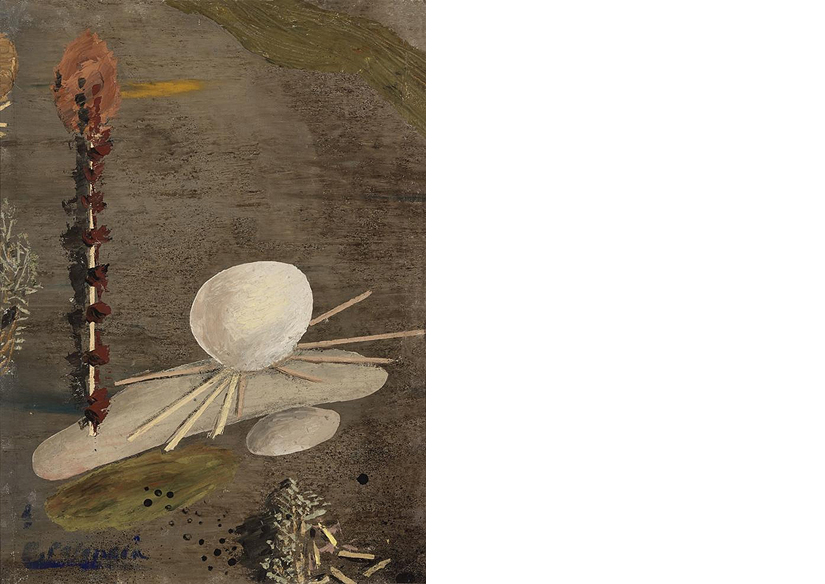
Nocturne, ca. 1927, by Benjamín Palencia
Benjamín Palencia (b. Barrax, Albacete, 1894 - d. Madrid, 1980) spent a brief spell in Paris, where he discovered the vibrant post-cubist and surrealist international art scene. At the end of the 1920s, he moved back to Spain where he and sculptor Alberto Sánchez founded the 'Vallecas School', a collective project which advocated creating an avant-garde rooted in the territory, using the fields to the south-east of Madrid as a laboratory for their experiments. Nocturne (1927) —like Palencia’s other painting in the exhibition, Geological Landscape (1931) (on loan from the Museo Reina Sofía) was one of the results of this experience. In this work, notes Álvaro Perdices, Palencia 'transfers the very texture of the ground to the canvas, using oil paint to construct rocks and fragments of straw that are almost sculptural, with a forceful material and tactile quality'. Palencia uses the pictorial material in much the same way as a farmer works the earth. In this gesture, says Perdices, lies the radical nature of his research: he breaks with the academic canon without mimicking European avant-garde movements, seeking a specific form of modernism through a poetic and physical appropriation of the landscape itself.
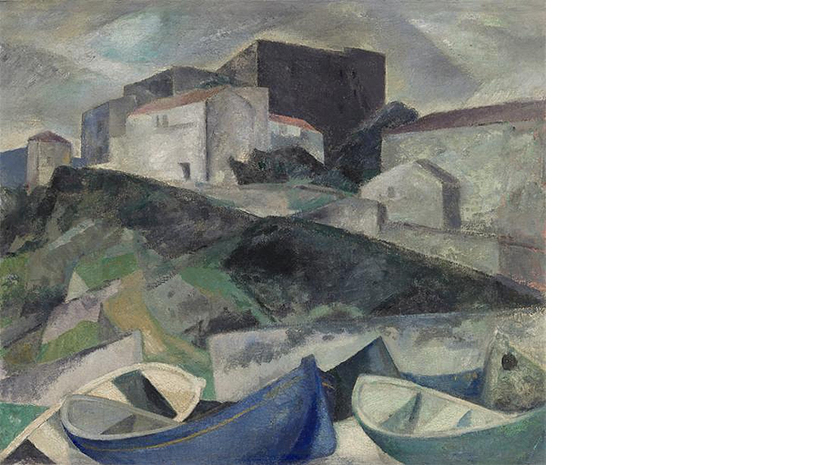
Fuenterrabía Landscape, 1927, by Daniel Vázquez Díaz
In Fuenterrabía Landscape, Daniel Vázquez Díaz (b. Nerva, Huelva, 1882 – d. Madrid, 1969) decomposes the view of the harbour in the Basque town of Fuenterrabia, using a compositional construction that owes much to Cézannian Cubism, stylising the environment to such an extent as to dilute its geographical and social identity. Álvaro Perdices writes that unlike other paintings by Vázquez Díaz from the same period — e.g. The Factory in the Mist (1920) and The Sleeping Factory (1925) — here his use of a Cubist-inspired visual language is purely formal, 'more stylistic than analytical'. The painting dates from 1927, the year when the artist began his great mural project for the La Rábida monastery in Huelva — a key moment in his own career and in the history of early twentieth-century Spanish painting.
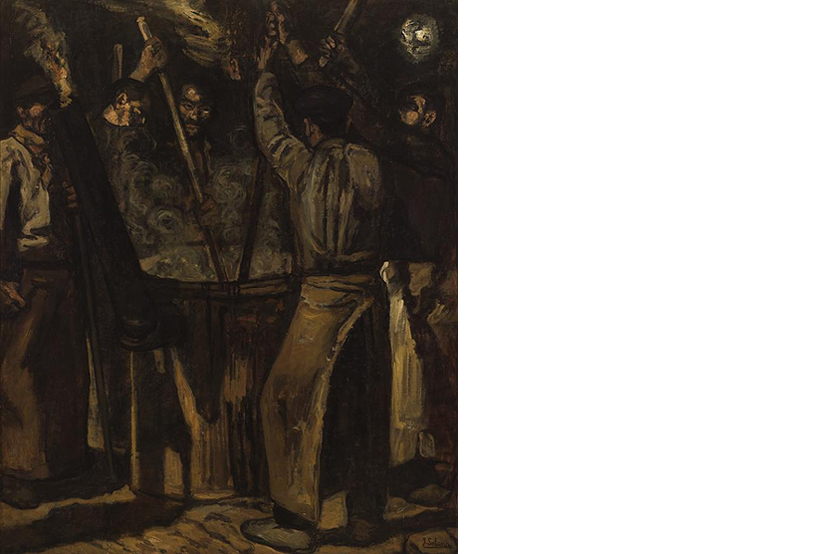
The Asphalt-Layers of the Puerta del Sol, 1930, by José Gutiérrez Solana
The protagonists of this painting are an anonymous group, a small sample of the many labourers who worked in precarious conditions on the urban remodelling of Madrid in the 1920s and 1930s, helping to turn it into the modern city we know today. The picture clearly references some of the work of Francisco de Goya, with its circular composition, blurred, masklike faces, rapid, impasto, expressionist lines used to convey the harsh tar fumes and the tenebrism of the night. Yet the parallels go further; like the Aragonese artist, José Gutiérrez Solana (Madrid, 1886 - 1945) brought a social and documentary slant to his work, transcending the restrictions of the genre to serve as a witness of the tensions and contradictions of his time. As Carlos Martín writes, The Asphalt Layers of the Puerta del Sol is an early example of his interest in portraits of workers from different walks of life, which allowed him to create 'a crude and fatalistically represented fresco of the working classes against the backdrop of the metropolis'.
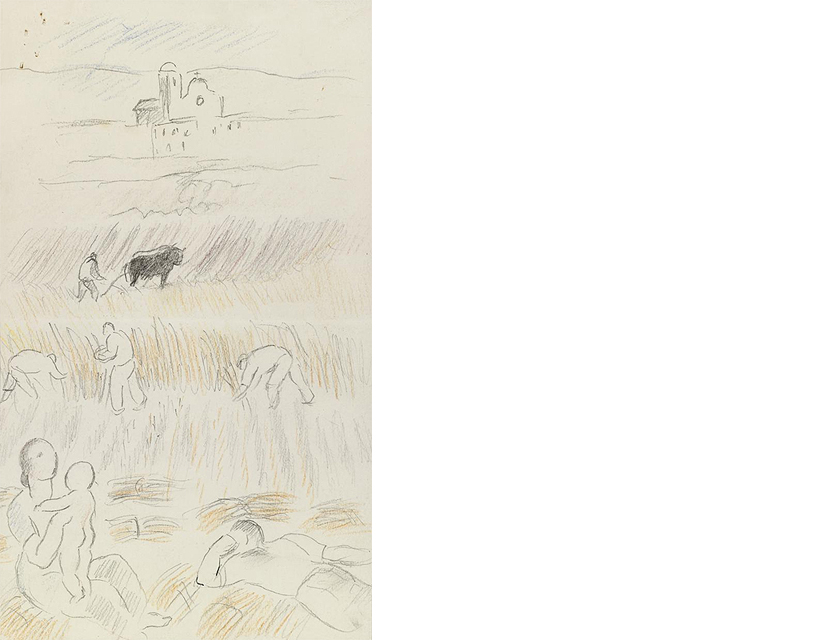
A Rural Family, 1935, by Joaquim Sunyer
Joaquim Sunyer (Sitges, Barcelona, 1874 - 1956) was a central figure in noucentisme. He sought to imbue Catalan art with an identity of its own, closely linked to the territory, the idea of nationhood and the Mediterranean spirit. He created idyllic pastoral scenes in which humans and nature coexisted in harmony, free from tension or conflict. An interesting example is his drawing A Rural Family (1935) — a precursor to his The Land (1952), commissioned for the lobby of the Banco de España's branch office in Barcelona, where it partners with Daniel Vázquez Díaz's The Sea (1955). The lower part of the drawing shows a tranquil rural family scene, while in the middle section, the artist depicts harvesting and ploughing. The composition is arranged vertically, as if Sunyer had intended it for some mural or monumental setting. The church silhouetted in the picture is probably inspired by the church of San Sebastián in Sitges, his hometown. 'This presence', says Álvaro Perdices, 'consecrates the whole and crowns the scene with a divine order that bestows meaning and harmony upon rural life, representing an idealized Catalonia'.
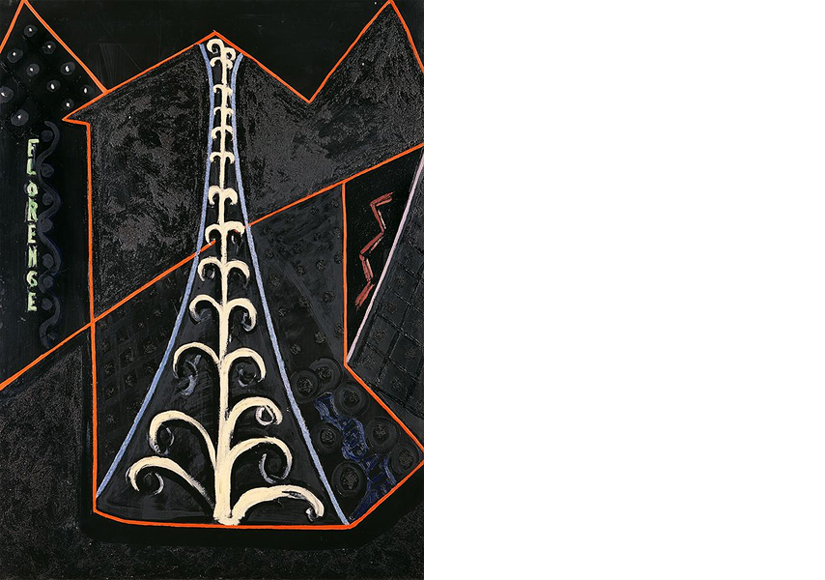
Paris, 1927, by Alfonso de Olivares
Alfonso Olivares (Hernani, Gipuzkoa, 1898 - 1936) borrowed insatiably from the major art movements of his time, but remained unwed to any one school. The result is an eclectic oeuvre that proves impossible to pigeonhole. Common features of his art are the use of collage, the notion of light as an element of renovation and his experimentation with compositional structures far removed from the strictures of naturalism. Paris is a depiction of the French capital in oils and shows influences of cubism and an incipient surrealism. In the centre is a luminous form reminiscent of the Eiffel Tower, which gives the picture a certain air of a theatrical set — an impression that is reinforced by the word 'FLORENCE' on one side, evoking the neon signs of hotels and cafés that were redefining the urban landscape of large European and North American cities at the time.
As Álvaro Perdices says, this fascination with artificial lighting is closely linked to the experiments of designers such as René Lalique, whose luminous fountain —presented at the 1925 International Exhibition in Paris— became an icon of decorative modernism. Perdices adds that the motifs so characteristic of Parisian nightlife that appear in this and other pieces by Olivares from the late 1920s, were synthesised in Spain in spaces such as the Banco de España's Trading Floor, 'where a monumental clock illuminates the room, turning it into an authentic theatrical scene'.