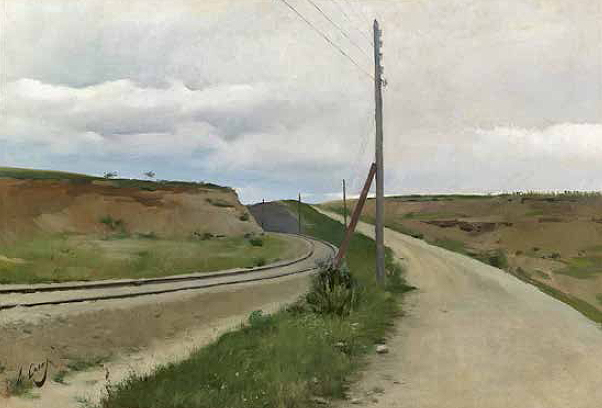
Ramón Casas i Carbó (b. 1866 – d. 1932, Barcelona): ‘Landscape (Old Vilanova Road)’, 1890. Oil on canvas. 109 x 147 cm. Banco de España Collection
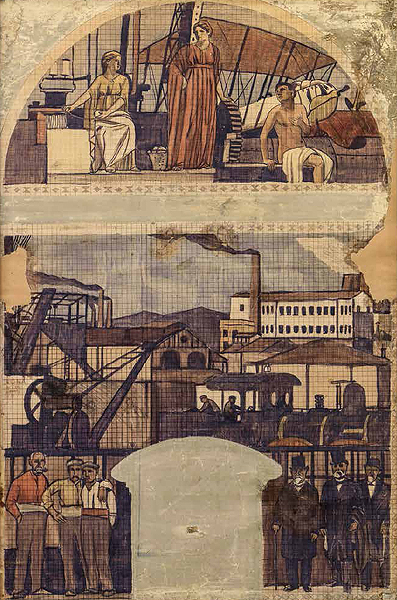
Joaquín Torres-García (b. 1874 – d. 1949, Montevideo): Industrial Catalonia, 1917. Sketch for the fifth fresco in the Saló de Sant Jordi, Palau de la Generalitat de Catalunya. Watercolour, pencil and ink on paper/card. Government of Catalonia
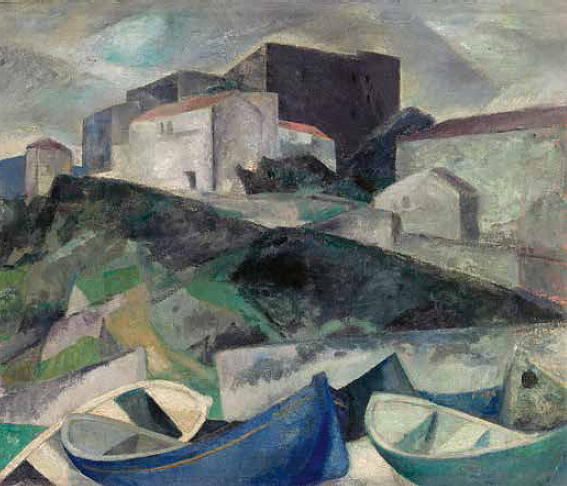
Daniel Vázquez Díaz (b. Nerva, Huelva, 1882 – d. Madrid, 1969): ‘Fuenterrabía Landscape’, 1927. Oil on canvas. Banco de España Collection

Aurelio Arteta (b, Bilbao, 1879 – d. Mexico City, 1940): ‘The Burceña Bridge’, ca. 1925–1930. Oil on canvas. Bilbao Museum of Fine Arts
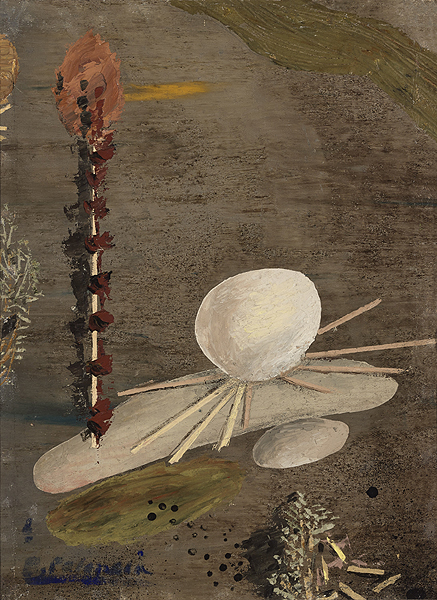
Benjamín Palencia (b. Barrax, Albacete, 1894 – d. Madrid, 1980): ‘Nocturne,’ 1927. Oil on canvas. 46 x 33 cm. Banco de España Collection
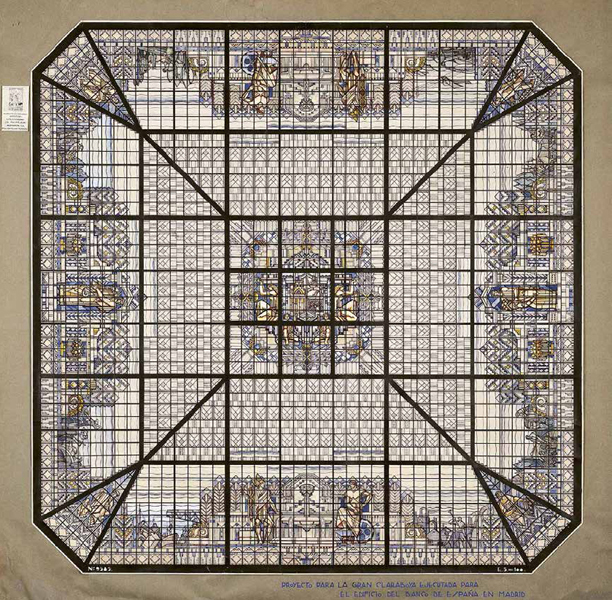
Alberto Martorell (b. Sant Feliu de Guíxols, 1890 - d. Calí, Colombia, 1979). Maumejean Hermanos, Madrid (b. 1923 – d. 1970). National Museum of Decorative Arts, housed at the National Glass Centre Foundation
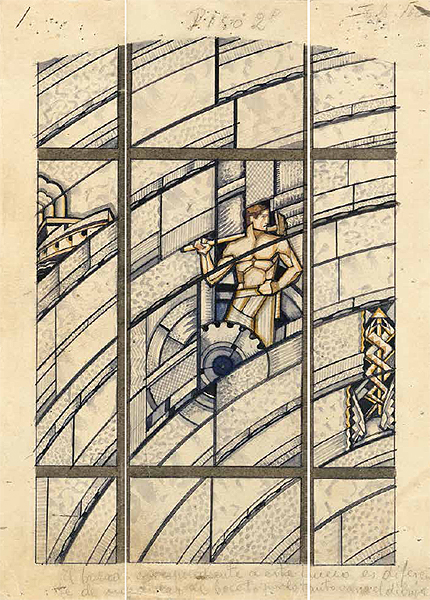
Alberto Martorell (b. Sant Feliu de Guíxols, 1890 - d. Calí, Colombia, 1979) (attributed). Maumejean Hermanos. ‘Allegory of Industry’, ca. 1933. Sketches for the windows of the main staircase of the extension. Ink, watercolour and pencil on paper
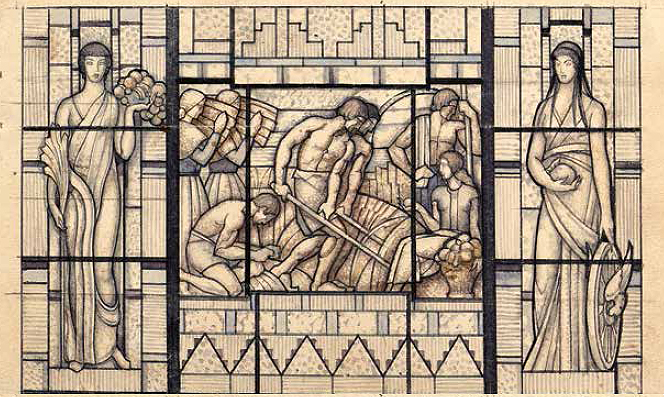
Maumejean Hermanos (1923 – 1970). Sketches for the stained-glass window in the entrance hall of the Banco de España extension. Watercolour and pencil on paper. National Museum of Decorative Arts, housed at the National Glass Centre Foundation
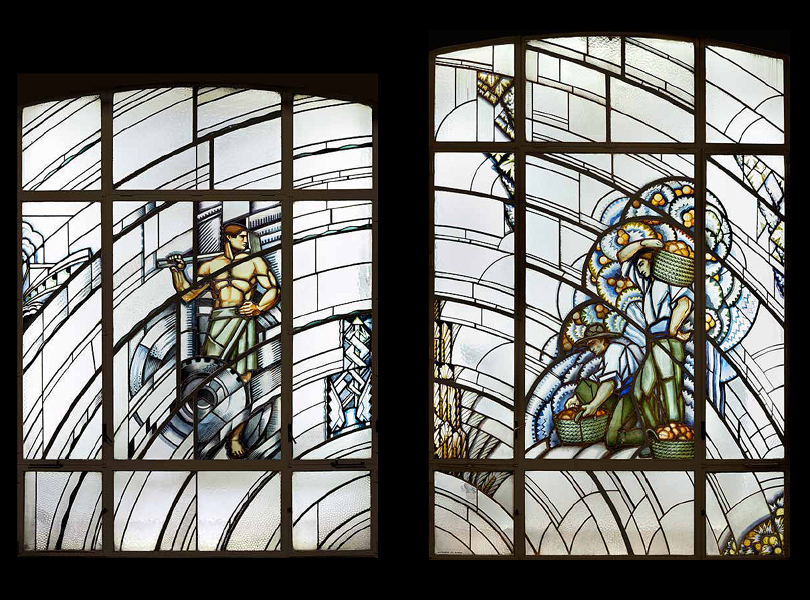
Maumejean Hermanos, Madrid (1923 – 1970). ‘Allegory of Industry and Allegory of Agriculture’, ca. 1934–1935. Enamelled and figured glass and metal, 415 x 306 cm. | 440 x 306 cm. Banco de España Collection

Alberto Martorell (b. Sant Feliu de Guíxols, 1890 – d. Calí, Colombia, 1979). Maumejean Hermanos ‘Shepherding’, ca. 1932. Cartoon for the stained-glass panel. National Museum of Decorative Arts, housed at the National Glass Centre Foundation

Alberto Martorell (Sant Feliu de Guíxols, 1890–Calí, Colombia, 1979). Maumejean Hermanos ‘Allegory of Agriculture (women picking fruit)’, ca. 1933. Cartoon for stained glass panel in the entrance hall of the extension of Banco de España's building
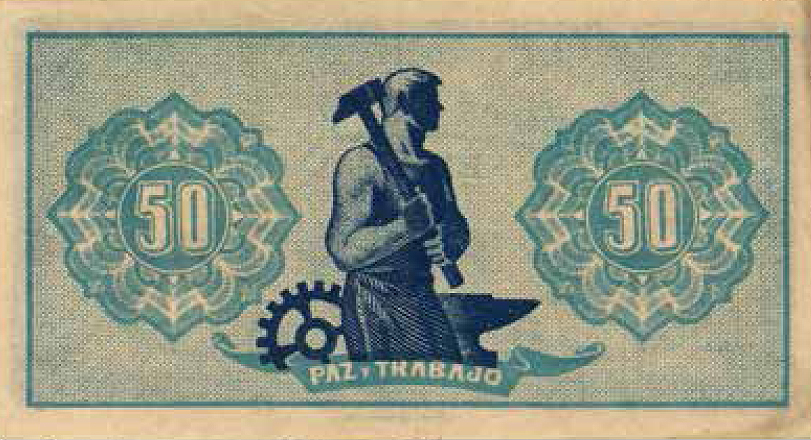
50-centimo banknote issued by the Consejo de Asturias y Leon, ca. 1937. Originals, printed by lithographic process. Printed by: Control de Litografía, Gijón, at the Artes Gráficas printing house. AHBE, Banknote Collection
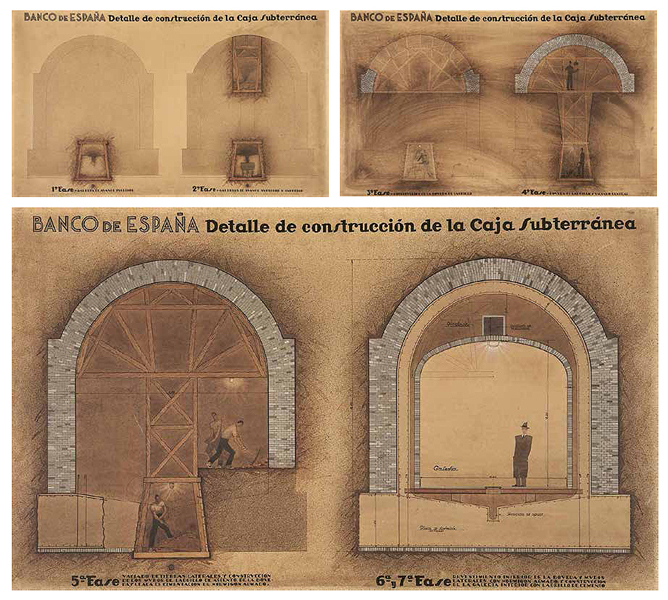
José Yárnoz Larrosa (b. Pamplona, 1884 – d. Madrid, 1966): ‘Construction of the Banco de España Underground Vault’ (details). Original drawings in Indian ink and watercolours on canvas-mounted paper. Banco de España Collection
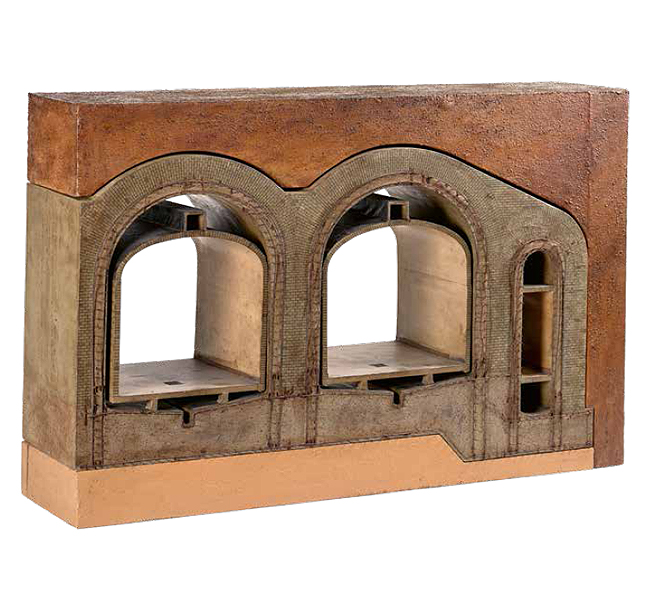
José Yárnoz Larrosa (b. Pamplona, 1884 – d. Madrid, 1966). ‘Architect’s model of Underground Vault cross-section’, 1932. Wood, plaster, metal and wallpaper. Scale 1:20. Banco de España Collection

Author unknown. Photograph of construction of the building’s underground vault, ca. 1932. Gelatin silver print. AHBE
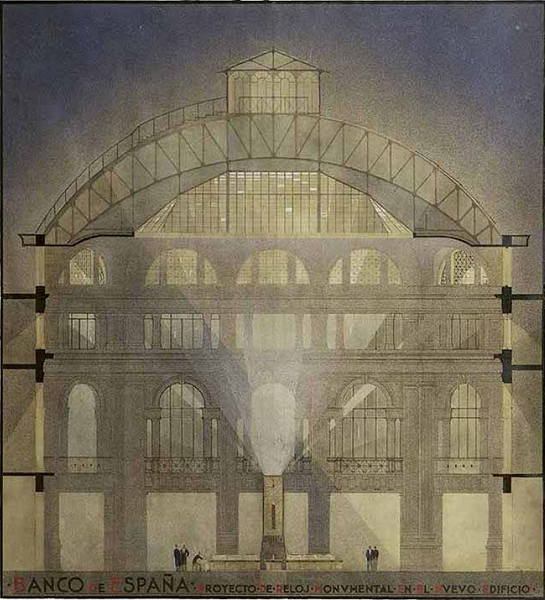
José Yárnoz Larrosa (b. Pamplona, 1884 – d. Madrid, 1966): ‘Banco de España: Design for a Monumental Clock in the New Building’. Watercolour and ink on cardboard. 79 x 72 cm AGUN. José Yárnoz Larrosa Collection

José Yárnoz Larrosa (b. Pamplona, 1884 – d. Madrid, 1966). ‘Plan of the roof structure in the Trading Floor’, 1930. Ink on waxed paper. AGUN. José Yárnoz Larrosa Collection
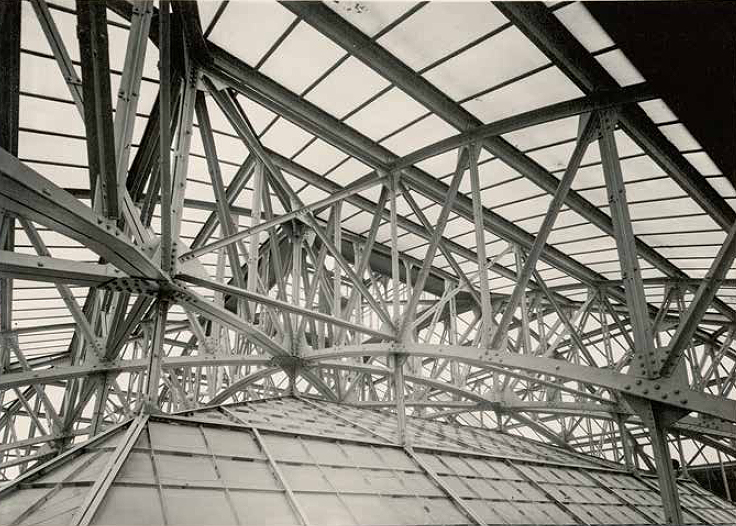
Antonio de Zárraga (b. Madrid, 1885 – d. Mexico City, 1957). ‘El Banco de España’ book, 1936. Framework of the Central Hall Dome, with the grand artisanal stained-glass panels below, 1936. AGUN. José Yárnoz Larrosa Collection
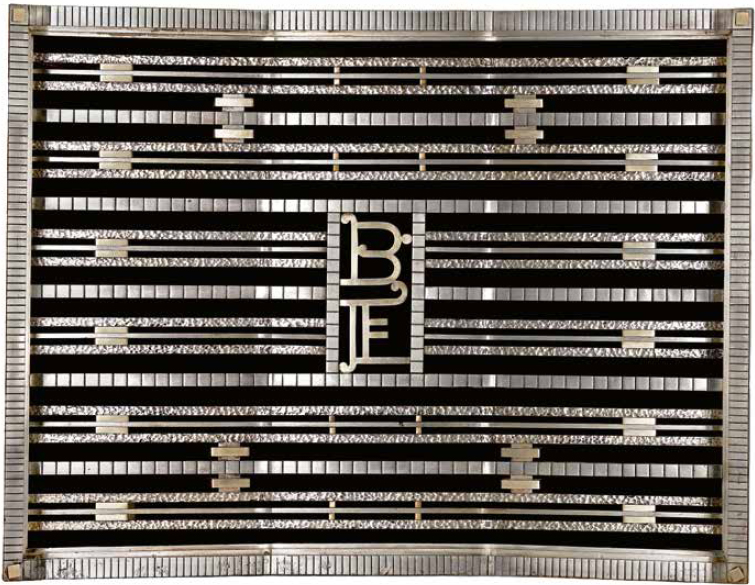
Cerrajería Artística Francisco Torras. ‘Radiator grille’, 1935. Steel structure. Banco de España Collection
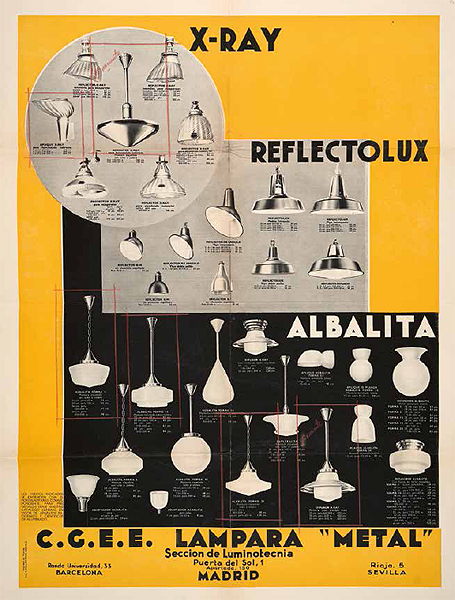
Original Advertising Poster for C. G. E. E. Metal lamp - X-Ray, Reflectolux and Albalita, ca. 1935. AHBE, Secretariat, C. 3256
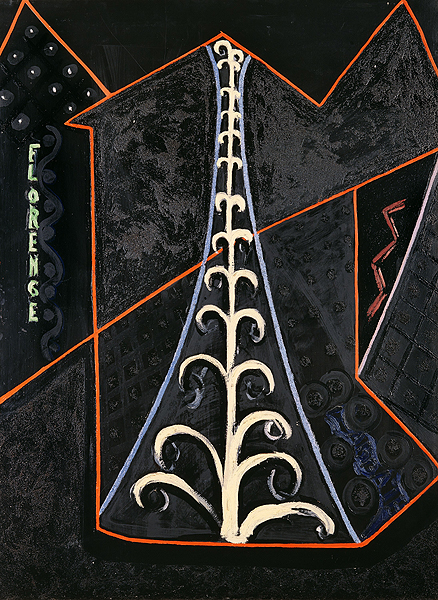
Alfonso de Olivares (Hernani, Gipuzkoa, b. 1898 – d. 1936): ‘Paris’, 1927. Oil on canvas. 130 × 97 cm. Banco de España Collection
ALLEGORIES OF WHAT IS TO COME
IMPORTANT NOTICE
On Saturday, April 11, from 4:00 PM to 8:00 PM, the exhibition will not be open to visitors. We apologize for any inconvenience.
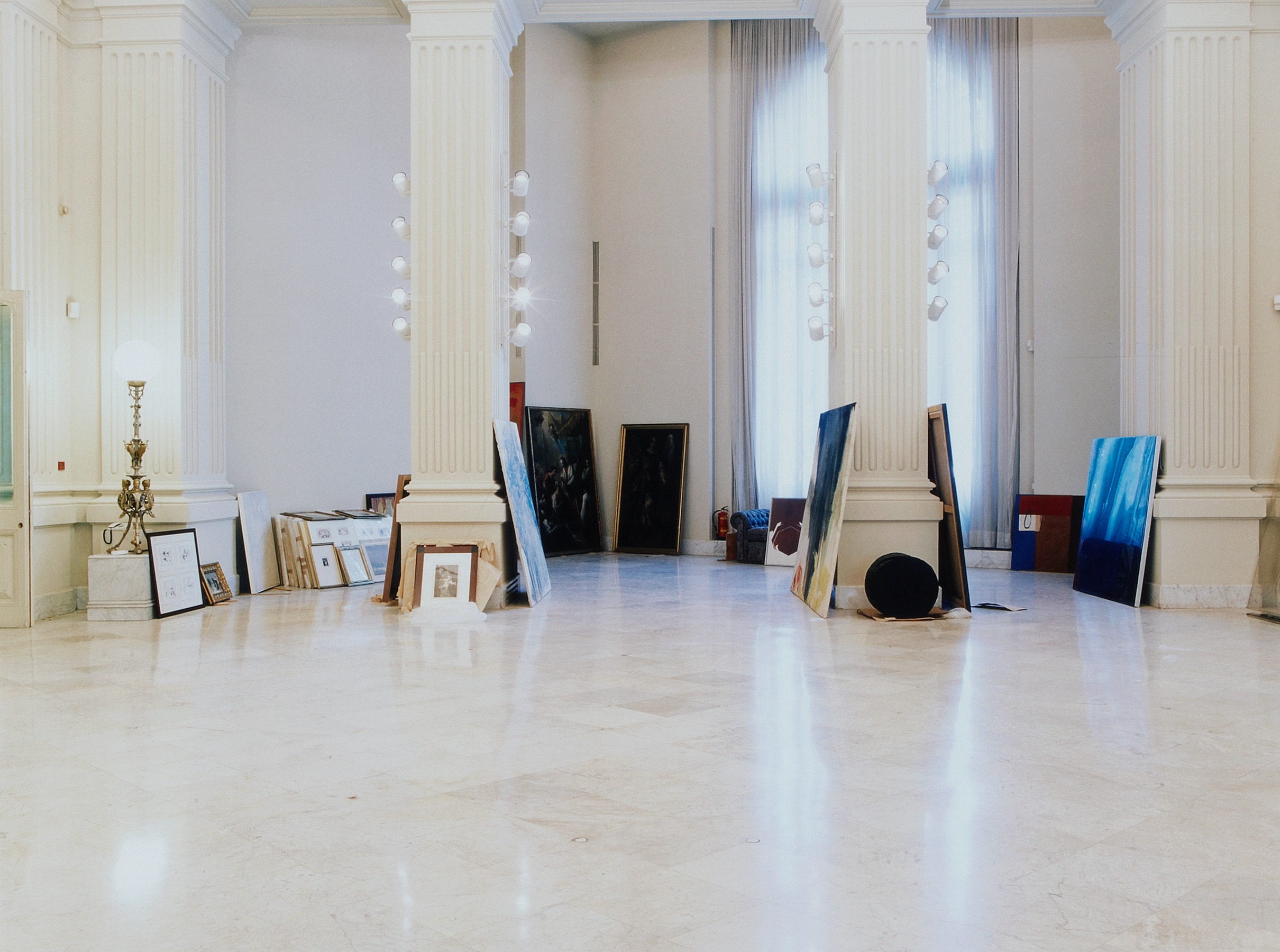
The Banco de España’s new exhibition, Allegories of What Is to Come, is the first to analyse the impact of the Art Deco movement on its head offices on Plaza Cibeles. Designed by architect José Yárnoz Larrosa in the 1930s, the extension included two of its most important architectural spaces: the trading floor, which boasts one of the finest Art Deco stained-glass panels in Europe, and the iconic gold vault, inaugurated just a few months before the outbreak of the Spanish Civil War.
Allegories of What Is to Come focuses on this key moment in the bank’s history and a project that combined engineering, design, decorative arts and a powerful institutional message. It takes a multifaceted, critical approach, exploring some of the contradictions and tensions of a period in which modernism was seen as both a promised land and a disputed territory.
Nearly 150 items are on show, including drawings, sketches and original cartoons produced by the Maumejean Hermanos studio for the stained-glass panels in the new building. Thanks to the combined efforts of the Banco de España, the National Museum of Decorative Arts and the National Glass Centre Foundation, these largely unpublished materials have been restored and are on display to the public for the first time.
Curated by the Banco de España’s conservator, Yolanda Romero, and artist, curator and researcher Álvaro Perdices, Allegories of What Is to Come will be on show in the exhibition hall of the Cibeles building from 25 November 2025 to 28 March 2026. There will be a programme of guided tours, and a catalogue providing extensive information on the artworks, documents and other items on display, with a selection of essays exploring in greater depth some of the issues and problems addressed in the exhibition.
The enlargement of the Cibeles headquarters, a key episode for the Banco de España
Allegories of What Is to Come looks back at one of the most significant episodes in the bank’s history: the enlargement of its Cibeles headquarters in the 1930s. Combining art, architecture and institutional history, the exhibition documents the way the bank sought to use the new facility to project an image of modernity, progress and stability in a period rocked by revolution and armed conflict, by employing the artistic language that was transforming the image of the great metropolises of Europe and the Americas.
Through a varied mixture of artworks, documents and other items of all kinds –sketches, furniture, architectural drawings, banknotes, archive photographs – Allegories of What Is to Come acts as a ‘thinking device’, inviting viewers to critically reinterpret the visual narratives that have shaped our times.
An exhibition about the past, made to consider the present
This new exhibition has a twin aim. On the one hand, it is a chance to showcase a selection of documents, artworks and heritage items linked to a crucial moment in the Banco de España’s history. At the same time, it offers a case study that will spark debate on the historical role played by the country’s institutions in shaping modern Spain. In this respect, it is intended not as a snapshot of the past but rather as a means of questioning our own present.
Although not the sole feature of the show, the central focus is architect José Yárnoz Larrosa (b. Pamplona, 1884 – d. Madrid, 1966), who designed the first extension to the Banco de España’s head offices. Yárnoz Larrosa’s work was forged at the crossroads between eclecticism and modernism. He successfully extended and reinterpreted Eduardo de Adaro’s original design, maintaining the historic harmony of the building’s exterior while bringing a contemporary architectural logic to the interiors that reflected the global emergence of the Art Deco movement.
Much of the exhibition centres on the trading floor and gold vault, which both the architect and the bank itself saw as symbols of a new era, combining functionality and symbolism. The large trading floor, spacious and monumental, is designed to look like a public square where the public can go to access financial services. The vault, concealed and armour-plated, guards the country’s gold reserves. This duality – the visible and the secret, the accessible and the protected, light and shade – forms the backbone of the exhibition narrative.
Searching for order amidst instability
Yárnoz Larrosa’s design for the new extension sought not only to represent the pursuit of efficiency and permanence, but also to express the values of modernity. This is reflected in his choice of materials – steel, stone, marble, glass and polished brass – and his use of the latest construction techniques.
He adopted the visual language of Art Deco, an international aesthetic combining geometry, order and sophistication and reinterpreting certain avant-garde (and especially Cubist) styles. The stained glass panels commissioned from the prestigious Maumejean Hermanos studio depict a series of images taken from the world of labour (arable and livestock farming, fishing and industry) and technology (aviation, railways, ocean liners), here turned into allegories of a nation – a world, indeed – immersed in a process of transformation.
They reflect the bank’s desire to build an institutional narrative that would endorse its role as the guarantor of national progress. However, the exhibition also looks beyond these celebratory representations, examining the darker side of these ‘allegories of the future’: the harsh and often precarious working conditions, the notable absence of female protagonists and artists, etc. In this way, it explores the political dimension of the images, inviting us to reconsider the historical role of institutional art as a tool for legitimising power and as a mechanism for concealment and control.
Recovering Maumejean Hermanos’ original cartoons of the stained-glass panels
This new exhibition takes a multifaceted look at the first major extension to the Banco de España’s head offices at Plaza Cibeles. Among other aspects, it explores how the incorporation of the international language of Art Déco into the eclectic lexicon of the building was a conscious design decision which reflected the perceived role of institutional architecture in a modern society.
In his designs, Yárnoz Larrosa sought to integrate all the separate components. The various applied arts used in the project played a fundamental role, particularly the stained glass panels from the Maumejean Hermanos studio, a decorative and utilitarian feature that allowed the architect to achieve the necessary sense of light and transparency, while still preserving the structure’s monumental feel.
Thanks to the combined work of the Banco de España, the National Museum of Decorative Arts and the National Glass Centre Foundation, the original cartoons for the panels have been located, studied and restored. They are displayed here alongside other associated materials, such as drawings, sketches, architect’s models and photographic plates from the Maumejean Archive, currently held at the Real Sitio de La Granja. The recovery of these materials, which are being presented to the public for the first time, highlights the technical complexity and artistic significance of the project, one of the most iconic institutional Art Deco decorative ensembles anywhere in Europe.
Theme areas of the exhibition
Allegories of What Is to Come is divided into five different but closely interrelated thematic areas. Together, they form a visual and narrative ecosystem offering a continuous counterpoint between institutional desire and collective experience, between iconography and document, between the artistic and the tangible.
- Landscape, Progress and Society: The first section of the exhibition takes visitors back to the beginning of the 1930s, evoking the historical and artistic milieu in which the Banco de España extension was created. It includes works by artists such as Joaquín Sorolla, José Gutiérrez Solana, Ramón Casas i Carbó, Daniel Vázquez Diaz, Joaquín Torres Garcia and Antoni Arissa, along with documents that provide an interplay with the figures from the stained glass panels by Maumejean Hermanos and allow us to explore the relationship between art, labour and nation building. This first area invites us to interpret the landscape as a locus of modernity, conflict and transformation, with art acting as both a witness to and an agent of the social changes that shaped the visual imagination of the 1930s.
- The second area, the Maumejean Hermanos Workshop, specifically explores the stained glass panels that formed such an essential feature of the new building. Through a selection of drawings, sketches and cartoons from the studio, the exhibition meticulously reconstructs the design process behind this fascinating decorative ensemble, with its vision of collective labour as the aesthetic and ideological foundation of institutional modernity.
- The central section of Allegories of What Is to Come offers a selection of the original cartoons for the motifs from the stained-glass panels on the trading floor, together with the original Agriculture and Industry panels, which have recently been restored and will be reinstalled in their original locations after the exhibition. The large-format cartoons were located as a result of the Banco de España’s research in the Maumejean Archive, which is owned by the National Museum of Decorative Arts and currently held in the Fabrica Fundación Centro Nacional del Vidrio. Attributed to Albert Martorell, this is the first time they are being shown to the public. Combined in a single space, these items form a powerful installation that offers an allegorical interpretation of labour as the engine of progress, as it was viewed during the Second Republic.
- The fourth area, Technology and Security, explores one of the most iconic but most hidden areas of the building: the Gold Vault. Located at a depth of thirty-five meters, the chamber was designed as a work of precision architecture. Every component – the armoured door, protective barriers, waterproof materials, metal fittings, etc. – is designed to ensure maximum security. More than just a technical structure, the Gold Vault is an embodiment of the institutional vision of economic power as a sacred virtue. It is a space that makes security a symbol and safekeeping a ritual. The exhibition contains a selection of plans, drawings and models documenting the construction process. There is also a frieze with photos from the Banco de España Archive showing the workers who helped build the vault, which introduces a human face amidst all the allegorical references.
- The fifth and final area, An Administered Modernity, focuses on the material and functional design of the extension. It highlights how the design brought to life a concept of architecture, in which each element – the spatial structure, materials, furniture, lighting, and signage – formed part of an overall view of the building as a symbol of modernity, efficiency and authority. And it was precisely this combination of function and monumentality that led the architect to employ an Art Deco aesthetic. The visual logic behind this decision can clearly be seen in drawings, sketches and photographs from the archives of Yárnoz Larrosa and the Banco de España. The architecture was designed to last, to represent and project an image of solidity in times of uncertainty and transformation.
ARTISTS. Antoni Arissa, Aurelio Arteta, Ramón Casas i Carbó, Juan Cabanas Erauskin, Horacio Ferrer, José Gutiérrez Solana, Mateo Inurria, Alberto Martorell, Marqués de Villa Alcázar, Jean Moral, Alfonso de Olivares, Benjamín Palencia, Joaquín Sorolla, Joaquim Sunyer, Joaquín Torres-García, Daniel Vázquez Díaz, J. Viñas, José Yárnoz Larrosa, Antonio de Zárraga
MANUFACTURERS. Maumejean Hermanos-Madrid (stained glass), Industria Eléctrica Francisco Benito Delgado S.A (lighting), Asín Palacios S.A (metal fittings), Herráiz. Muebles y Bronces de arte, Deogracias Magdalena (furniture), Francisco Torras (wrought iron).