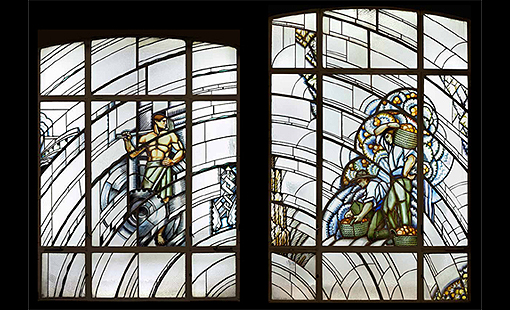
Stained glass panels by Maumejean Hermanos, one of the most iconic sets of twentieth-century institutional Art Deco in Europe
In the 1930s, the Banco de España undertook an ambitious enlargement of its Cibeles headquarters and commissioned José Yárnoz Larrosa from Navarra to design the architecture and decor. Allegories of What is to Come, now showing at the bank, reflects the key role the project played in the bank's transition to the modern era. It also explores some of the tensions and contradictions of one of the most conflictive periods in recent history, all narrated through a wide variety of artworks, documents and other related items – including sketches, furniture, architect's drawings, banknotes and archive photographs. Due to the great success of the exhibition, the initial run has been extended until 30 May 2026.
Yárnoz Larrosa's design for the extension involved enlarging and at the same time reinterpreting the original building by Eduardo de Adaro. Combining engineering, design, decorative arts and a powerful institutional message, it led to the creation of two major new spaces: the trading floor and the iconic Gold Vault. Both were designed to combine functionality and symbolism, reflecting not only a sense of efficiency and permanence, but also a desire to showcase the values of the modern age.
Crucially, Yárnoz Larrosa decided to adopt the language of Art Deco, a movement that was currently transforming the appearance of major cities across Europe and America, and which drew its inspiration from the early avant-garde (particularly cubism). The most outstanding feature of the project was the stained-glass ceiling in the trading floor's great hall. The skylight served both a decorative and a functional purpose, providing the light and sense of transparency Yárnoz Larrosa wanted to achieve whilst preserving the monumental appearance of the structure. Today, it is recognised as one of the finest sets of twentieth-century decorative Art Deco anywhere in Europe. The stained-glass panels for the ceiling were made by Maumejean Hermanos, S.A.
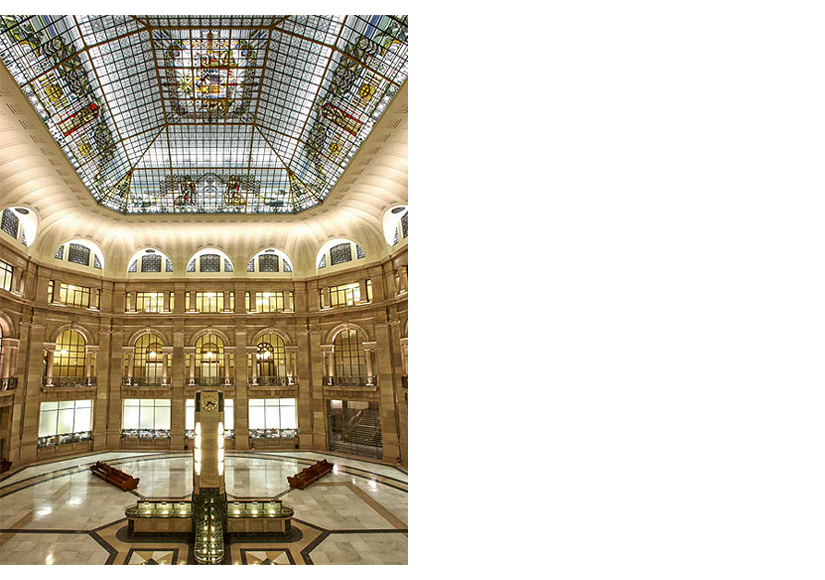 Trading Floor. Stained-glass skylight functioning as a large dome
As Carlos Muñoz de Pablos writes in the exhibition catalogue, given the complex network of studios across France and Spain and the various members of the Maumejean family involved, with different artists operating at different points in time, 'it is difficult to conduct a thorough study of Maumejean as a single studio, with a shared common project'. The original firm, founded in the mid-nineteenth century by Jules Pierre Maumejean, spawned many offshoots. The panels in the Banco de España are the work of Maumejean Hermanos, S.A., set up in Madrid in 1898 by one of Jules Pierre's descendants, José Maumejean. In 1923, Maumejean became a public limited company. The board was chaired by José Yárnoz Larrosa with directors including Mariano Benlliure, Gabriel Benito Larrea and the brothers José and Enrique Maumejean. It employed some of the best stained-glass artists, draughtsmen and painters anywhere in Europe, as well as master cutters and leadmakers.
'From the founding of Maumejean Hermanos, S.A., in 1923, until the 1950s, when the studio began to decline,’ writes Muñoz de Pablos, 'it produced thousands of square metres of stained glass panels in every imaginable style and trend – from Neos, mimicking historical styles and techniques, to some of the latest and most energetic forms of the time – all achieved with an unrivalled level of technological skill'. 'Behind these works,' adds Muñoz de Pablos, 'stood a large group of creative artists and craftsmen working on a common project, who generated a repertoire of styles and aesthetic forms that could hardly have been achieved in other circumstances or with other individuals'.
The panels designed for different locations in the Banco de España – the skylight on the trading floor, the lobby on Calle de Alcalá and the main staircase of the new extension – feature a sophisticated array of images, depicting the world of labour (arable and livestock farming, fishing and industry) and the great landmarks of technological progress (aviation, the railway and oceangoing liners). Intended to function as allegories of a nation (of a world, indeed) in transformation, they are nonetheless a product of the contemporary zeitgeist, articulating an ideal of labour, strength and productivity that is closely associated with virility.
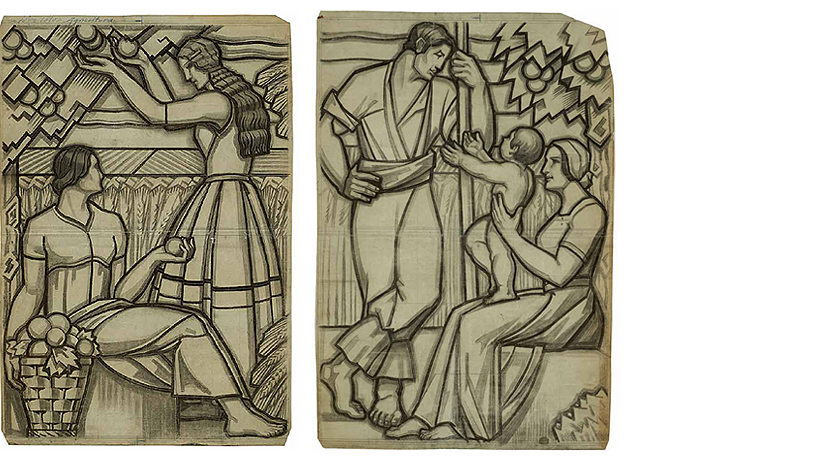 Alberto Martorell. Maumejean Hermanos, Madrid. Allegory of Agriculture (women picking fruit), ca. 1933. Cartoon for stained glass panel in the entrance hall of the extension to the Banco de España building. Charcoal on paper. National Museum of Decorative Arts, housed at the National Glass Centre Foundation | Alberto Martorell. Maumejean Hermanos, Madrid. Allegory of Agriculture, ca. 1933. Cartoon for stained glass panel in the entrance hall of the extension to the Banco de España building. Charcoal and ink on kraft paper. National Museum of Decorative Arts, housed at the National Glass Centre Foundation
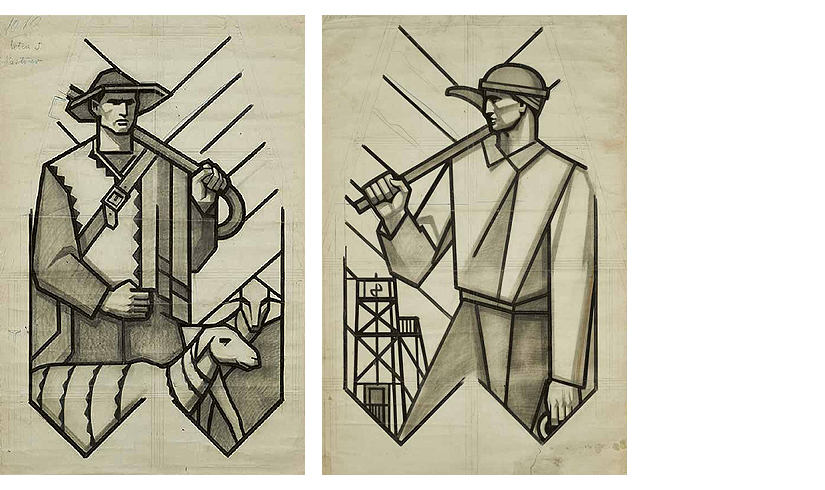 Alberto Martorell. Maumejean Hermanos, Madrid. Shepherding, ca. 1932. Cartoon for stained glass panel over the trading floor. Corner panel Charcoal and ink on kraft paper. National Museum of Decorative Arts, housed at the National Glass Centre Foundation | Alberto Martorell. Maumejean Hermanos, Madrid. Mining, ca. 1932. Cartoon for stained glass panel over the trading floor. Corner panel. Charcoal and ink on kraft paper. National Museum of Decorative Arts, housed at the National Glass Centre Foundation
The centrepiece of Allegories of What is to Come consists of two recently restored panels and a selection of cartoons (large drawings) with full-size reproductions of the decorative panels designed by Maumejean Hermanos, which are on show for the first time at this exhibition. Attributed to Albert Martorell, one of the most talented artists working for the studio at the time, they were tracked down by Banco de España researchers in the Maumejean Archive at the National Museum of Decorative Arts , now housed at the Royal Glass Factory of La Granja. The cartoons, in ink, pencil and charcoal, were used to accurately transfer the images onto the glass plates before they were cut and leaded. In stylistic terms, they display a certain synthesis of form, with strong, defining lines creating delimited features, derived from the calculated austerity of modernism.
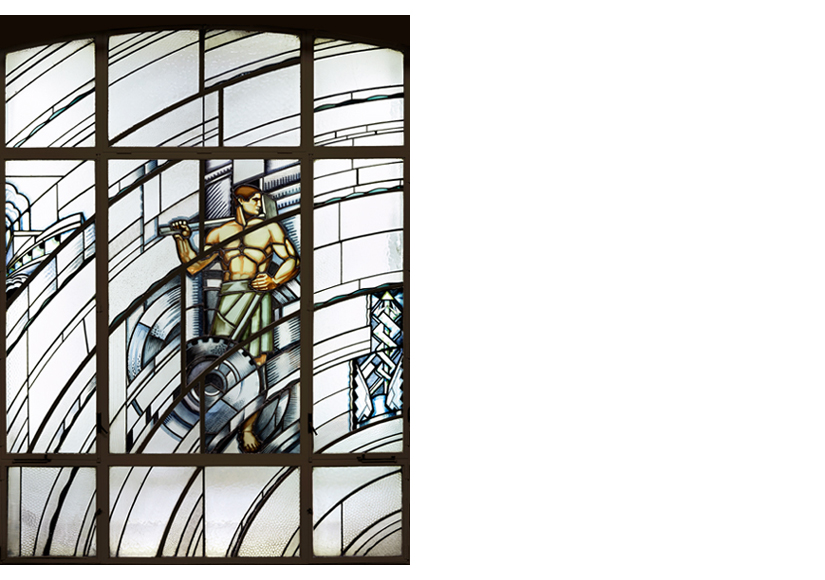 Maumejean Hermanos, Madrid. Allegory of Industry, 1934-1935. Enamelled and figured glass and metal. Banco de España Collection
The two restored stained-glass panels, which will be returned to their original location after the exhibition, depict industry and agriculture. They were designed as a set to occupy successive positions on the new main staircase created by Yárnoz Larrosa's extension, drawing viewers into their circular dynamism as they ascended or descended the stairs. Álvaro Perdices – who is co-curating the exhibition with Yolanda Romero – writes that this dynamism is represented by 'the gearwheel, here depicted as a spiral, which drives the body, the machine and, thus, the very economy of progress'.
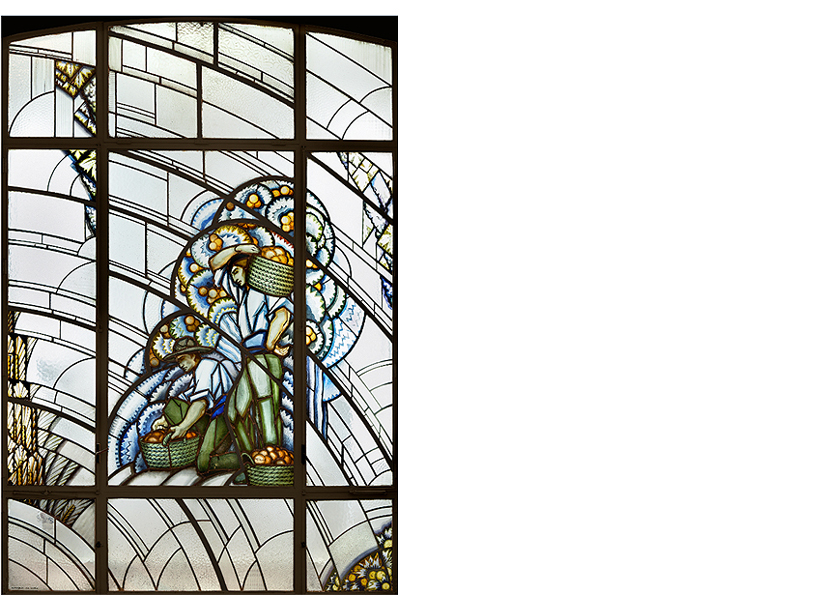 Maumejean Hermanos, Madrid. Allegory of Agriculture, 1934-1935. Enamelled and figured glass and metal. Banco de España Collection
Like the other stained-glass designed by Maumejean Hermanos for the Banco de España, these two panels are made of industrially manufactured enamelled and figured glass, which let through a large amount of light. They are notable for the avant-garde visual language used. The idealised male figures are similar to those that were popular at the time in American muralism and the propaganda of Italian fascism and Soviet socialism, whilst the geometric backgrounds combine the elegance of Art Deco with the bold experimentalism of abstract artists such as Sonia and Robert Delaunay. A large gearwheel is shown around one of the legs of the figure of industry, becoming a spiral that gives the window a hypnotic dynamism and is reminiscent of some of the compositions found in Vorticism, Futurism and Machinism. The other panel shows two peasants carrying orange baskets, in another allusion to physical effort. They also contain a reference to a specific Spanish imagery, since the figures recall the Levantine farmer immortalised in pictures such as Sorolla’s Orange Seller.
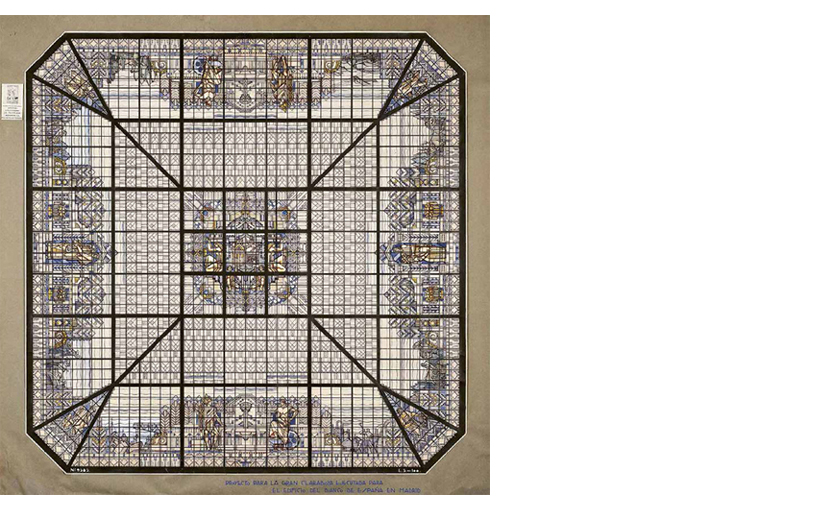 Alberto Martorell (attributed). Maumejean Hermanos, Madrid Border with allegorical figures and scenes of industry and trade, with the Spanish coat of arms in the centre. Sketch for the large stained-glass window over the trading floor of the Banco de España, 1932. Ink, watercolour and pencil on paper. National Museum of Decorative Arts, housed at the National Glass Centre Foundation
As well as the preparatory cartoons and these two stained glass panels, Allegories of What is to Come includes a wide selection of designs, sketches and drawings produced by Maumejean Hermanos during the process of creating the panels. They serve to trace the origins and development of the project. For example, we can see how the male figures gradually came to take on a more central position, as emblems of strength and productivity, while the – more statuesque – female figures were relegated to a secondary position, framing and legitimising the symbolic function of the man.
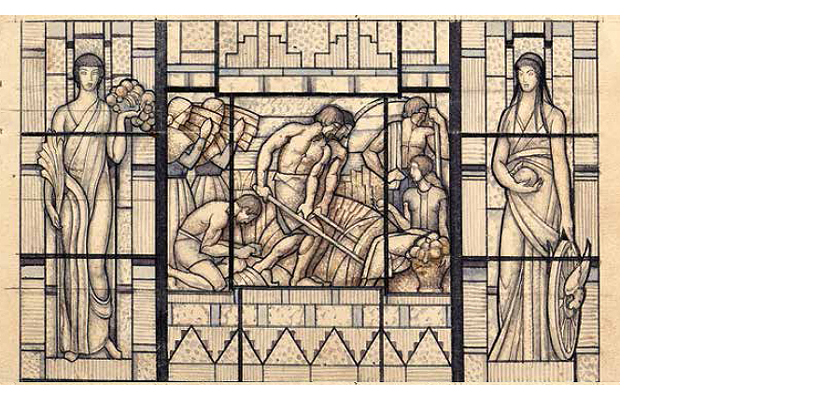 Maumejean Hermanos, Madrid. Harvest scene with allegorical figures in sidepieces, ca. 1933. Sketch for the stained-glass window in the entrance hall of the Banco de España extension. Watercolour and pencil on paper. National Museum of Decorative Arts, housed at the National Glass Centre Foundation
Due to the great popular success of the exhibition, it has been decided to extend the initial run by two months. It will now end on 30 May 2026, instead of the originally planned date of 28 March. The visiting hours will remain unchanged: Tuesday to Saturday, 11 am – 2 pm, 4 pm – 8 pm. Admission is free of charge. Prior reservation is required.
A wide range of guided tours is available, with special sessions on Saturdays from 12:30 to 1:30 pm for families with children aged between 6 and 12. To supplement the exhibition experience, a catalogue is available to download free of charge from the publications section of our website.
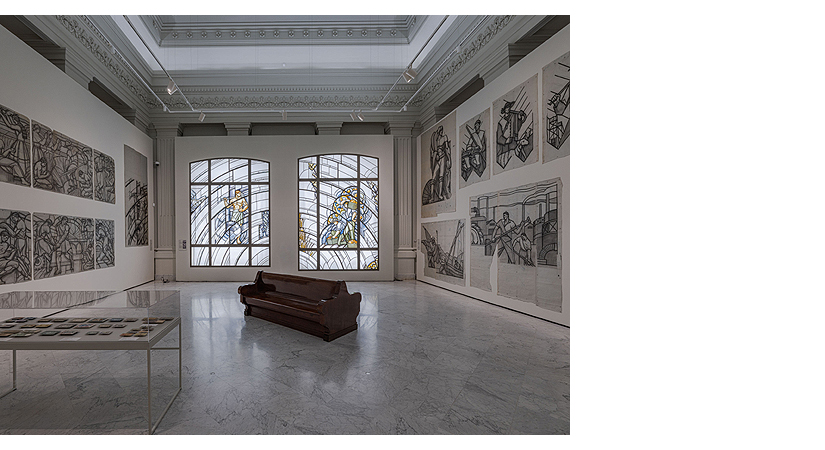 Allegories of What Is to Come. View of the exhibition hall