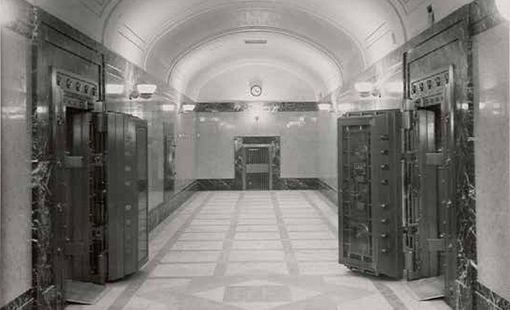
Charged with symbolism and mystery, the gold vault is an embodiment of economic power viewed as a sacred value
Allegories of What Is to Come explores the architecture and decoration of the extension added to the Banco de España's Cibeles building in the 1930s, highlighting its key role on the institution's path towards modernity. In his design for the extension, Navarra-born architect José Yárnoz Larrosa extended and reinterpreted Eduardo de Adaro's original building. The result was the creation of two of the most important architectural features in the complex: the trading floor – home to some of the most outstanding institutional Art Deco décor in Europe – and the iconic gold vault, purpose-built to hold the state's gold and silver reserves and opened just a few months before the outbreak of the Spanish Civil War.
Thanks to the many urban legends surrounding the vault and its place in the successful TV series Money Heist, it holds a special place in the popular imagination. The exhibition currently showing at the Cibeles building (until March 28) includes a special section (Technology and Security) exclusively devoted to this space.
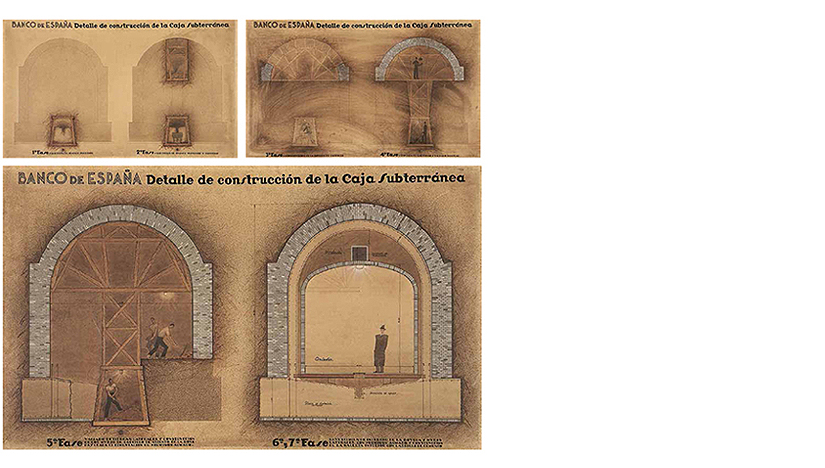 José Yárnoz Larrosa. Construction of the Banco de España Underground Vault (details). Original drawings in Indian ink and watercolour on canvas-mounted paper. 1:20 scale. 510 x 870 cm. Banco de España Collection
The gold vault is situated 35 meters below ground level. As Patricia Alonso del Torno notes in her essay in the Allegories of What is to Come catalogue , construction of the vault posed a 'truly complex' challenge. The most advanced techniques and materials of the time had to be used to avoid seepage from underground water courses in the area. The vault was built during the final phase of the enlargement project between 1934 and 1936, to a design by Yárnoz Larrosa, who supervised all construction work closely.
The vast reinforced fireproof doors, some weighing over fourteen tonnes, show a particularly high standard of technical workmanship and are still all in perfect working order. They were built by York Safe & Lock Co., an American firm that had previously made similar doors for the Federal Reserve in New York, the Bank of Tokyo and the Royal Bank of Canada.
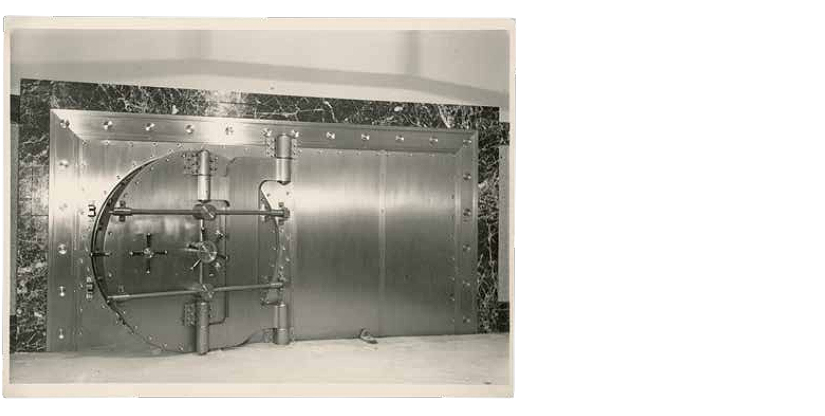 Antonio de Zárraga. Reinforced Circular Door leading to Shaft No. 1 of the Underground Vault, 1936. AGUN. José Yárnoz Larrosa
Made from pieces of high-strength steel and fitted with the innovative crane hinge mechanism, the doors are a paradigmatic example of the twin functional and symbolic dimension of Yárnoz Larrosa's design for the new extension. As Álvaro Perdices – who is co-curating the exhibition with Yolanda Romero – explains: 'This underground enclosure was designed as an element of precision architecture, in which every element – the armour-plated doors, the reinforcement systems, the waterproofing, the metal fittings – were designed in accordance with a logic of absolute protection. More than just a technical structure, the vault is an embodiment of the institutional vision of economic power as a sacred virtue, a space where security is a symbol and safekeeping a ritual'.
Alonso del Torno agrees, noting that the singularity of the space is reminiscent of other constructions — for example the pyramids of Egypt and the inner sanctums in temples of other faiths; in the same way, it takes the form of an 'inaccessible, concealed fortress'. As Perdices points out, the fact that the site was not intended to be visited did not deter the architect from decorating the main areas with decorative features similar to those to be found elsewhere in the building.
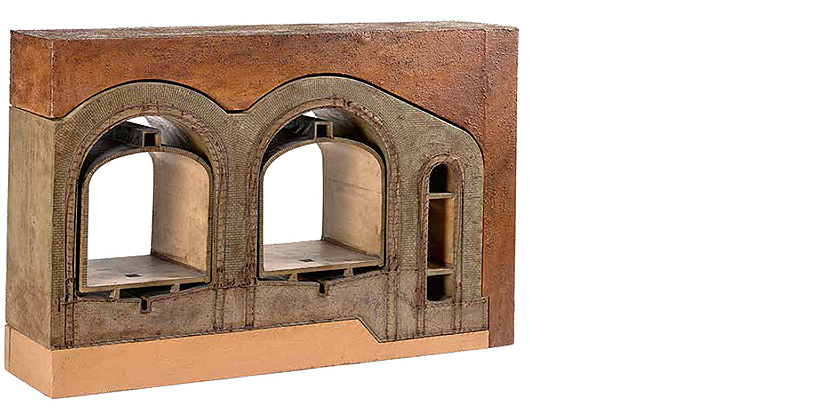 José Yárnoz Larrosa. Architect's model of the underground vault in cross-section, 1932. Wood, plaster, metal and wallpaper. Scale 1:20 53.5 x 83 x 19.5 cm. Banco de España Collection
The bank’s latest exhibition, Allegories of What is to Come, includes a section especially devoted to the gold vault. The display, entitled Technology and Security contains a wide variety of documents and materials – many previously unpublished – exploring the conception, design and construction of the space, which occupies a total floor area of around 1,500 square meters (16,000 sq. ft.).
The items on show include three detailed and precise Indian ink drawings depicting the seven construction phases, a cross-section model of the vault, a drawing of the general layout, some of the original Art Deco lamps and furniture and a set of photographs of the completed work taken by Antonio de Zarraga in 1936. There are also two large-scale technical drawings kindly loaned by the José Yárnoz Larrosa archive, depicting in extraordinary detail the reinforced doors and the hatches of the security systems manufactured by Dutch firm LIPS. They were probably drawn for a provincial branch of the Banco de España and although originally intended as commercial illustrations, the fine draughtsmanship gives them an undeniable artistic quality.
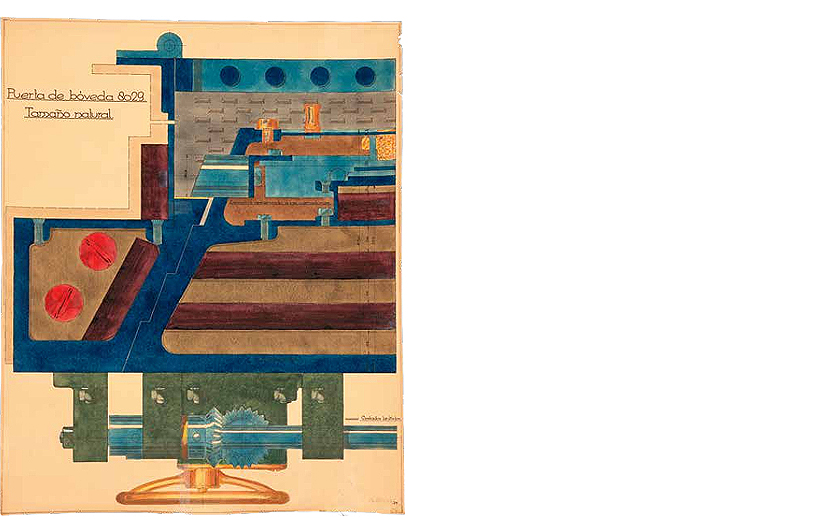 Unknown Author. Vault door 8029 (detail of burnished sides), c. 1930 Watercolour and ink on card 90 x 71.5 cm. AGUN. José Yárnoz Larrosa Collection
Together with these promotional and technical items, the exhibition also includes a large wall panel containing photographs of different moments in the construction process, and in particular, the anonymous workers employed in this immense undertaking, from the Banco de España's Historical Archive. As Álvaro Perdices remarks, these photographs add 'a vision that is not so much allegorical as human'. Here, 'the machinery is not a symbol; it is weight. The architecture is not envisaged; it is suffered. The space is not celestial; it is dark, damp and enclosed'.
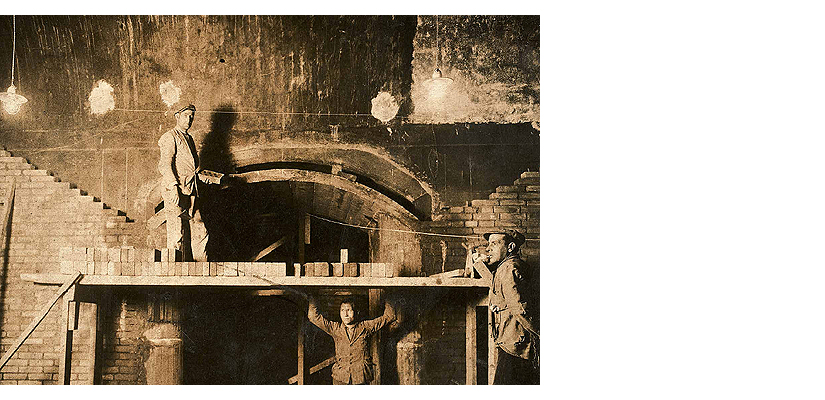 Unknown Author. Photograph of construction of the building's underground vault, ca. 1932. Gelatin silver plate. Banco de España Historical Archive
This contrast, says Perdices, makes the exhibition a 'machine of meaning' providing a 'dialectical interpretation, combining the abstraction of power and the manifestation of effort, the idealized drawing and the reality of its execution'. In contrast to the heroic figures depicted in the stained-glass panels on the trading floor, which turn labour into 'pure form', these images 'return it to its inescapable material and corporeal dimension'. In its approach to the history and background to the construction of the gold vault, the show seeks not so much to dismantle the 'fantasy' forged about this space by the institutional narrative and more recent references from visual culture, but to 'ground it', to remind us that 'behind the symbol lies mud and damp, behind every mechanism lies the hand that assembled it'.
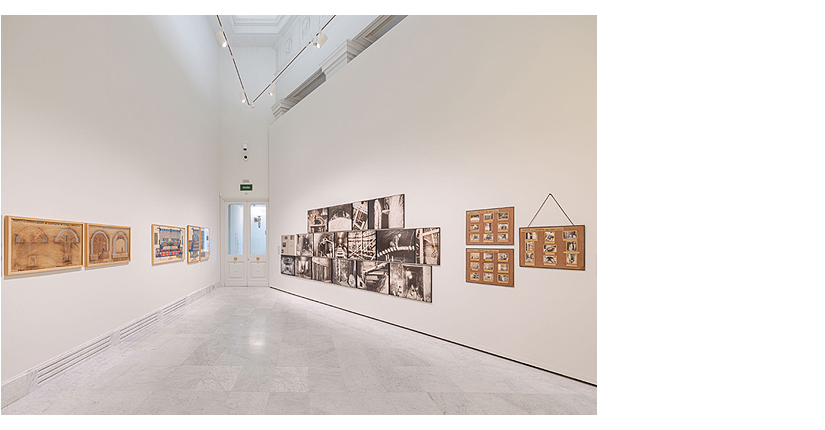 Allegories of What Is to Come. View of the exhibition hall