The Pliable Plane: Textiles at the Juncture between Art, Architecture and Industry in the Banco de España’s new exhibition
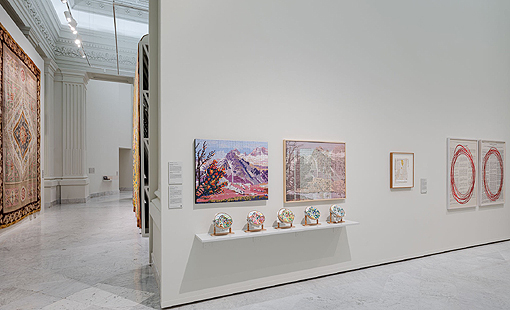
Our latest exhibition, which turns the spotlight on textile art, is scheduled to run until 28 March 2027 in the exhibition hall at the Banco de España’s head offices on Plaza Cibeles (Madrid). Featuring a diverse selection of contemporary and classical pieces, it explores the role of textiles at the juncture between art, architecture and industry. As the exhibition demonstrates, in addition to their decorative function, fabrics have also been used to protect, define and structure the space around us and make it habitable, as well as serving as a means of telling stories, representing institutions and illustrating the relationships between culture and society.
The centrepiece of the exhibition – curated by Yolanda Romero, the Banco de España's conservator – is a selection of tapestries and carpets and rugs from the Banco de España Collection. It takes its title from an essay (The Pliable Plane: Textiles in Architecture) published in 1957 by Anni Albers, a German designer, weaver and researcher who was one of the few women to head up a studio at the Bauhaus School. Albers defined textiles as active, flexible surfaces capable of transforming space, filtering light, absorbing sound and altering our experience of architecture.
The historical tapestries and carpets from the bank's collection illustrate the decorative, functional and narrative dimensions of textile art. Designed to blend into the bank’s architecture, they played a key role in shaping institutional spaces, where they served a variety of practical, representational and hierarchical functions.
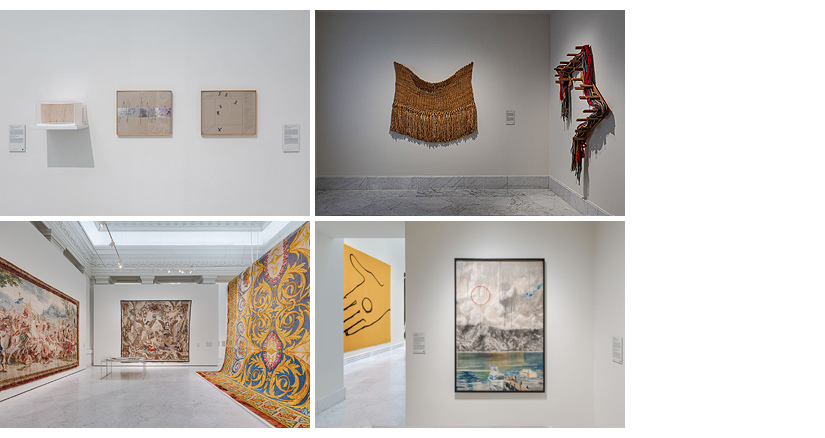
Views of the exhibition hall with The Pliable Plane. The Banco de España's Textile Collection
The exhibition also features a large selection of contemporary works illustrating some of the ways in which the potential of textile art has evolved and expanded in recent decades. Feminist artist and thinkers have played a key role in this process, reclaiming the genre as a tool for cultural, political and gender discourse, with work that subverts traditional hierarchies, challenging and transcending the modernist separation between fine arts and applied arts.
From the seventeenth to the twenty-first centuries, The Pliable Plane uses textile art to explore issues such as labour, memory, value construction and the transmission of knowledge. It suggests that textiles should be viewed not merely as a technique or artistic medium, but as a way of envisioning and weaving together different eras, disciplines and ways of living and relating to the environment. If – to borrow Albers analogy – architecture is our third skin, then fabrics mediate between our body and the world, making it easier to interpret and inhabit.
The exhibition will be open to the public from Tuesday to Saturday, 11 am to 2 pm and 4 pm to 8 pm. It will also open on Sundays throughout December from 11 am to 2 pm and 4 pm to 8 pm. There is a programme of guided tours for adults (Wednesdays and Fridays, at 6 pm; and Saturdays, at 11.15 am and 6 pm) and families (Saturdays, at 12.30 pm). Admission to the exhibition and the guided tours is free of charge. Prior booking is required via this link . A brochure has been published to accompany the exhibition, with comprehensive information on all the works in the exhibition.
Exhibition Sections
The exhibition offers an expanded interpretation of textile as a field of symbolic, material and emotional output. It contains around fifty pieces, including tapestries, carpets, paintings, photographs, videos, documents and coins and is organised into four theme areas: The Needle as a Pencil, Defeated Minorities, Indoor Existences: Adorning Architecture and Times, Narratives and Economies of Value.
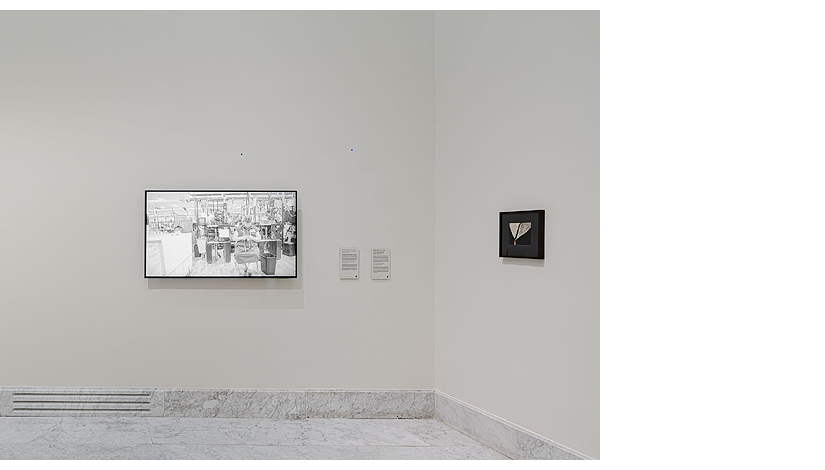
Carole Frances Lung: Frau Fiber vs. the Circular Knitting Machine, 2015. Institute 4 Labor Generosity Workers & Uniforms | Narelle Jubelin: As Yet Untitled (José Guerrero, 1966). From the series Flamenco primitivo [Early Flamenco], 2014. Banco de España Collection
The first of these sections, The Needle as a Pencil, features a series of contemporary works in which the artists use their needles as tools for drawing, writing and constructing spaces, thus transferring techniques traditionally associated with textile work into the realm of visual art. Graphite is replaced by thread, lines by stitches and pen strokes by seams. The very act of sewing becomes a vehicle for artistic reflection and feminist critique, in keeping with the thinking of many artists since the mid-twentieth century who have challenged the traditional view of textiles as a purely domestic and decorative craft.
This section includes a critique of the roles assigned to women in Francoist Spain; a vision of sewing as something that subverts the productivist logic of capitalism, enabling a space to be created in which to explore identity and power relations; a celebration of the legacy of women textile workers and an investigation of the boundaries between body, action and architecture. It features work by Isabel Oliver, Elo Vega, Victoria Gil, Carole Frances Lung, Narelle Jubelin, Esther Ferrer and Elena del Rivero.
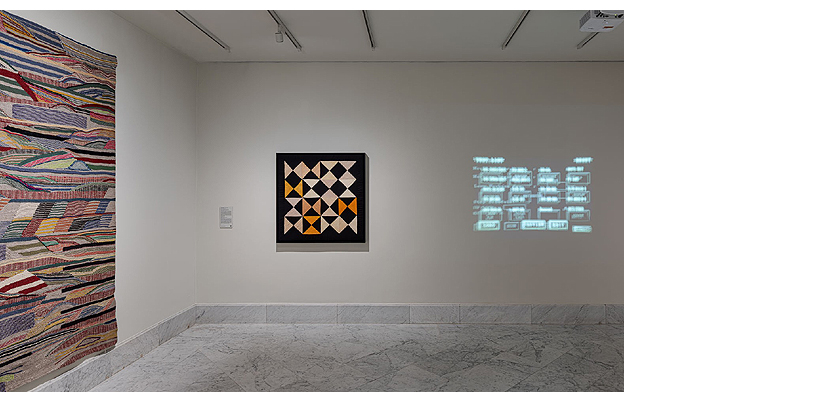
From left to right: Teresa Lanceta: Tejido [Fabric], 1999, 1999. Banco de España Collection | Yto Barrada: Hourglass II, 2023. Banco de España Collection | Yto Barrada: The Power of Two or Three Suns, 2000. Courtesy of Pace Gallery; Sfeir-Semler Gallery and Galería Polaris, Paris
The second section of the exhibition, Defeated Minorities, takes its name from Anni Albers' judgement on the decline of craft work and the subordinate position to which it was relegated in the modern age, despite which ancient textile traditions have continued to evolve and find new channels of transmission. The works featured champion textile art as a place for learning, collective memory and cultural resistance, in stark contrast with the speed and standardisation of industrial production.
Works by Teresa Lanceta, Aurèlia Muñoz, Yto Barrada and the Tz’utujil Maya artist Antonio Pichillá revive techniques linked to folk traditions and weaving communities that have passed their knowledge down from generation to generation, defying the contemporary homogenisation of production rhythms and models. Far from being some nostalgic relic of a bygone world, this revival views manual labour as a living, collective practice – a space of experimentation from which to revisit the central issues of our time.
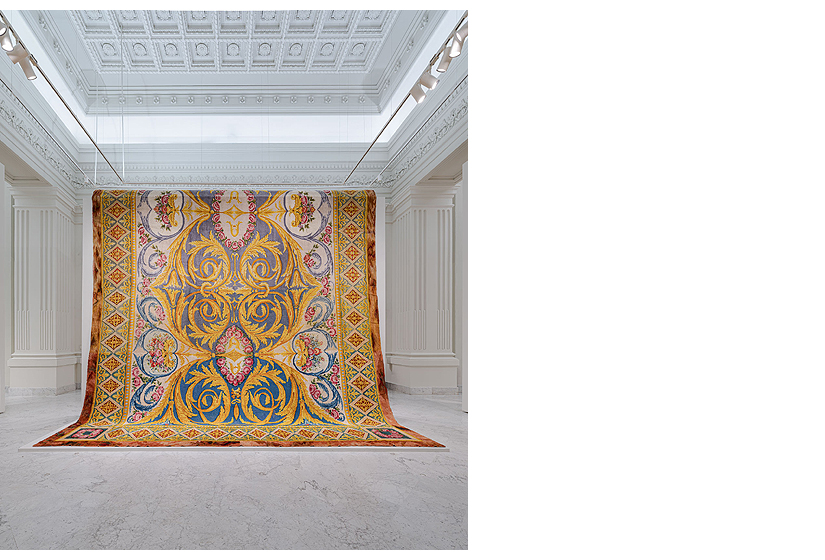
Real Fábrica de Tapices [Royal Tapestry Works]. Carpet, 1861. Fabric with symmetrical or Turkish knots. Banco de España Collection
The third section centres on the decisive role textiles have played in interior design. The title, Indoor Existences: Dressing Architecture, is taken from another phrase by Anni Albers. This section explores ways in which textile art was traditionally regarded as having both a functional and a symbolic function. Rugs and tapestries can protect against the cold, dampen sound and provide comfort, but they have also been used to imbue architecture with meaning, transforming buildings into narrative settings and shaping the sensory experience of anyone who occupies or passes through them.
Since its inception in the late eighteenth century, the Banco de España has provided interesting examples of this close relationship between textiles and architecture and the exhibition includes a number of documents relating to the carpets and tapestries that adorned the first premises on Calle de la Luna. Also on display is a set of six tapestries by Geraert Peemans, depicting the months of the year and the signs of the zodiac, acquired by the bank in 1934 for the newly refurbished Assembly Room in the building on Plaza Cibeles. There are also some of the earliest carpets in the Bank’s collection, commissioned from the Royal Tapestry Works in the latter half of the nineteenth century.
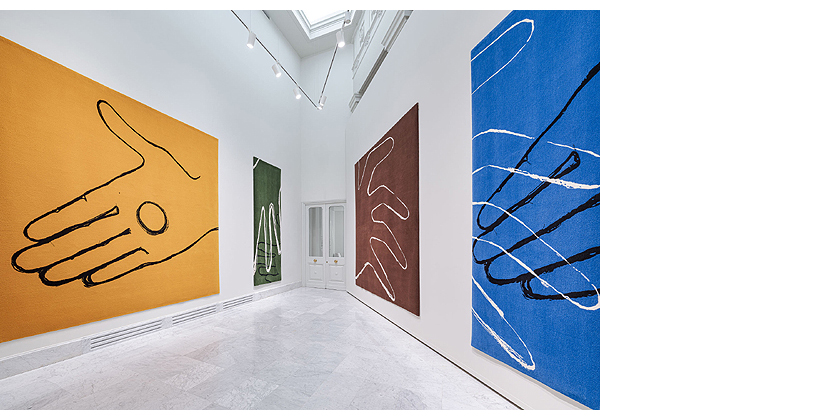
Dora García: Giving Hands, Receiving Hands (six tapestries for the Banco de España's Collection Hall) . 2025. Banco de España Collection
The fourth and final section of the exhibition, Times, Narratives and Economies of Value, explores an issue directly linked to the functions of the Banco de España: the creation of value. The world of textiles – in which each thread is linked to others –offers a particularly fertile metaphor for this idea. Value never arises in isolation, instead, it is tied to complex relational processes, entailing mechanisms of collective trust, shared conventions and narratives that sustain its legitimacy.
The exhibits here use fabric to explore the relationship between economy and culture, underscoring the notion that value is always a social construct. The section opens with a group of tapestries recently commissioned by the bank from Dora García for the Collection Hall at the Cibeles offices. Evoking Adam Smith’s notion of the ‘Invisible Hand’, they consider the socio-cultural, economic and psychoanalytical implications of the act of giving and receiving. This is an interesting example of the multifaceted nature of textile art; as well as improving the acoustics of the location for which it was designed, the tapestry also endows it with a new symbolic dimension.
This section also features work by Andreas Maria Fohr, Mercedes Azpilicueta, Manuel Chavajay and Patricia Esquivias, who use textile art to question how value is produced in modern societies through a deconstruction of the notion of debt, a recovery and re-examination of displaced histories and memories and an exploration of the persistence of temporalities and ways of relating to the land that break with the productivist discourse and the homogenising impulse of Western modernity.