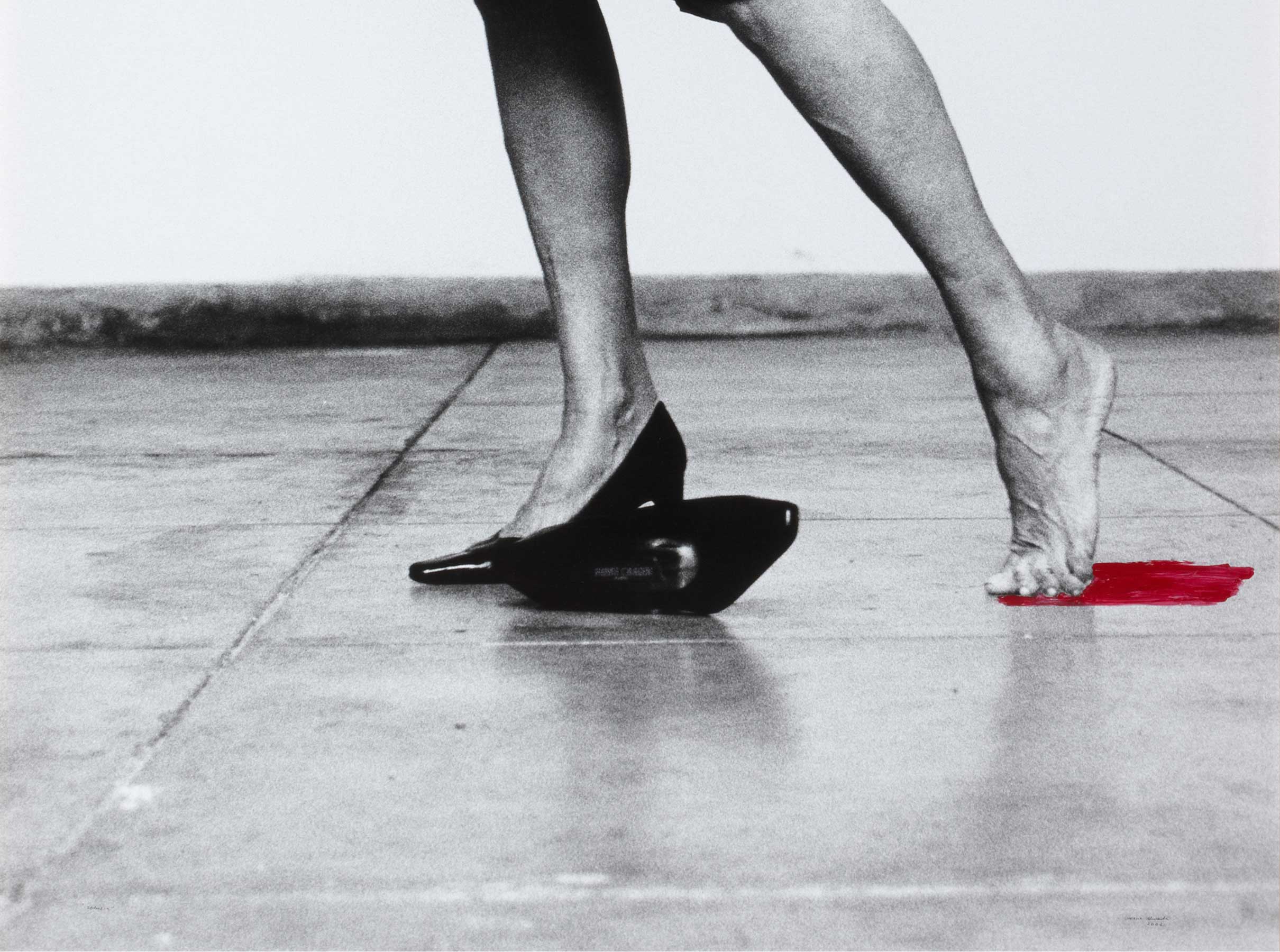
![Manos que dan, manos que reciben (seis tapices para el Salón de Cobradores del Banco de España) [Giving Hands, Receiving Hands (six tapestries for the Banco de España’s Collection Hall)]](/f/webca/OAR/Obras/ficheros-estaticos/T_103_M.JPG)
![Manos que dan, manos que reciben (seis tapices para el Salón de Cobradores del Banco de España) [Giving Hands, Receiving Hands (six tapestries for the Banco de España’s Collection Hall)]](/f/webca/OAR/Obras/ficheros-estaticos/T_103_G.JPG)
![Manos que dan, manos que reciben (seis tapices para el Salón de Cobradores del Banco de España) [Giving Hands, Receiving Hands (six tapestries for the Banco de España’s Collection Hall)]](/f/webca/OAR/Obras/ficheros-estaticos/T_103_P.JPG)
Manos que dan, manos que reciben (seis tapices para el Salón de Cobradores del Banco de España) [Giving Hands, Receiving Hands (six tapestries for the Banco de España’s Collection Hall)]
- 2025
- 100% virgin wool and 100% cotton. Hand Tufting
- 350 x 350 x 1,3 cm
- Cat. T_103
- Comissioned from the artist in 2025
- Observations: The four tapestries were made entirely in Spain by Alfombras y Tapices La Alpujarreña (La Zubia). They are made of 100% virgin wool, spun in Castilla-La Mancha and sourced in Spain, the UK, New Zealand and South America. It was dyed on the skein in the Community of Valencia.
The Banco de España is currently repurposing the former collection hall at its head offices, which will now be used a meeting and conference hall. The intention is to install six handmade tapestries in virgin wool in order to improve the acoustics and damp any echo or reverberation caused by reflected noise. The hand tufting and natural fibres are particularly suitable for this task. Due to its dense fibrous structure, virgin wool is excellent at absorbing noise; it traps and dissipates the sound waves, reducing reverberation, impact noise and airborne noise. It is also naturally flame-retardant and meets all safety requirements for public and semi-public spaces.
The images in the tapestries reference the act of giving and receiving, the interactions between the hand and an object or the absence of that object, and the ‘invisible hand’ – a metaphor coined by philosopher and economist Adam Smith to explain the incentives that the free market provides for self-interested people to unintentionally act in the public interest.
For example, in The Theory of Moral Sentiments (1759), Smith discusses a hypothetical example of all wealth being concentrated in the hands of a single person, who squanders it (through ‘a hole in his hand’) thereby, despite himself, redistributing it and giving employment to others. Even better known is Smith’s use of the concept in The Wealth of Nations (1776), where he writes that each individual, in pursuing his own self-interest, is guided by an invisible hand (N.B. never the invisible hand), which causes that self-interest to contribute to the greater good and economic efficiency. This notion can also be inverted: Bishop Joseph Butler, for example, believed that the pursuit of the common good was the best way to achieve one's own benefit.
Other commentators on Smith, such as Noam Chomsky and John D. Bishop, point to the contradiction in his thinking, noting that the interests of those who accumulate wealth will always be different – and often irreconcilable – to those of wider society; an unregulated market is detrimental to the common good and – by extension – to wealth accumulators too.
Be that as it may, the image of the hand is often associated with capital and the movement of money. A hand that gives and a hand that receives, a transaction, securities changing hands, value being distributed, the object of desire (the coin) being held out, the hand reaching out towards something that is desired and given.
But is it really possible to give? Can we actually give anything away without in the same instant entering into a circle of exchange that turns the gift into a debt to be repaid? It was this question that led Jacques Derrida to posit an irresolvable paradox regarding the fundamental nature of a gift: for a gift to be received as a gift, it must not be seen as a gift, since its mere appearance as a gift places it in the cycle of repayment and debt.
Derrida's analysis was guided by a short story by Charles Baudelaire, called Counterfeit Money (1869). In the tale, a friend of the poet gives a beggar a counterfeit coin, thus earning his gratitude. This pleases the friend, even though he is well aware that the gesture may land the beggar in jail. The poet is indignant with his friend, who appears to believe that one can do a good deed and at the same time make a good deal. The detachment involved in the act of giving must involve a loss in order for someone else to gain. Giving counterfeit money does not involve a loss.
But is all money not counterfeit? Money is not a thing, but the marker of a social relationship of credit and debt between two parties. Money is not value in itself; no form of money (as money) ever possesses an intrinsic positive value. Value is only created in the act of giving and receiving, of asking and giving.
Hence the forms depicted in the designs for these tapestries – freehand lines on monochrome surfaces, based on colours deduced from the original tiles in the Collection Hall. They are hands that give and receive, that request and grant, that show and try to reach that which is shown.
Other works by Dora García