Manifesti I
- 2023
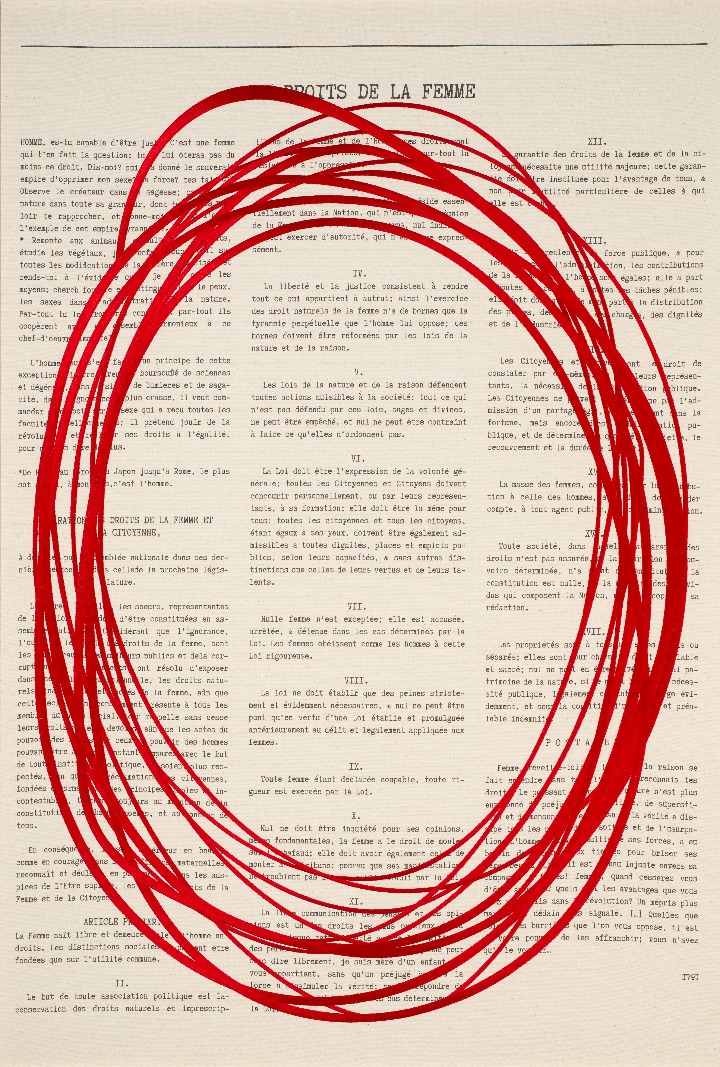
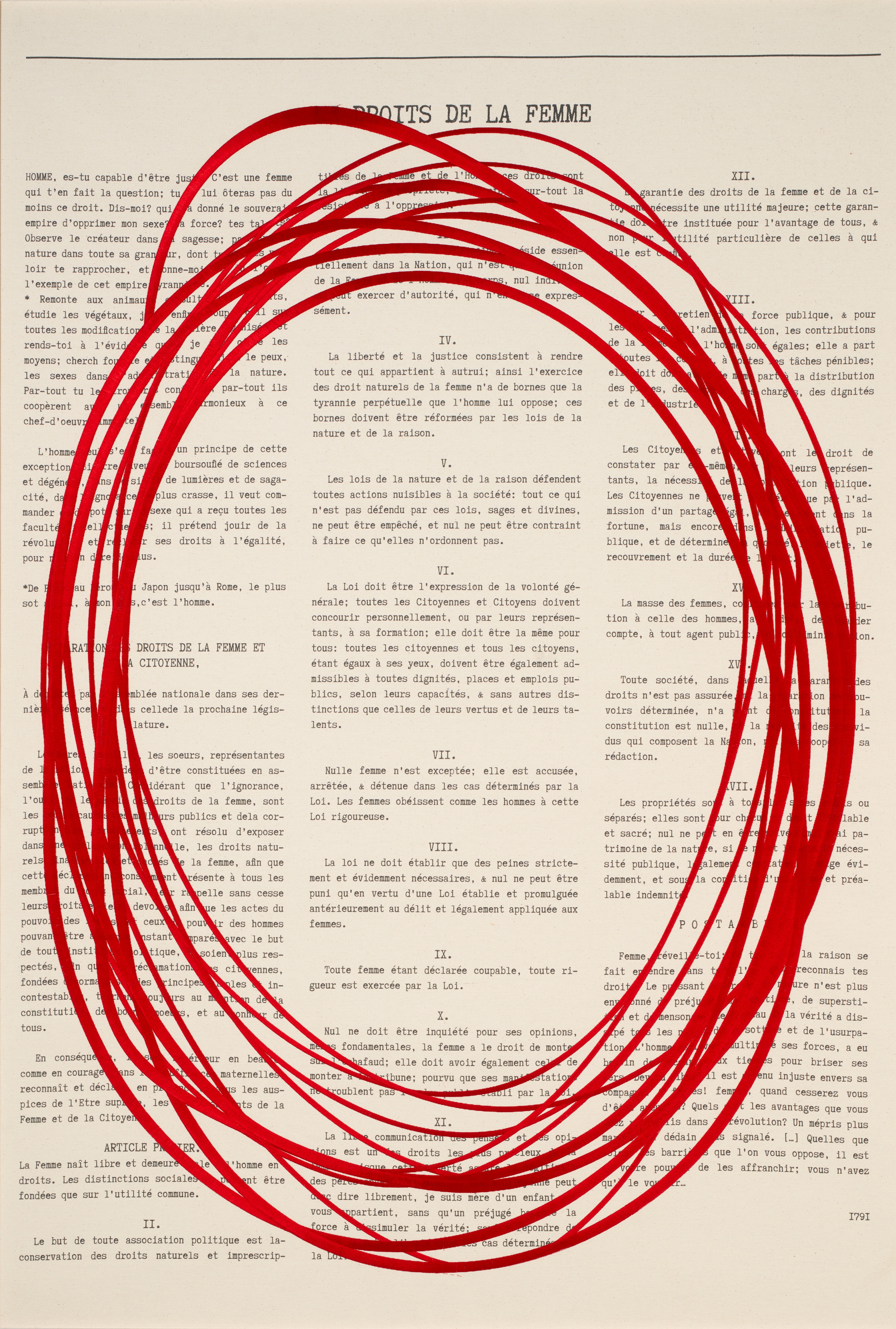
- Text printed on linen with embroidery in red thread
- 130 x 90 cm
- Cat. T_31
- Acquired in 2023
- Observations: Text in French: ‘Les Droites de les Femmes (1971)’, by Olympe de Gouges
On 14 September 1791, writer and activist Olympe de Gouges published her Declaration of the Rights of Women and Female Citizens in answer to the Declaration of the Rights of Man and of the Citizen of 1789, from what might today be described as a gender perspective. In it, she made a radical call for equal political, legal and social rights for women. De Gouges, who was also a pioneer in the campaign to abolish slavery in the French colonies, was guillotined scarcely two years later during the Reign of Terror, on charges of promoting counter-revolutionary causes. She was indicted of abandoning the virtues expected of her sex, thereby defying the gender order of the French Revolution.
Almost sixty years later, in 1848, Elizabeth Cady Stanton and Lucretia Mott organised the famous Seneca Falls Convention in New York State, at which a group of women once again demanded, inter alia, the right to the vote for women. In 2023, artist Elo Vega brought new visibility to the two declarations in her two works, Manifesti #1 and Manifesti #2, which show that the struggle for equality is an arduous journey that remains unfinished, almost 250 years on.
Here, Vega, who frequently makes use of wordplay in her works, explores the dual meaning of the word ‘manifesto’; on the one hand it refers to what is obvious, clear or evident (manifest), and, on the other, to a written document whereby an individual or group publicly declares their ideas or intentions. In these as in other pieces, she also engages in an exercise in historical memory, bringing texts, images or characters from the past into the present, onto which she superimposes a range of visual elements – in this case, in textile – which transform or add new meanings to the altered images.
In Manifesti #1 and Manifesti #2, Vega reproduces these two pioneering feminist texts, which continue to challenge us today, in block letters, as if they were revolutionary leaflets, and presents them with a textile overlay that imbues them with new meanings. The meaning of this violent, circular gesture is elusive: it could be intended either to underline or to strike out. It is mechanically embroidered in red thread onto the fabric, drawing the viewer’s attention to the text. The circularity suggests the idea of going round in circles, of an act that is repeated, preventing progress.
And as the artist herself has noted, the technique of embroidery also evokes the tradition of needlework performed by women throughout history. In particular, in relation to the notion of repetition, it references the myth of Penelope, endlessly weaving and unravelling the shroud in a task that never ends. Alongside this interpretation, Elo Vega appears to advocate a ‘different’ kind of rationality – an alternative to the linearity characteristic of patriarchal culture – and the need not to treat certain feminist issues as concluded when they have not actually been resolved and which require greater insistence.
Other works by Elo Vega