The Banco de España Collection's Latest Commissions and Acquisitions: Focus on Textile Art
As part of its commitment to disseminate and showcase the work of female artists (still underrepresented in our collection) the Banco de España has recently commissioned and acquired works by four contemporary Spanish female artists of different generations: Aurelia Muñoz (b. Barcelona, 1926 – d. Barcelona, 2011), Elena del Rivero (b. Valencia, 1949), Dora García (b. Valladolid, 1965) and Laura Fluxà (b. Palma de Mallorca, 1985). Several of the pieces are related to textile art, a discipline which has often traditionally been viewed as a secondary artform, largely because of its link to domestic work and the female sphere. In addition, the bank recently acquired two gouaches by Valencian painter Joaquín Sorolla and Bastida, including a sketch for his magnificent ceiling painting, Voltaire Telling a Story (1905), now held in the collection and which was restored last year.
Aurelia Muñoz was a key figure in the 1960s reappraisal of textile art and one of the only female Spanish artists to be exhibited in the permanent collection of the MoMA (New York). She studied at the Escola Massana in Barcelona and was closely associated with movements such as the Nouvelle Tapisserie. Throughout her career, she always focused particularly on research and theory, and consistently argued that her work should be classed as contemporary rather than decorative art, a category into which she was often pigeonholed.
According to Isabel Tejeda, Cloak (1973), the piece that has now been acquired by the bank, is part of a 'moment of transition' in her career, constituting 'something of a fulcrum between Muñoz's early career with her studies of embroidery and her first pieces (including some sculptures) in macramé'. Made in the early 1970s, when Muñoz had achieved major international fame, participating in the Lausanne and São Paulo biennials, this piece escapes from the two-dimensionality of tapestry, taking on a certain sculptural quality. In later works, she was to take this exploration even further, giving an increasingly central position to three-dimensionality and the relationship with the surrounding space. Cloak, says Tejeda, is an interesting example of the 'move towards greater abstraction' begun by the artist during that period, with pieces which 'preserved echoes of recognisable objects but did not represent them directly'.
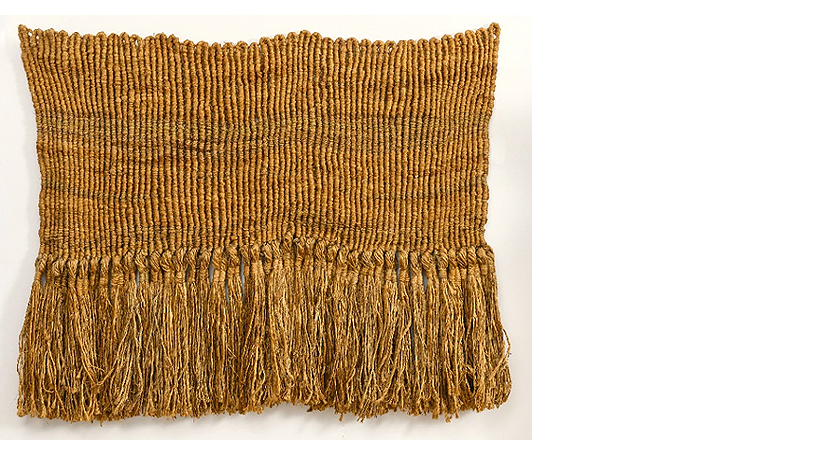 Aurelia Muñoz: Cloak (1973)
This confluence between sculpture and textile is also a strong feature of the work of Elena del Rivero, a Valencian artist who – writes Clara Derrac – views her projects as 'processes in which stitching, repair and mending acquire a political meaning, as she champions reproductive work and feminist knowledge'. Del Rivero has worked on the New York scene since the early 1990s and uses her personal experience as a starting point from which to address universal issues such as memory, motherhood and grief. She goes beyond the logic of the monument, placing herself at the intersection between the domestic and the public, between the intimate and the collective, often using modest materials such as fabrics, dishtowels and paper. One example is #9 Safety Pins Wound (2014), a small piece of pictorial reminiscences combining different materials, such as ink, gold leaf, primed cotton, staples, safety pins and miscellaneous handmade paper.
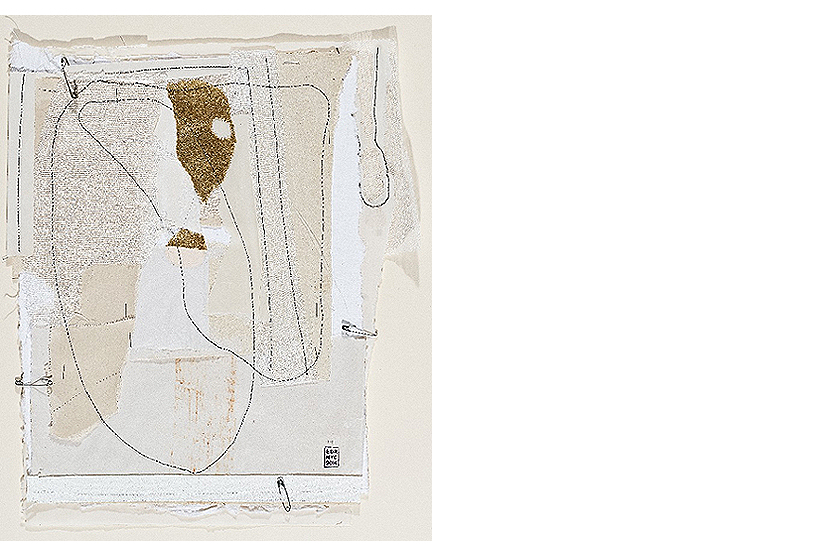 Elena de Rivero: #9 Safety Pins Wound (2014)
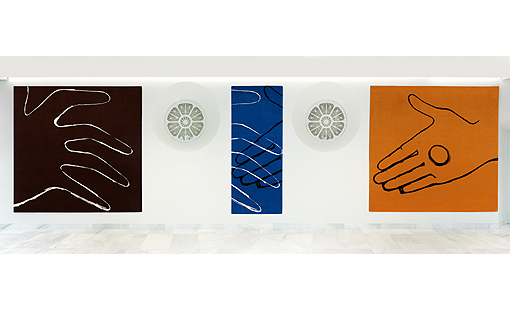
The Collection has recently acquired two pieces by Dora García, an artist who uses very diverse media to establish a direct, open dialogue with the public. The new pieces are Dismembered (Hand with Coin), 2021 and Giving Hands, Receiving Hands (six tapestries for the Collection Hall at the Banco de España), 2025 - in which she reflects on the ontological nature and ethical, psychoanalytical and socioeconomic implications of the act of giving and receiving. The first of these two pieces is a notebook with a drawing of an outstretched hand, onto which she has placed a sterling silver coin plated in 18K gold. The second, commissioned by the Bank itself, is a set of six tapestries depicting hands on monochrome surfaces, some of which also appear to be holding coins. 'They are hands that give and receive, that request and grant, that show and try to reach that which is shown', says that artist.
Made from 100% virgin wool, the tapestries have been specifically designed for the Collection Hall at the Banco de España's Cibeles offices. They serve a practical purpose, improving the acoustics of the space by helping to reduce reverberation, impact noise and airborne noise. In terms of the imagery used in the tapestries, García explains in a text written especially for our website that they refer to 'the act of giving and receiving', playing with the metaphor of the 'invisible hand' of the Scottish philosopher and economist Adam Smith. 'Can we actually give anything away without in the same instant entering into a circle of exchange that turns the gift into a debt to be repaid?', muses the artist. It is a dilemma which was addressed by French-Algerian thinker Jacques Derrida in his 'irresolvable paradox of the meaning of the gift': for a gift to be received as a gift, it must not be seen as a gift, since that would mean inserting it into the cycle of repayment and debt.
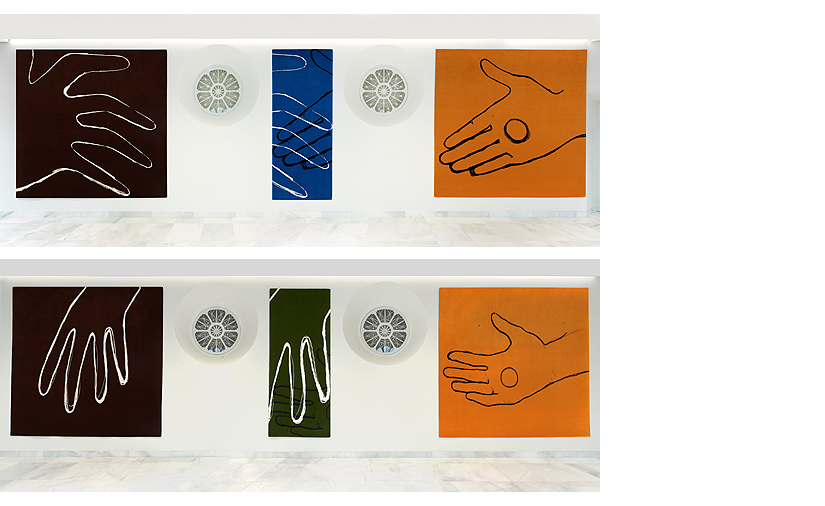 Dora García: Giving Hands, Receiving Hands (six tapestries for the Banco de España's Collection Hall) (2025)
Laura Fluxà is the youngest artist with work included in our latest series of acquisitions. Since the early 2010s, her work has centred on environmental issues, science and eco-feminism, with a particular emphasis on the notion of care, viewed in a material, ethical and political sense. Using materials such as water, air, glass and a range of industrial fluids, she creates hybrid works, halfway between sculpture and installation, in which, according to Clara Derrac, she makes 'critical use of fragility to challenge the ways in which we relate to our surroundings', highlighting the effects of the extractivism of modern capitalism.
Her sculpture Jol (2025) forms part of the Firefly project, a series of works in which Fluxà takes visual and symbolic references from power production and distribution infrastructures. Made of iron and glass, it is suspended a few centimetres above the ground and could just as soon be an industrial object or some strange biomorphic entity. 'This ambiguity is no accident', writes Derrac; 'it lies at the political and conceptual heart of much of Fluxà's work (...) It is neither an organic figure nor a functional machine; it is an assemblage that appears to have developed survival strategies in a hostile environment'.
Derrac finds a link between Fluxà's sculpture and American philosopher Donna Haraway's theories on the cyborg, which she saw 'not as an emblem of the technological future', but as 'a conceptual tool for considering the interdependencies and responsibilities that emerge in damaged worlds'. Jol, writes Derrac, 'can be viewed in those terms', acting as 'an entity that does not fully belong to any stable ontological regime and which – precisely for that reason – challenges the narratives of progress associated with energy-related development'.
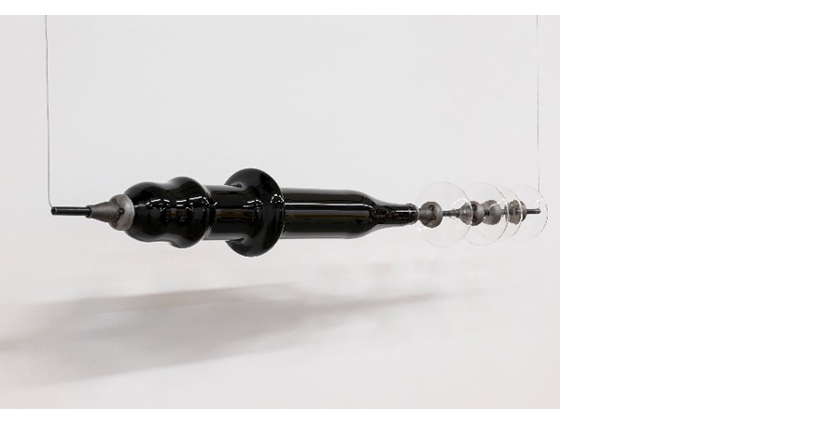 Laura Fluxà: Jol (2025)
As well as the new pieces by Aurelia Muñoz, Elena del Rivero, Dora García and Laura Fluxà, the Banco de España Collection has also acquired two gouaches painted by Joaquín Sorolla in 1905: Study of Basque Characters Dancing, a pictorial piece with free, abstract brushstrokes that reflects the Valencian artist's lifelong interest in painting folk figures; and a preparatory cartoon for Voltaire Telling One of his Stories, the central piece in Sorolla's decoration for the ceiling of the house of civil engineer Calixto Sánchez, which has formed part of the Bank's collection since 1970. The finished painting is in what is known as the 'casacón' (or dress-coat) style', much favoured by the nineteenth-century upper classes and has recently been restored. The sketch offers a firsthand view of the artist's approach to the complicated low-angle perspective, skilfully recreated using architectural features.
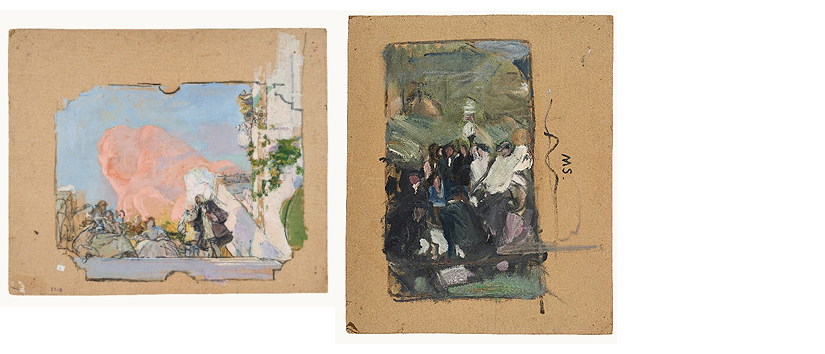 Joaquín Sorolla y Bastida: Sketch for his ceiling painting 'Voltaire Telling a Story' and Study of Basque Characters Dancing (1905)