The latest in our ‘Itineraries’ section explores the origins, references and connections in Dora García’s work ‘Giving Hands, Receiving Hands’
In 2025, the Itinerarios section of our website took a new direction with Sheep, Systems, Chocolates and Plants: Another History of Money, a podcast-cum-itinerary by curator, writer and researcher Sonia Fernández Pan. On that occasion, she talked to Patricia Esquivias, Francesc Ruiz, Rubén Grilo and Fritzia Irízar about their work in the collection and other issues related to their art and investigations.
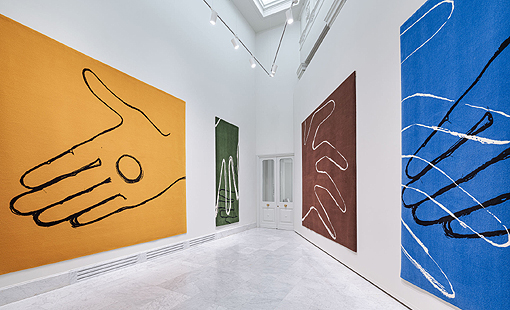
We are now releasing the first episode in the second of these audio tours, entitled ‘From Hand to Hand, the Other Side of the Coin’. This time, Fernández Pan talks to Valladolid-based artist Dora García, winner of the 2021 National Visual Arts Award, about her work Giving Hands, Receiving Hands (Six Tapestries for the Collection Hall at the Banco de España), exploring her many and varied references, and the links to be seen between this project and her previous work.
The tapestries were especially commissioned for the Collection Hall in the bank’s original head offices on Plaza Cibeles, a room with a Neo-Mudejar air, whose design was inspired by the Alhambra palace in Granada. Four of the pieces in the set are currently on show in The Pliable Plane. The exhibition combines some of the bank’s most iconic historical tapestries and carpets with contemporary artworks and illustrates how the potential of textile art has evolved and expanded over recent decades.
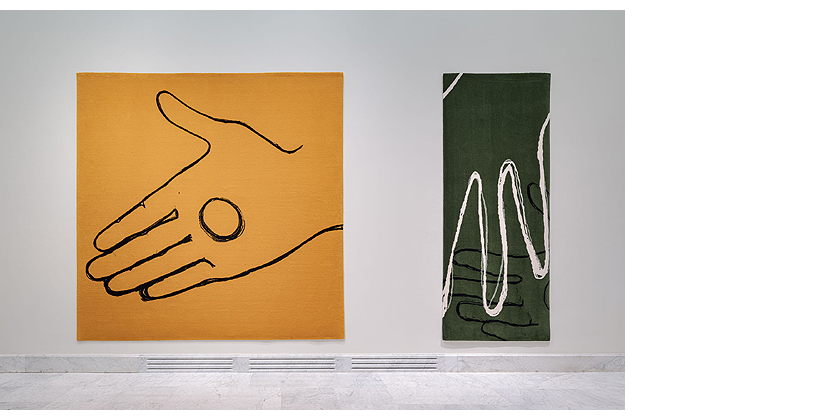 Two of Dora García’s set of tapestries, Giving Hands, Receiving Hands at The Pliable Plane. The Banco de España’s Textile Collection.
The six tapestries in ’Giving Hands, Receiving Hands’ are made from 100 per cent virgin wool. As the artist explains in a text she wrote for the Collection’s website, they also serve a practical purpose, improving the acoustics of the Collection Hall, which, following recent refurbishment, has been repurposed as a meeting room and lecture hall. García says that the imagery of the pieces alludes to ‘the act of giving and receiving, and the interactions between the hand and an object… or the absence of that object’. The piece also references the ‘invisible hand’, a term coined by Scottish philosopher and economist Adam Smith to explain the intrinsic benefits of a free market. According to Smith, the pursuit of self-interest ultimately benefits society as a whole. García, however, argues that the principle does not hold up in practice. As Walter Benjamin noted, capitalism was not only created under the influence of religion, but operates as a religion in its own right.
The podcast begins with Dora García recalling the first time she visited the room, before the refurbishment work had begun. The conversation – in Fernández Pan’s words – ‘then wound its way through a series of situations before arriving at the murky relationship between money and artwork’. García points out, for example, that the imagery used in the tapestries – depicting hands on monochrome backgrounds, some apparently holding coins – can already be seen in some of her earlier works, such as Klau Mich, a project associated with book-stealing that she made for Documenta 13 in Kassel. It is also visible in Dismembered (Hand with Coin) (2021), the other work by García in the Banco de España collection, which is also on show in The Pliable Plane.
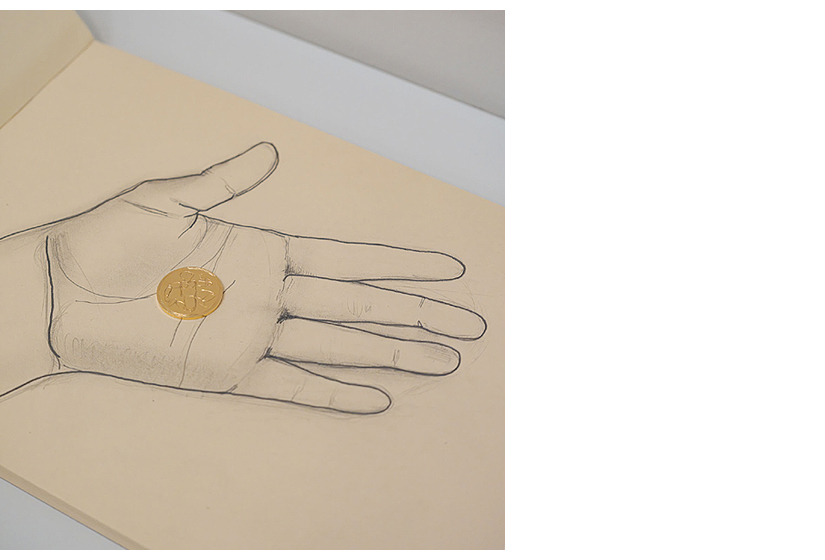
Dismembered (Hand with Coin) (2021), by Dora García, on show in The Pliable Plane. The Banco de España’s Textile Collection.
During the conversation, García also discusses her relationship with textile art. In Klau Mich, for example, as in ’Giving Hands, Receiving Hands’, she worked with a Granada-based carpetmaking firm, Alfombras Artesanales La Alpujarra (alp_). She also explains why, at a time when digital currency is all the rage, she chose to use the motif of outlined coins; the decision, she says, was driven by both aesthetic and metaphorical considerations. In the introductory text to the podcast, Fernández Pan notes that coins have a quality other forms of currency lack: ‘they allow the act of giving and receiving to merge in a single gesture’. And it is precisely that ‘ambiguity’, that polysemy, that interests Dora García. ‘Because exchange, even when it is intended to be altruistic’, argues Fernández Pan, ‘can easily lead to a sense of obligation, especially if no money is involved or if there are unspoken agreements at play’. Debt, she adds, ‘drives capital, but it also shapes human relationships’.
Another of the issues García addresses in Giving Hands, Receiving Hands is the danger – or rather the fallacy – of altruism. Money, she says, originally arose because it was a highly effective system for regulating processes of exchange. Precisely for that reason, however, it is shown to be a fiction; it has no intrinsic positive value. To put it another way, all money is counterfeit. Charity, too, is always false – or fictitious. To elucidate this idea, she talks of Baudelaire’s short story Counterfeit Money (1869) in which a friend of the poet gives a beggar a counterfeit coin. The tale illustrates how behind the satisfaction of giving there is always some selfish gesture. Thus, charity is counterproductive, she argues; ‘there should be no charity, only justice’. In any case, one might well ask whether true altruism, based on pure empathy, can ever really exist. Perhaps the nearest thing we have to genuine altruism, she thinks, is the myth of Cimon and Pero (or Roman Charity), a popular theme among artists of the seventeenth and eighteenth centuries. It tells the story of a new mother whose own mother (or father) has been condemned to death by starvation. The woman uses her milk to feed her parent.
As already discussed, Giving Hands, Receiving Hands was originally commissioned by the Banco de España to help improve the acoustics of the repurposed Collection Hall. The technique (hand tufting) and materials used (natural fibres, virgin wool) helps damp excessive noise by reducing reverberation, impact and airborne noise. In her conclusion to the introductory text, Sonia Fernández Pan notes that, in a way, this conversation with Dora García might be said to have the opposite effect, amplifying ‘the less visible echoes and functions of money’.
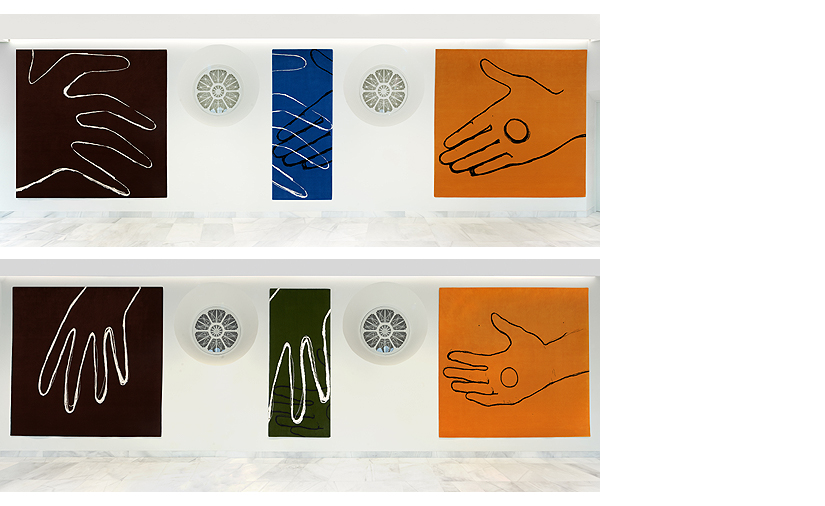
Dora García: Giving Hands, Receiving Hands (six tapestries for the Banco de España’s Collection Hall) (2025). The Banco de España Collection Hall.