'Allegories of What is to Come' finally closes, after a resoundingly successful run
Through an extensive variety of art works, documents and other materials (including sketches, furniture, blueprints, banknotes, archive photographs, etc.), Allegories of What is to Come told the story of one of the most significant episodes in the bank’s history: the enlargement to its offices on Plaza Cibeles, designed by Navarrese architect José Yárnoz Larrosa in the 1930s.
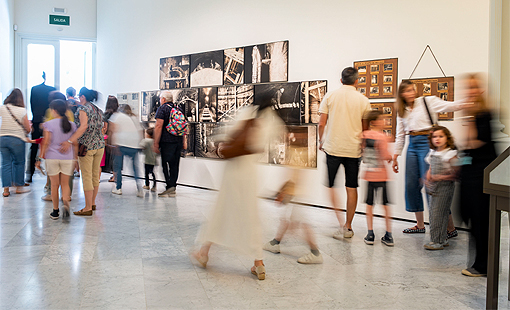
The exhibition ran from 25 November 2025 to 30 May 2026 and attracted over 41,000 visitors. More than 2,200 people also joined the guided tours and special workshops organised around the event and over five hundred people signed up for the special educational activities offering families with children aged 6 to 12 an informative but user-friendly introduction to the exhibition.
In light of the exhibition’s success, it was extended for a further two months beyond its initial closing date of 28 March to accommodate the high demand for tickets. Nearly nine thousand extra visitors showed up in April and May, giving a similar daily average as in the previous four months.
Curated by Yolanda Romero, the Banco de España's conservator, and artist, curator and researcher Álvaro Perdices, Allegories of What is to Come sought to show that Yárnoz Larrosa's design for the extension not only created two of the most singular of the architectural spaces in the Cibeles building – the Trading Hall and the Gold Vault – but also marked an essential milestone in the bank's transition to modernity.
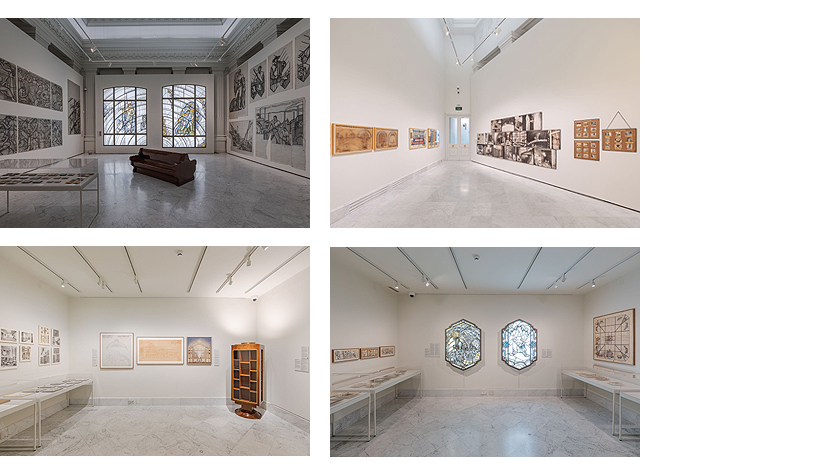 Allegories of What is to Come: view of the exhibition hall
The architectural project combined engineering, design and decorative arts with a strong institutional message, as the bank sought to project an image of modernity, progress and stability in a context of major social and political tension. In conveying these values, the decision to use the language of Art Deco – an international aesthetic, inspired by the early avant-garde, which was currently transforming the image of the great metropolises of Europe and the Americas – was decisive.
One of the focal points of the exhibition was the set of stained-glass panels designed by Maumejean Hermanos for the ceiling of the great hall of the Trading Floor and other areas. The panels are perhaps the most iconic example of the bank's desire to project the values of modernity, key to any understanding of the ambitious architecture and décor conceived by Yárnoz Larrosa's for the new building. The original sketches (cartoons) for the panels were traced to the Maumejean Archive at the Real Sitio de La Granja, restored and displayed to the public for the first time at this exhibition.
In its multifaceted approach to this major episode in the Banco de España's history, the exhibition also opened up one of the most iconic and least visible sections of the building: the Gold Vault. Located thirty-five metres beneath the ground, the room is designed to hold Spain’s gold and silver reserves. The design epitomises the institutional view of economic power as a sacred value, with the vault functioning as a space where security became a symbol and safekeeping a ritual.
The exhibition also paid particular attention to some material and functional aspects of Yárnoz Larrosa's design, in which each element forms part of a comprehensive concept of the building as a symbol of modernity, efficiency and authority. Likewise, it explored the historical context of the time, with a selection of artworks and other items which, in conjunction with the figures in the stained-glass panels by Maumejean Hermanos, looked at the relationship between art, labour and nation-building. It also sought to cast light on the darker side of the narratives of 'allegories of the future', and some of the contradictions and tensions of an era in which modernity became both the promised land and a disputed territory.
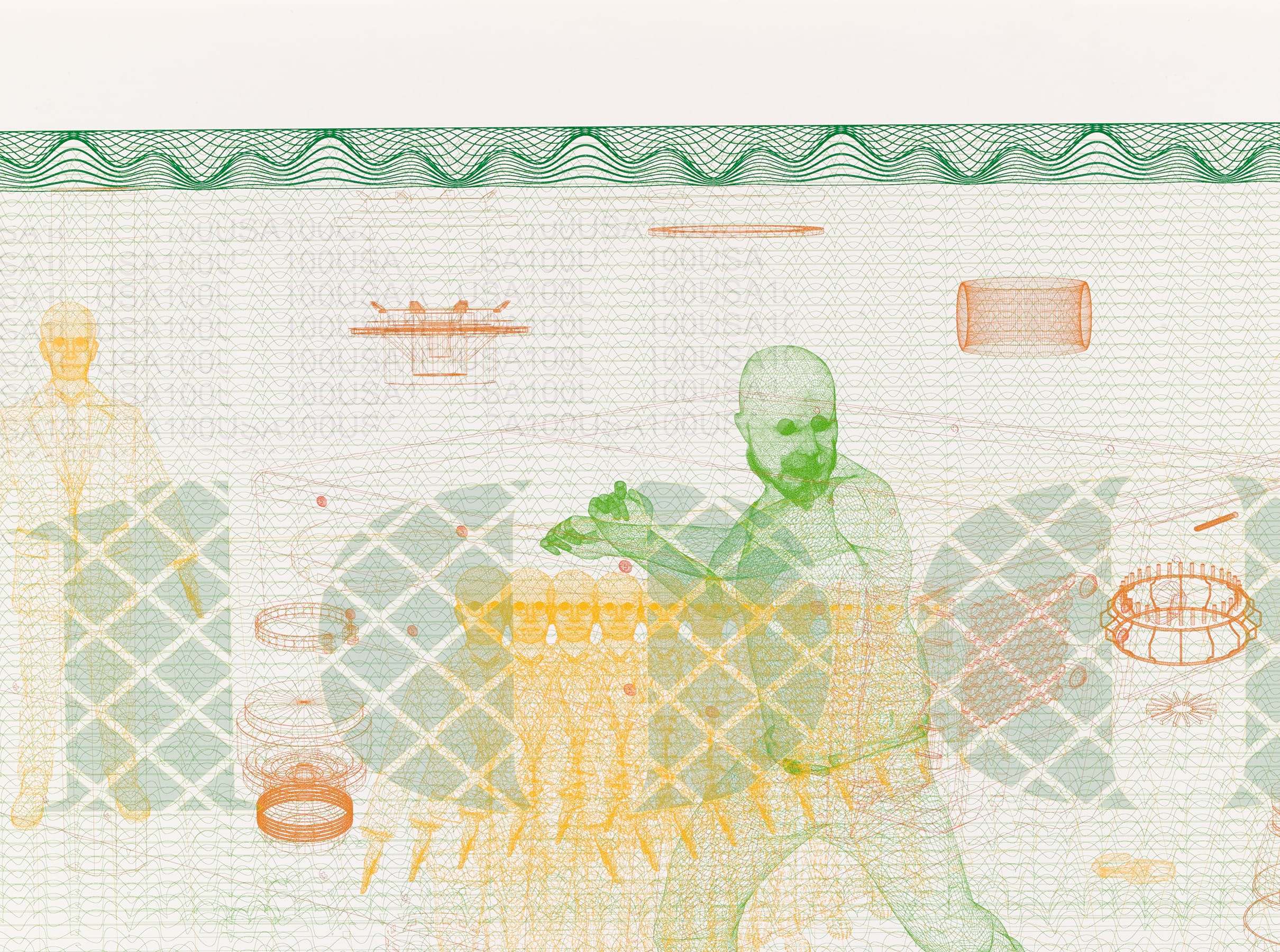
 Cover of the exhibition catalogue of Allegories of What is to Come
A 368-page exhibition catalogue has been published. As well as providing detailed information on the exhibits, works and documents on display, it also contains a selection of essays exploring in greater depth some of the issues addressed. A pdf version can be downloaded free of charge from the 'Publications' section of our website.