Isabel Oliver. The Paintbrush as a Needle
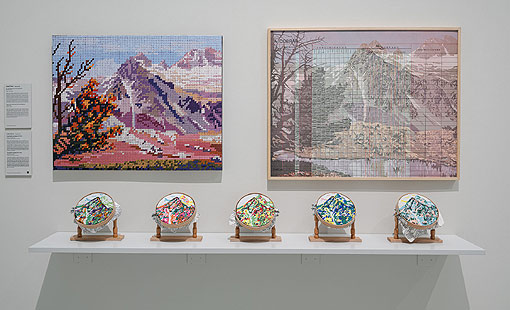
Born in Valencia in 1946, Isabel Oliver began her artistic career in the early 1970s. She went on to become one of the pioneers of feminist art in Spain. From her earliest work, produced at the studio of the Equipo Crónica collective – with whom Oliver worked as an assistant – she saw political painting as a ‘niche’ through which to denounce (in the words of Isabel Tejada) ‘the Spanish state's legislative marginalization and control of women and their bodies'. The two pieces by the artist in The Pliable Plane are a good example. Both are painted on canvas and needlework hoops, imitating cross-stitch embroidery and both condemn the impositions, restrictions and constraints women endured during the Franco regime.
No. 34 (1975), forms part of the Banco de España Collection; it is one of three pieces in Oliver’s series The Commodification of Art (La mercantilización del arte), an attack on art speculation and the precarious conditions under which artists worked – particularly female artists, who at the time she made the series had almost no access to the market and thus no way to make a living from their work. The other piece in the exhibition is on loan from the Museo Nacional Centro de Arte Reina Sofía and comes from her series Occupation: Housewife (De profesión: sus labores) (1972–1974), an installation in which she repeats a single landscape (made to resemble needlework) across multiple frames.
In our interview with Isabel Oliver we discussed these two pieces, the connection between them and her other work, her relationship with textile art, and her impressions of the exhibition, amongst other topics. This is the first in a series of interviews which will be released over the coming weeks with some of the artists featured in the exhibition. The show itself runs until 28 March 2027 at the exhibition hall at the Banco de España’s headquarters on Plaza Cibeles.
The two pieces of yours on show in The Pliable Plane imitate cross-stitch and are painted on embroidery hoops. As Isabel Tejeda notes, this is not an arbitrary choice; it is intrinsic to the very meaning of the two pieces. So, the first thing I'd like to ask about is your relationship with textile art – in your art and in your personal life.
The pieces on display are not embroideries. They are not textile pieces in the strict sense, but paintings that depict embroidery. Because of my background, I’ve had a fairly stormy relationship with textile art. Women of my generation in Spain were made to do needlework every afternoon. I rebelled against that from a very early age, because I felt that they were depriving us of a chance to learn about things that really mattered.
At the Bauhaus School – which was a paradigm of modernity – they ran fabric workshops. However, that didn't mean they saw textiles as anything more than craftwork. All the leading lights of the Bauhaus movement – the people I call the ‘divines’ (who were, hardly surprisingly, all men) – were involved with other disciplines, like sculpture, architecture and painting, which they saw as Art with a capital A. They didn't see textiles as art. They let women do textile work, so that they’d feel included, while still playing a secondary role.
But I didn’t want to play a secondary role. That's why I had this deep aversion to textile work, which I felt had been forced upon me. I saw it as something I was expected to do simply because I was a woman, while I was being denied access and a chance to learn about the things that really interested me.
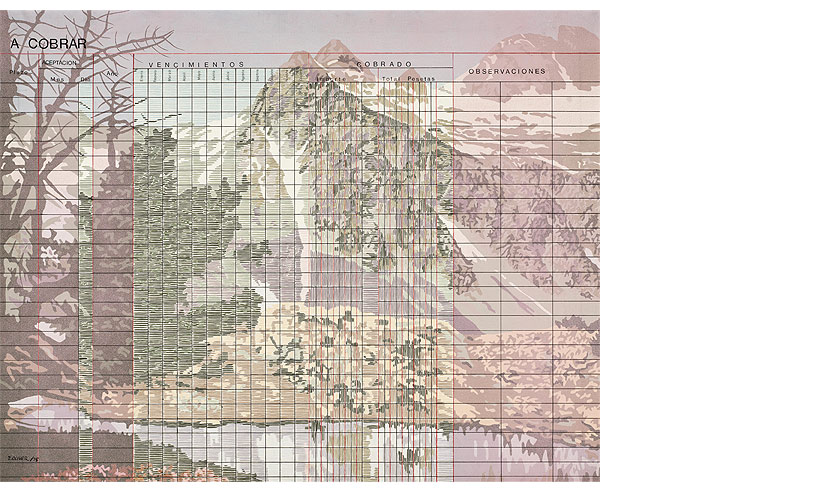
Isabel Oliver: No. 34. From the series: The Commodification of Art, 1975. Acrylic on canvas. 82 x 104 cm. Banco de España Collection.
So would it be true to say that your use and reappropriation of textiles is not only critical but also ironic?
That's right. But as I said earlier, those pieces aren’t embroidered, they’re painted. There's a piece in the series Occupation: Housewife which I called What I Want to Do is Paint (Yo lo que quiero es pintar). The title is a rejection of the way women of my generation were never asked what we wanted to be or do, or what we really enjoyed. We were brought up on dictatorial lines, and we had to submit to a type of education that was modelled on the women’s section of the Falange movement; the sole aim was to train us to be good mothers and good wives. And needlework played a key role in that education.
Because – as I say in the title – what I wanted to do was paint. I was asserting my right to be whatever I wanted to be, not something I was supposedly predestined to be as a woman. In the piece, I portray myself like Velázquez in the Meninas, with a series of embroidery hoops beside me being thrown out a window. It’s a representation of my desire to free myself from something that had been imposed on me against my will.
One might say that in these pieces you re-appropriate textile art to introduce a political and gender-based discourse, albeit in a different way to the other contemporary female artists featured in the exhibition. But in addition, you do it using a pictorial genre – landscape – which might not initially appear very well-suited to a feminist critique...
In the two pieces of mine in The Pliable Plane, the feminism is evident, because I have deliberately chosen to paint them on embroidery frames, imitating cross-stitch needlework. At the time, the fact that I painted on a sheet of lined paper from a ledger and imitated embroidery with paint was considered provocative.
But I have no particular interest in landscape painting as a genre. You can see that in the way I always use the same landscapes and never really take much time over them. I use them because it's a neutral motif, associated with contemplation – a motif you could describe as depoliticised, just like a still life. What actually interests me is using it as a pretext to introduce a different line of argument. In the pieces in this exhibition, I express this narrative not only through the imitation cross-stitch, but also by using embroidery frames – those kits we girls used to get for Christmas during the Franco years to teach us ‘our needlework’.
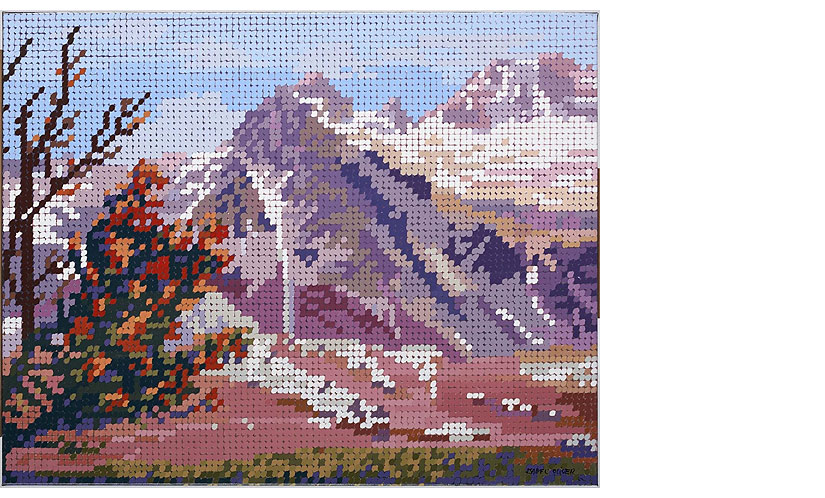
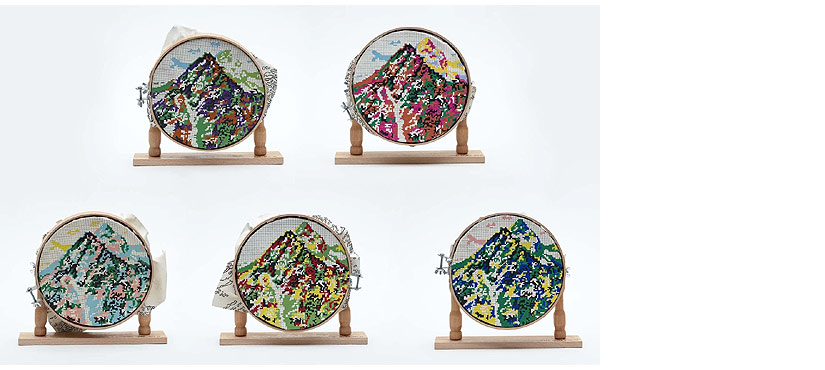
Isabel Oliver: Occupation: Housewife, 1972–1974. Painting: oil on canvas. 74.5 x 94 cm. | Frames: Acrylic on canvas and wood (varying dimensions). Museo Nacional Centro de Arte Reina Sofía.
What similarities and differences do you see between these two works and your earlier paintings, which you group under the general title Woman (La mujer)? You made them in the studio of Equipo Crónica – a collective you had links to at the start of your career…
My relationship with Equipo Crónica began in the early 1970s. After I finished my degree in art, they let me work at their studio. That’s where I started the first pictures in the Woman series, but I didn’t paint them all there; I did lots of them in my own studio. I don't think the works in that series had any particularly close association with the ideas Equipo Crónica were championing, apart from the fact that we were both very critical of the situation in Spain at the time.
People didn’t understand my work. It was rejected by the art scene, which was profoundly misogynistic and patriarchal at the time. My paintings were viewed disparagingly as ‘women’s art’; they were seen as being ‘too’ feminist and as not having a place on the art market. Despite that rejection, I stuck to the same approach; I felt it was what I wanted to do and what I had to do. I've always insisted — then and now — on doing whatever I want to; I won't bow to the dictates of others, even if it means beating my head off a reality that is completely at odds with that position.
The series Occupation: Housewife and the earlier —or concurrent— work The Game (El Juego) were a natural continuation of the Woman series. They emerged as a response to the legacy of oppression, obligations and impositions that women faced under the Franco regime. The title itself was a critique of the identity automatically assigned to women on their ID cards during the Franco regime. To say that a woman ‘devoted herself to her duties’ (a literal translation of the Spanish title would be ‘Occupation: Her Duties’) was a way of saying that she could do everything, but without being paid.
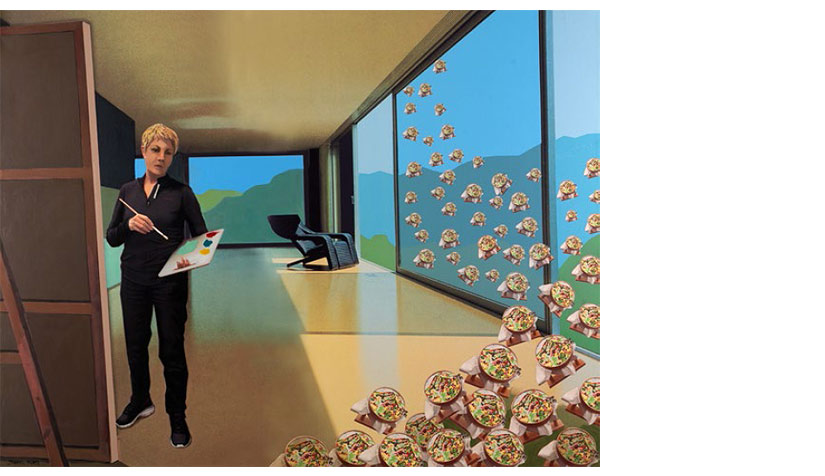
Isabel Oliver: What I Want to Do is Paint, 2020. Mixed technique on canvas. 125 by 157. Private collection.
One of the ideas expounded in the exhibition is that we have to get beyond the idea of textiles as just a technique or an ornament, and recognise their functional and representational dimension. To what extent did your recreation of embroidery in these two works enable you to link feminist criticism – which is always so prominent in your work – with a reflection on the material conditions of art and the possibilities for expanding the field of the pictorial?
You’re right, you could see it as a way of forging that link. But I need to stress that my reappropriation of textile work was based on rejection. There is nothing nostalgic about it, no deliberate championing of anything. In the Commodification of Art series, I posed that criticism of the material conditions of the artist and explored that expansion of the pictorial sphere, not in the abstract or in any generic way, but as a specific denunciation of the way women were marginalised on the art market.
From a very early stage, I realised that, as a woman, I couldn’t make a living from painting, in the way that my male colleagues could (albeit precariously). My art didn't sell. The art world was not prepared to accept female artists, let alone female artists who weren’t producing the sort of decorative works associated with them – i.e. pretty little pieces that matched the sofa.
In The Commodification of Art I argued that when there’s money involved, you can lose your freedom of expression. Your artistic style becomes distorted because you have to bow to the demands of the market. For example, you might even be asked to paint a particular picture in shades of pink. Reacting to that dynamic, I decided to use sheets from a ledger book and adapt the brushstrokes to them; the landscapes are the same in all the paintings in the series. What I was trying to highlight with that choice of materials was that bowing to the demands of the market always ends up restricting your brushstrokes and your freedom of expression. In the specific case of No. 34 – the picture from the series that features in this exhibition – the brushstrokes in the central section are defined by the lines on the account sheet. So in Occupation: Housewife the brushstroke was defined by the pattern you had to embroider, but in this case, it’s defined by the pattern of market demands. Both series share the same determination to rebel against the different forms of oppression that stifle and restrict freedom and creativity.
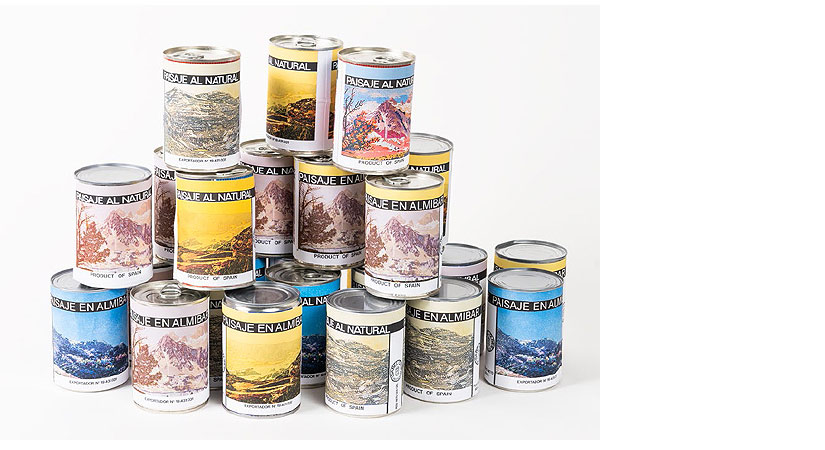
Isabel Oliver: Tinned Landscapes (Botes de paisajes en conserva), tins with adhesive paper labels. 11 x 7.5 x 7.5 cm each. Private collection.
What similarities or differences do you think there are between these works and what you’ve been doing since the 1990s?
Actually, when I look at my art in the round, I think there’s a close link between all my pictures. For example, in the series we talked about, The Game – which I also began in the mid-1970s, I criticise the rules of the game of Spanish society at the time, using a manipulated set of Spanish playing cards. Those rules – amongst other things – prevented women from developing freely in their personal and professional lives. There's always been a strong feminist perspective in my work. And a sense of humour and irony too. This series, The Game, is a good example.
In later works, I continued to explore the themes and issues I had addressed in Occupation: Housewife and The Commodification of Art, but in some cases I also developed on some of the sketches or ideas I’d come up with during those years, which I hadn’t previously completed, for one reason or another. It’s important to remember that for a long time, I prioritised my academic career (I’m a professor in painting at the Polytechnic University of Valencia) over my artistic career, just to get by. And to add to that, I’d become a mother, with everything that entails. So I had to cut back considerably on my strictly creative work. Since then, I've been able to take it up again, and I’ve had a chance to explore many of the ideas from those years in greater depth. For example, I have a series called Pop Landscapes (Paisajes Pop), which revisits the language of pop art from my early days. It features landscapes on tinned food, all ready to be sold in the supermarket.
Occupation: Housewife features needlework hoops, which ties in with a device I've used a lot in my work, where I often include pictures-within-pictures. Some recent examples linked to this series include What I Want to Do is Paint (2020) and The Painters (Las Pintoras) (2020). In The Painters [female], I recreate Velázquez's picture The Spinners but without any of the items related to needlework (the spinning wheel, the threads, etc.). I turn the spinners into painters – a profession which has historically been denied to women.
For many years, I was unable to combine painting, bringing up my children and my academic career, so, as I said, I had to cut back a lot on my creative work... But at the same time, that allowed me to paint whatever I wanted to. Pursuing a career in academia gave me that freedom, because I wasn’t bound by the rules and constraints of the art market.
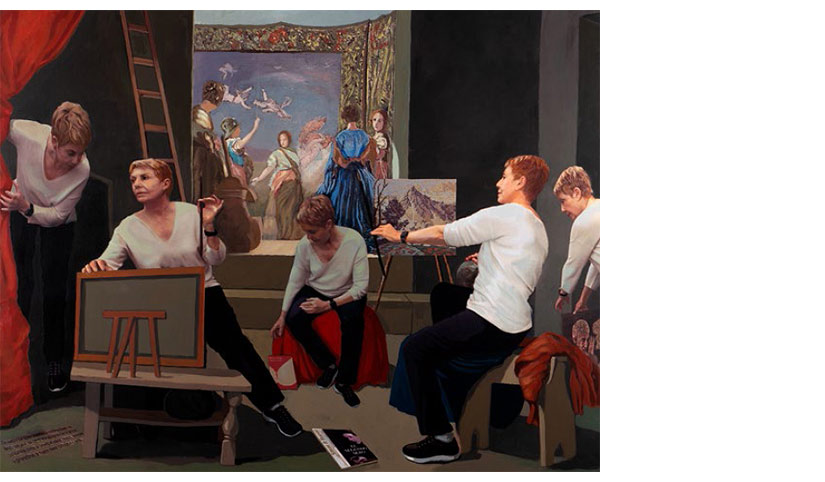
Isabel Oliver: The Painters, 2020. Mixed technique on canvas. 125 x 157 cm. Private collection.
To conclude, could you talk a bit about your works in the context of this exhibition, which combines historical and contemporary works of textile art. Your two pieces are in the section entitled The Needle as a Pencil, which features contemporary artworks which have taken techniques traditionally associated with textile work into the realm of the visual arts. What possibilities do you think this encounter between pieces from such different eras and formats offers?
I actually found the exhibition very powerful and interesting, because it highlights the complexity and boldness of many projects linked to textile art that have historically been denigrated and undervalued because of their association with craftwork. The show creates a dialogue between these historical pieces and contemporary works that are telling different stories. It’s like a breath of modernity, which hits you the moment you step into the exhibition. I thought that was a good move.
As for the specific section of the exhibition in which my two works are included, The Needle as a Pencil, there’s one thing I should mention. I think the title very aptly describes most of the works in the section, which make artistic use of needles, thread and embroidery... But in actual fact, my two pieces serve as a sort of counterpoint. Given their focus on painting itself and on women as painters, they might better be described as ‘the brush as needle'. Because there’s no thread in them, no needle... What there is, and what I'm championing, is painting. I really liked the way this served as a counterpoint; it made me very happy to be included in the exhibition.