Highlights section updated with works by Eva Lootz, Jesús Rafael Soto & Jonathan Monk
The Collection section of the website includes a subsection where we regularly highlight works from our heritage collection. The idea is not just to focus attention on some of the most valuable pieces in the collection built up by the bank over its more than two hundred years of history, but also to highlight how varied the collection is, with over 4500 works dating from very different periods and in very different styles and formats.
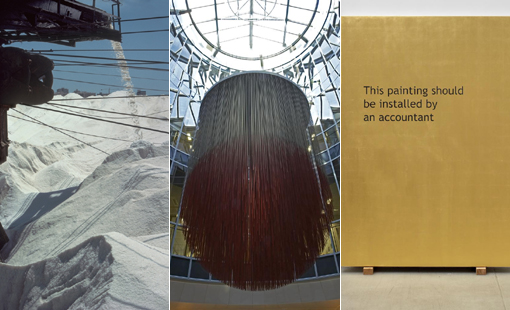
For the latest update we have selected three works from our Contemporary Art section. These works reflect some of the main themes that have marked the creation of art in the last few decades. They are the photo Salinas de Torrevieja Series by Eva Lootz (b. Vienna, 1940), an Austrian artist who has lived in Spain since 1967, the major sculpture Red Sphere by Venezuelan artist Jesús Rafael Soto (b. Ciudad Bolívar, 1923 - d. Paris, 2005) and This Painting Should Be Installed by an Accountant, a sort of 'conceptual canvas' by UK artist Jonathan Monk (b. Leicester, 1969).
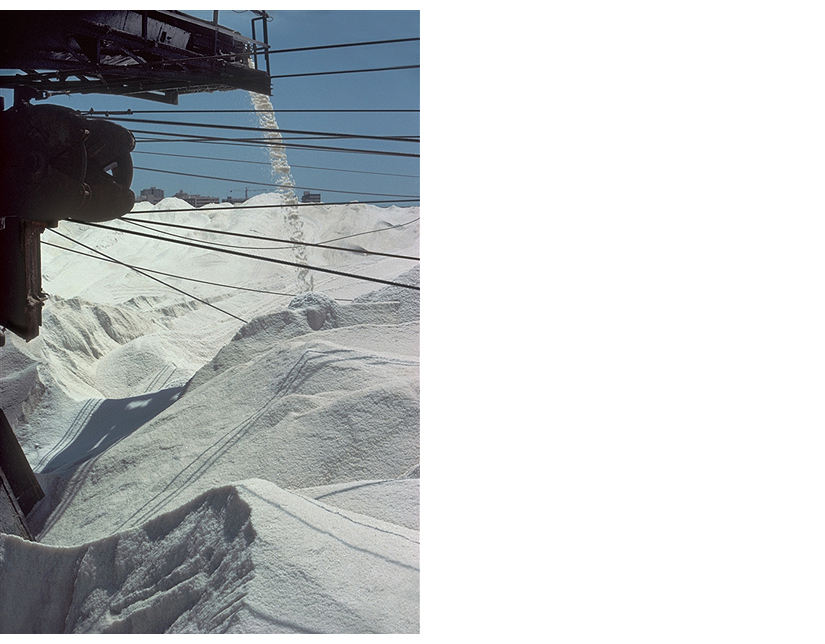 Eva Lootz: Salinas de Torrevieja Series (1984)
The first work, Salinas de Torrevieja Series (1984), is a series of photos of one of Europe's biggest salt marshes, in the south of the province of Alicante. It has been worked since Roman times in the first century BCE. The photos —which Eva Lootz did not show in public until 2010, 26 years after they were taken— focus on the production, transportation and storage of thousands of tonnes of salt at the location. Álvaro de los Ángeles writes that it is their documentary approach that gives these photos their radically contemporary feel. They also reflect the importance of elements of the soil and its properties in Lootz's output.
It is worth recalling here that physical properties and processes of change in the 'materials that make up the world' (mercury, bronze, paraffin, dry ice, sealing wax, cotton, sand, salt, etc.) have been a leitmotiv of her output ever since the early 1980s, when this series was produced. Lootz traces the way in which their extraction, processing and use are key in understanding the history and evolution of humankind, highlighting the conflict-ridden relationship between civilisation and nature. In The Torrevieja Salt Works her reflection is inextricably bound up with her exploration of the passage and material nature of time, in the sense of time both as a marker of human activity (a time for industrial production, a time for art, etc.) and as a transcendent element (the unfathomable time of the rhythms and cycles of nature). This is not the only work in our collection by Eva Lootz, who won the National Award for Plastic Arts in 1994. We also have one of the sculptures that she produced in the early 1960s, which takes the form of twin cups. This was the first time that she addressed the theme of femininity in her work, although it subsequently came to be a major theme for her.
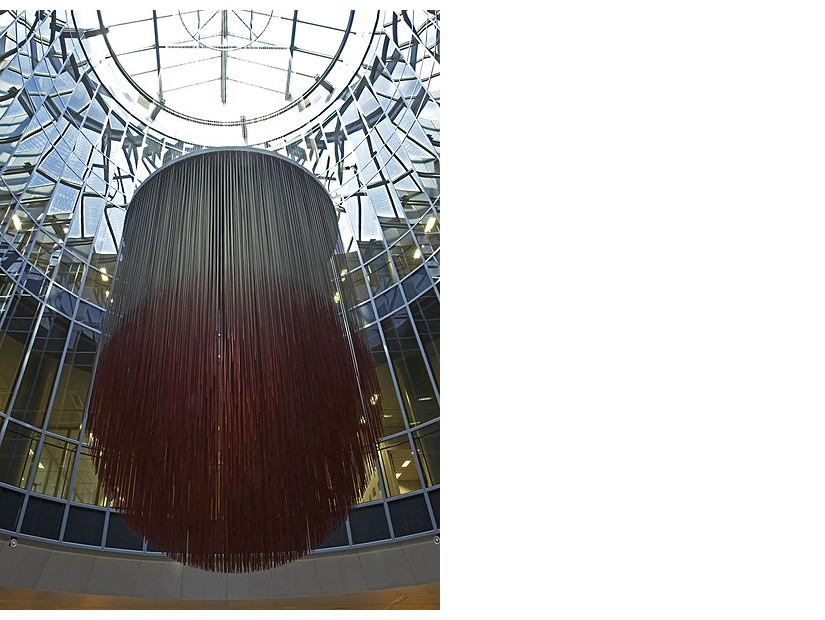 Jesús Rafael Soto: Red Sphere (1992)
The second work selected is Red Sphere (1992), a large sculpture by Jesús Rafael Soto, one of the leading exponents of op art and kinetic art on the international stage. It is part of a large group of 'multidimensional' spheres generated from hanging threads, produced for various events and locations, including the well-known Caracas Sphere (1974), located on the Francisco Fajardo motorway in the Venezuelan capital, and Japan Sphere (1988), produced for the Seoul Olympics. As in other projects by Soto, his 'spheres' interact directly with the locations where they are placed, seeking to actively involve spectators and turn them into a fundamental part of the work. He does the same in the group of installations known generically as Penetrables: without spectators there is no art work.
Red Sphere is an example of this need for active spectators, of the importance of movement and of the vision of energy as the basic structure of matter that is prevalent in Soto's work. The sphere is constructed virtually of colour, and its volume cannot be perceived or understood until the spectator walks around it. In itself the piece has no traction: it is that movement which gives it its apparent vibratory, dynamic nature. As Isabel Tejeda writes, it is worth remembering that Soto drew a direct link between his work and the notions of movement and time. Paraphrasing his own words, he structured his work in space and time, centring on elements and qualities associated with them, such as vibration, light and movement.
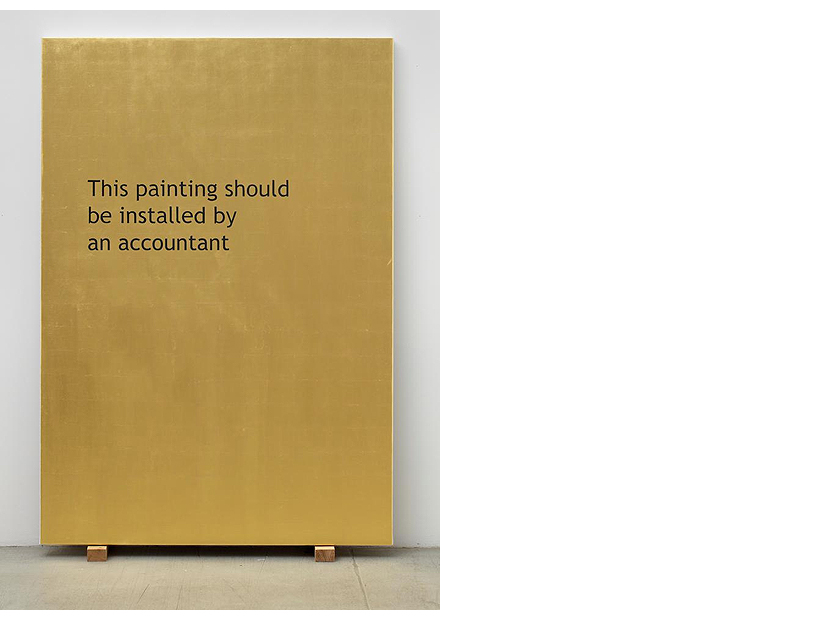 Jonathan Monk: This Painting Should Be Installed by an Accountant (2011)
The third and last piece selected here is This Painting Should Be Installed by an Accountant (2011) by Jonathan Monk, a British artist who has been producing markedly meta-artistic works in various disciplines since the 1990s, in which texts often play a fundamental role in form or via their titles. This piece is a good example. It belongs to a series called This Painting Should Be Installed by..., which comprises a number of monochrome canvases which contain the title phrase, followed in each case by the name of a different type of individual as the person charged with installing the painting.
In the case of the painting from the series that we have in our collection, that individual is an accountant. The picture is produced using gold leaf, in a direct allusion to the revolutionary use of monochrome gold colouring by French artist Yves Klein. In other cases it is a broker, a millionaire, a prostitute, etc. In an incisive, critical reappropriation of the conceptual art of the 1960s, Monk thus turns his characteristic 'instructions' into a work in themselves, introducing an ironic sense of distance underlaid, as Yolanda Romero puts it, by 'interesting reflections on the role of the artist in the world of art, the financial value of art works and the role of the public'.