The Banco de España's new exhibition explores the impact of Art Deco on the bank’s head offices in Madrid
Allegories of What is to Come is open to the public until 28 March 2026 at the Banco de España's exhibition hall (Calle Alcalá 48, Madrid) . It can be viewed from Tuesday to Saturday from 11 am to 2 pm and 4 pm to 8 pm. In December, it will also be open on Sundays from 11 am to 2 pm. Admission is free of charge, by reservation , and there is a wide range of free guided tours, with specific family-friendly sessions on Saturdays from 12:30 pm to 1:30 pm, for families with children aged 6–12.
The exhibition looks at one of the most significant episodes in the bank's history: the expansion of its head offices on Plaza Cibeles in the 1930s, to a design by Navarrese architect José Yárnoz Larrosa. The project included two of the bank's most important architectural spaces, the trading floor and the gold vault. It also reflected the bank's desire to project an image of modernism, progress and stability at one of the most convulsive junctures in Spain's recent history It is not unsurprising, then, that the architect – and the bank itself – viewed the two areas as symbols of a new era, intended to combine functionality and symbolism.
One of the main themes of the exhibition is that Yárnoz Larrosa's design for the new extension reflects not only his own wish to represent the pursuit of efficiency and permanence, but also a conscious attempt by state institutions to express the values of modernity. This is reflected in the choice of materials –steel, stone, marble, glass and polished brass – and the use of the latest construction techniques. This goal was further enhanced by the adoption of the visual language of Art Deco – a movement that had reinterpreted some of the styles of the avant-garde, especially cubism and was transforming the image of the great European and American metropolises of the day.
 Allegories of What is to Come: view of the exhibition hall
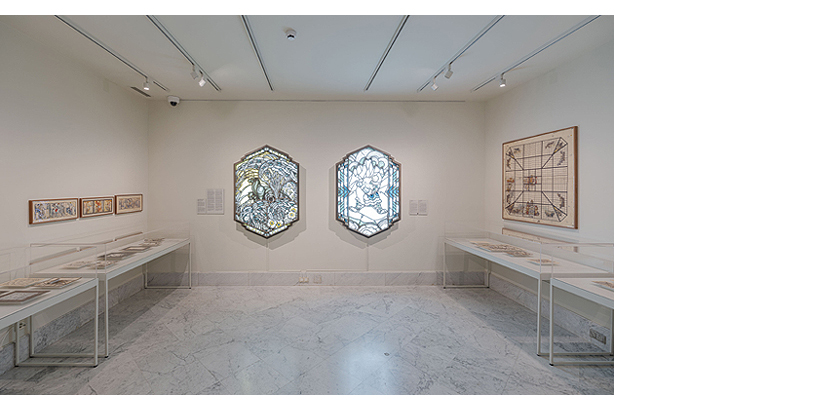
In a varied range of artistic works, documents and materials of different kinds –sketches, furniture elements, architectural plans, banknotes and archive photos – Allegories of What is to Come interprets this key episode in the bank's history as a way of questioning the contradictions and tensions of an era in which modernity was seen as both the promised land and a disputed territory. In other words, the exhibition does not ignore the political dimension of the images, examining the darker side to these narratives of 'allegories of the future' – the harsh and often precarious working conditions, the notable absence of female protagonists and artists, etc. – and shining a spotlight on the historical role of institutional art as a tool for legitimising power.
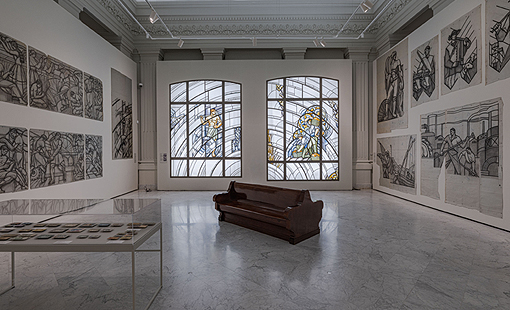
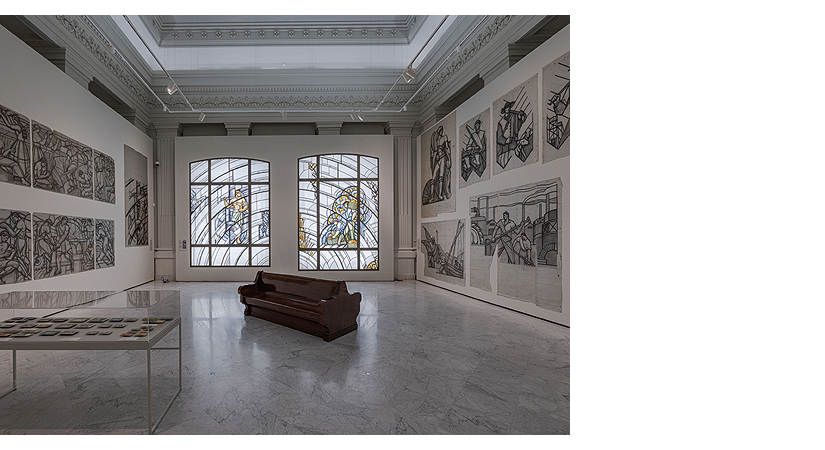
Particular attention is paid to the stained-glass panels designed by Maumejean Hermanos for the trading floor, one of the most iconic institutional Art Deco decorative ensembles anywhere in Europe. The panels, which feature a series of images expressing a vision of collective labour as the aesthetic and ideological foundation of institutional modernity, were crucial for Yárnoz Larrosa in enabling him to achieve the necessary sense of light and transparency, while still preserving the structure’s monumental feel.
As part of a joint collaboration between the Banco de España, the National Museum of Decorative Arts and the Fundación Centro Nacional del Vidrio, the original cartoons for the panels, attributed to Albert Martorell, have been located, studied and restored and are now being displayed in public for the first time.
 Allegories of What is to Come: view of the exhibition hall
Curated by the Banco de España’s conservator, Yolanda Romero, and artist, curator and researcher Álvaro Perdices, Allegories of What is to Come has a twin aim. On the one hand, it is a chance to showcase a selection of documents, artworks and heritage items linked to a crucial moment in the history of the Banco de España and its transition to modernity. At the same time, the show seeks to provide a space for critical reflection on the stories and images that have shaped our collective identity, attempting to promote a dialogue between institutional memory and some of the underlying questions of our time.
The exhibition is the result of extensive collective research in which inter-institutional collaboration has been fundamental. It is complemented by a 368-page catalogue, which, as well as offering extensive information on the artworks, documents and other items on display, includes a selection of essays exploring in greater depth some of the issues and problems addressed in the exhibition.
Theme areas of the exhibition
The 150 items in Allegories of What is to Come (many of which are being displayed in public for the very first time) are divided into five different but closely interrelated thematic areas. Together, they form a visual and narrative ecosystem offering a continuous counterpoint between institutional desire and collective experience, between iconography and document, between art and the tangible.
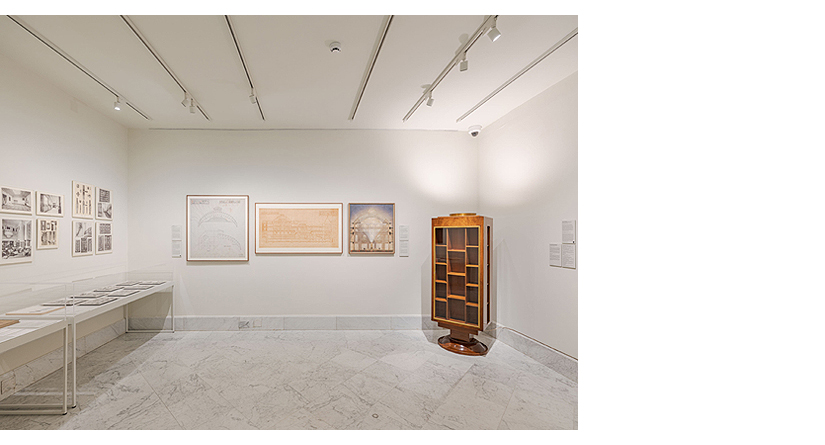 Allegories of What is to Come: view of the exhibition hall
Landscape, Progress and Society, the first area of the exhibition takes visitors back to the beginning of the 1930s, evoking the historical and artistic milieu in which Yárnoz Larrosa created his extension for the Banco de España. It includes works by artists such as Joaquín Sorolla, José Gutiérrez Solana, Ramón Casas i Carbó, Daniel Vázquez Díaz, Joaquín Torres Garcia and Antoni Arissa, along with documents that provide an interplay with the figures from the stained glass panels by Maumejean Hermanos and invite us to explore the relationship between art, labour and nation building.
The second, The Maumejean Hermanos Workshop, specifically explores the stained-glass panels that formed such an essential feature of the new building. It uses a selection of drawings, sketches and cartoons from the studio to meticulously reconstruct the process behind the creation of this fascinating decorative ensemble.
The titular section, Allegories of What is to Come, offers a selection of the original cartoons for the motifs from the stained-glass panels, attributed to Albert Martorell, together with the recently restored Agriculture and Industry panels. Combined in a single space, these items form a powerful installation that offers an allegorical interpretation of labour as the engine of progress.
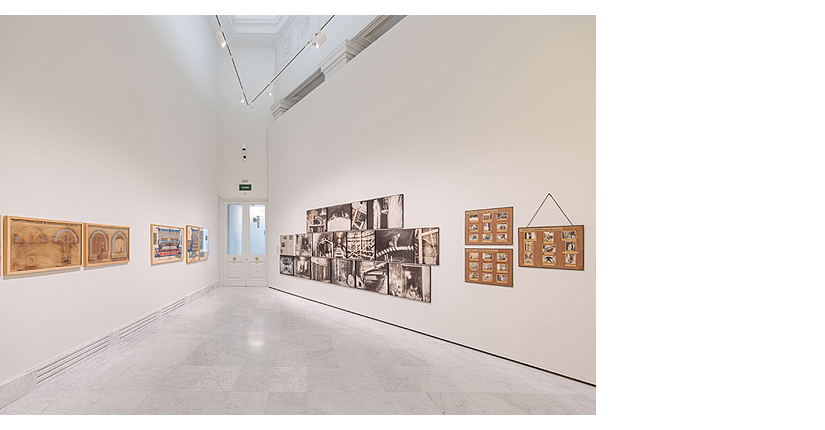 Allegories of What is to Come: view of the exhibition hall
The fourth area, Technology and Security, explores one of the most iconic areas of the building, the gold vault, showing the room as an embodiment of the institutional vision of economic power as a sacred virtue, where security is a symbol and safekeeping a ritual. In addition to a selection of plans, drawings and models documenting the construction process, there is also a frieze with photos from the Banco de España's Historical Archive of the workers who helped build the vault.
Finally, the fifth section, An Administered Modernity, focuses on the material and functional design of Yárnoz Larrosa's extension to the building on Plaza Cibeles and highlights the way in which it brought to life a concept of architecture, in which each element contributed to the overall conception of the building as a symbol of modernity, efficiency and authority. The architecture was designed to last, to represent and project an image of solidity in times of uncertainty and transformation.