Economies of the Residual. A Theory of Landscape as a Fold
Itineraries is a special section of the website in which we invite external authors (including historians, writers and artists) to design their own personalised tours of the Banco de España Collection. Economies of the Residual: A Theory of Landscape as a Fold is the latest in this series of texts offering fresh perspectives on the works in our collection. Víctor del Río, Doctor of Philosophy and Professor of Art History at the Universidad Nacional de Educación a Distancia (UNED), has selected a series of works which, in his words, 'swing between attention to detail, the poetics of the fragile and revisions of Western aesthetic concepts in new conditions of production and expression'. 'Each one', he adds, 'is a new declination, transforming the notion of landscape from a specific geopolitical awareness'.
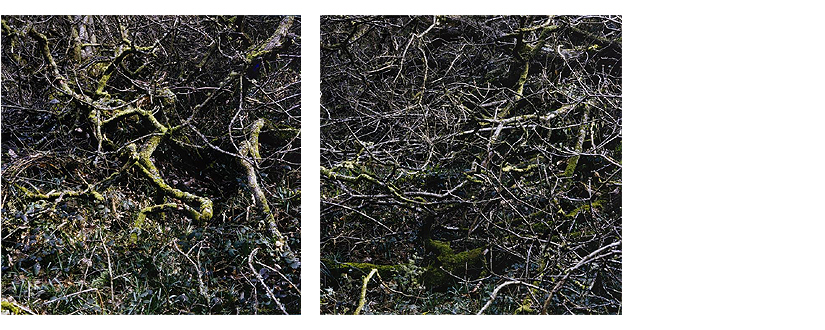 Willie Doherty: Beneath the Surface I (1999) | Beneath the Surface II (1999)
The starting point for del Río’s itinerary is an essay published by Karl Marx in 1842 in the Rheinische Zeitung, entitled Debates on the Law on Thefts of Wood, in which he criticised the regional government's proposal to abolish the peasants’ ancient right to gather fallen firewood in the forests of the Rhineland and treat the practise henceforth as theft. The text anticipates certain aspects that were to be highly significant in Marx's later economic and political theory. However, del Río argues that it also reveals the way mechanisms of dispossession – entailing the dismantling of socially accepted rights, the criminalisation of poverty and the privatisation of natural resources – function and are legitimised.
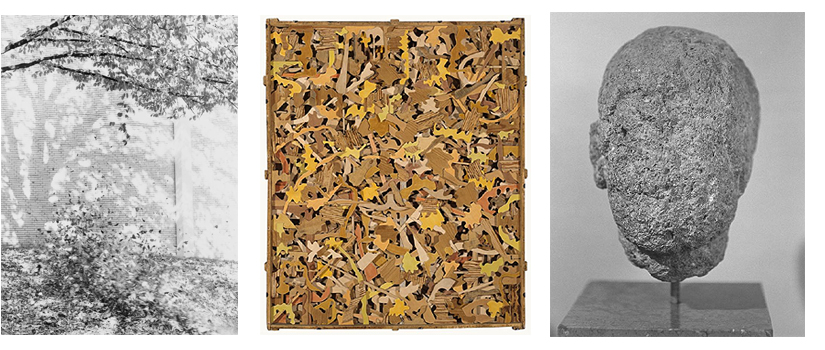 Jochen Lempert: Photosynthesising (2009) | Alfredo Alcaín: Autumn Starts in the Forest (1989) | Jorge Ribalta: Petit Grand Tour (Series) (2007-2008)
The 'almost prophetic' dimension of the young Marx's writing, says Victor del Rio, not only 'raises some pressing issues that are still with us today', but also offers us 'a powerful image'. And it is this image that del Río uses as the 'allegorical axis for a new conception of the landscape' in his proposed itinerary, comprising works by fourteen different artists from between 1989 and 2024. Using this concept, he says, we can see 'a sort of fold in our surroundings, in the natural world, that is both a gesture of original re-use, but also the sign of a dynamic in which wealth generation makes a secondary economy of the residual necessary'.
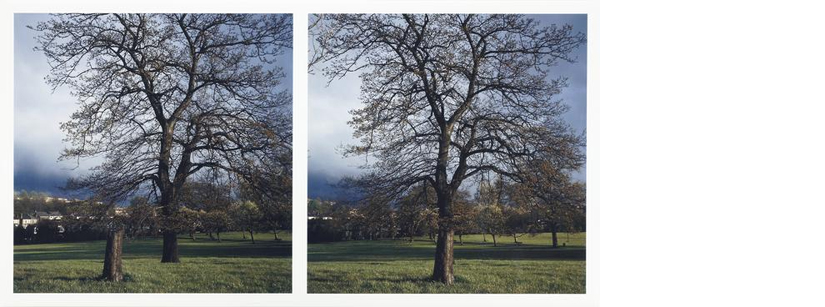
Mireya Masó: Washing Away Time (2001)
In this regard, del Río notes that one of the premises expressed by his tour is the 'notion of the fold as a structure that is consubstantial with the very idea of landscape'. One is reminded of French thinker Gilles Deleuze’s definition of the fold not as a limit between two planes, but as the movement that brings them closer and makes them coexist without merging. From this perspective, the landscape can be read 'as a surface in a perpetual state of inflection, an intermediary zone in which the territory, the gaze and the body are folded over on one another'. 'Thus', writes del Río, 'an aerial image taken from a weather satellite and the miniscule closeness of a soil fragment are not distant extremes, but modulations of the same field of perception. Ultimately, they are different degrees of curvature in the surface on which the landscape experience takes place'.
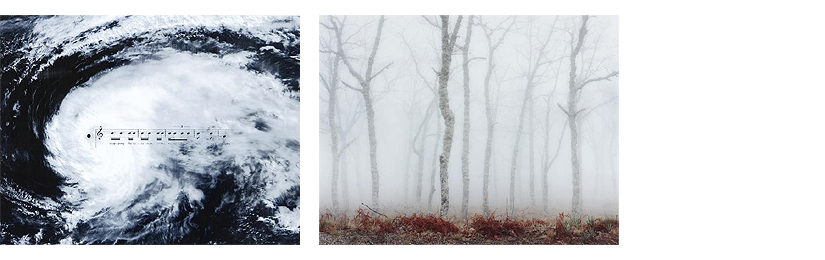 Joana Pimentel: From serie 17 proposition P6 (2007) | Axel Hütte: Yuste II (Fog) (2002)
Víctor del Río concludes the introductory text of his itinerary – and the accompanying essay – by asserting that the very existence of an art collection in the Banco de España is 'symptomatic of the twin course of capital', which is both patrimonial and symbolic. Alongside the gallery of portraits of former bank governors, there are other depictions 'that appear to draw our attention away from the illustrious, to concentrate instead on the narratives of more minor characters' as illustrated by del Río’s selection of works. This 'focus on the residual', he notes, becomes in turn ‘a form of surplus [...] that sustains the legitimacy of the whole’. 'Perhaps it is this new symbolic fold, associated with the value of things, that defines this itinerary', he concludes.
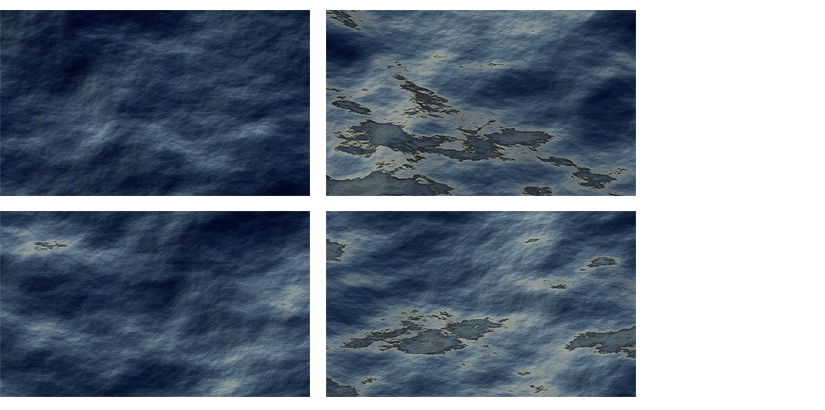 Javier Núñez Gasco: Open Sea 12-13 hours (2024), Open Sea 13-14 hours (2024), Open Sea 14-15 hours (2024), Open Sea 15-16 hours (2024)