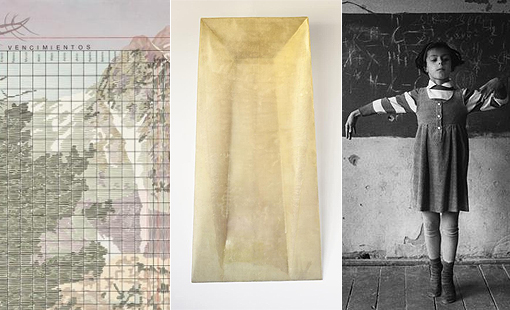
New additions to our 'Highlights' section: works by Isabel Oliver, Salomé Cuesta and Cristina García Rodero
Since the bank took the first steps towards the creation of a contemporary art collection in the mid-1980s – under the leadership of José María Viñuela – it has been firmly committed to supporting work by women artists, who had been greatly underrepresented in the collection for historical reasons. It was during that period that a commission to paint the portrait of the bank's governor first went to a female artist – Isabel Quintanilla – followed in the 1990s by two portraits by Carmen Laffón, who was also commissioned to paint King Juan Carlos I and Queen Sofía in 1987 and 1988, respectively. Around the same time, the collection acquired pieces by Esther Ferrer, Soledad Sevilla, Carmen Calvo and Teresa Duclós, who had all begun to carve out a niche for themselves in an art world still very much dominated by men.
And that commitment to giving greater visibility to the vision and work of women artists has been kept up ever since. For the latest update to our 'Highlights' section, we have selected three such works to mark International Women's Day: an acrylic Nº 34, from Isabel Oliver's 1975 series The Commodification of Art; a sculpture Interchangeably by Salomé Cuesta in 1990; and a photograph Dance Lessons (Georgia) taken by Cristina García Rodero in 1995). Together, they echo the strength and determination with which women artists emerged onto the Spanish arts scene in the last three decades of the twentieth century.
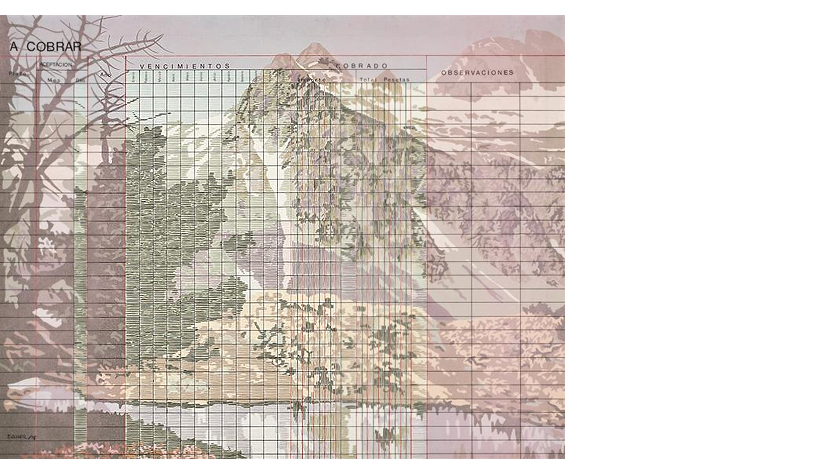 Isabel Oliver: No. 34, from the series The Commodification of Art (1975)
The first of the three pieces is Nº 34, an acrylic painting on canvas. It is a 'feminist landscape' from a series entitled The Commodification of Art painted by Isabel Oliver. Born in Valencia in 1946, Oliver was an active member of the Movimiento Democrático de Mujeres (MDM), the feminist wing of the Spanish Communist Party, and the series was painted in 1975, the year Spain's dictator, General Franco, died. It continues, albeit less explicitly, the same critical political discourse that had marked her early career, when she rubbed shoulders with the left-wing collective Equipo Crónica.
The Commodification of Art reinterprets the landscape genre in a pop idiom, an approach Oliver had already explored in works such as Pop Landscapes and Women's Work. As her starting point, she takes a clichéd calendar or postcard image: a snow-capped mountain surrounded by giant fir trees, all reflected in a small lake. The base is a grid in ink and Rotring pen, which mimics both the ruled fabric used in cross-stitch embroidery and the squared paper of an accounting ledger. As Isabel Tejada writes, 'The pattern comes in three distinct forms, in which the debit and credit side of the sheet are increasingly visible, while the coloured brushstrokes are corseted within small cells'. In this way, Tejada adds, Isabel Oliver is criticising 'art speculation and the precarious conditions under which artists operate (...) drawing a parallel between the formal demands of the market and the creative restraints of her childhood education in the embroidery classes of the Women's Section of the Spanish Falangist Movement'.
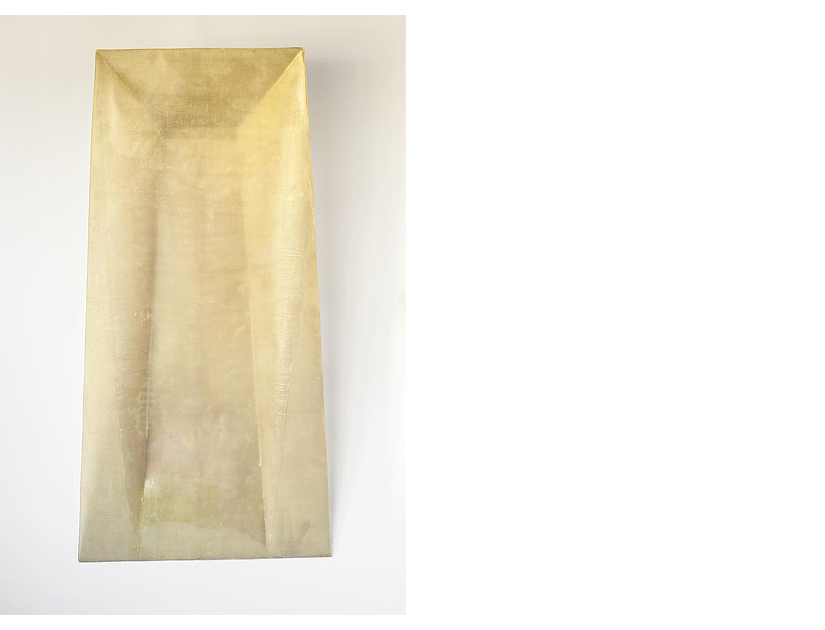 Salomé Cuesta: Interchangeably (1990)
The second of our featured works is Interchangeably (1990), a sculpture by Salomé Cuesta (b. Valencia, 1964) dating from the beginning of her career. Although her fascination with transparencies and translucent objects is already apparent here, Cuesta had yet to dematerialise the object and reduce its physicality to mere light, as she would in much of her later work.
The piece is made of polyester resin and fibreglass. Isabel Tejeda describes it as a 'a cryptic piece which plays at being a frame with no picture, and which seeks to delimit, enclose or imprison space on three sides, but ultimately shows that this cannot be done, via an aporia that emerges from the bottom of the work in acceptance of its infinite nature'. As Tejeda notes, Cuesta's core concern is to examine how space is constructed and occupied. She frequently extends this search beyond the material sphere, using non-physical media –such as mirrors and projections – and exploring the creative and conceptual capabilities of light and shadow.
![Cristina García Rodero: Lecciones de danza (Georgia) [1995]](/f/webca/ADS/Noticias/8M2026_CristinaRodero01.jpg) Cristina García Rodero: Dance Lessons (Georgia) [1995]
Cristina García Rodero: Dance Lessons (Georgia) [1995]
The third featured piece in our 'Highlights' section to mark International Women's Day is Dance Lessons, taken by Cristina García Rodero during her first trip to Georgia in 1995, shortly after the former Soviet republic had come out of a bloody civil war. The photo shows a small girl, aged about seven, with a solemn face, dancing gracefully. Behind her is a makeshift blackboard on a peeling wall, while two other children look on from the side.
![Cristina García Rodero: Círculo infantil [1995]](/f/webca/ADS/Noticias/8M2026_CristinaRodero02.jpg) Cristina García Rodero: Children's Circle [1995]
Cristina García Rodero: Children's Circle [1995]
From the same series is her Circle of Children, which is also in the Banco de España Collection and taken from a report she shot in Georgia in collaboration with Médecins Sans Frontières. A group of children huddled in a doorway gaze in surprise at the photographer who – as Isabel Tejeda notes – is thus converted from the observer to the observed. Despite the starkness of the images, the two photos contain an undeniable element of hope, showing how an innocent look can overcome all the adversities of a devastated society. García Rodero (winner of the 1996 National Photography Prize) managed to reflect this same aspect in many of her pictures of Spanish religious traditions and festivals from her celebrated 1989 book España oculta [Hidden Spain].