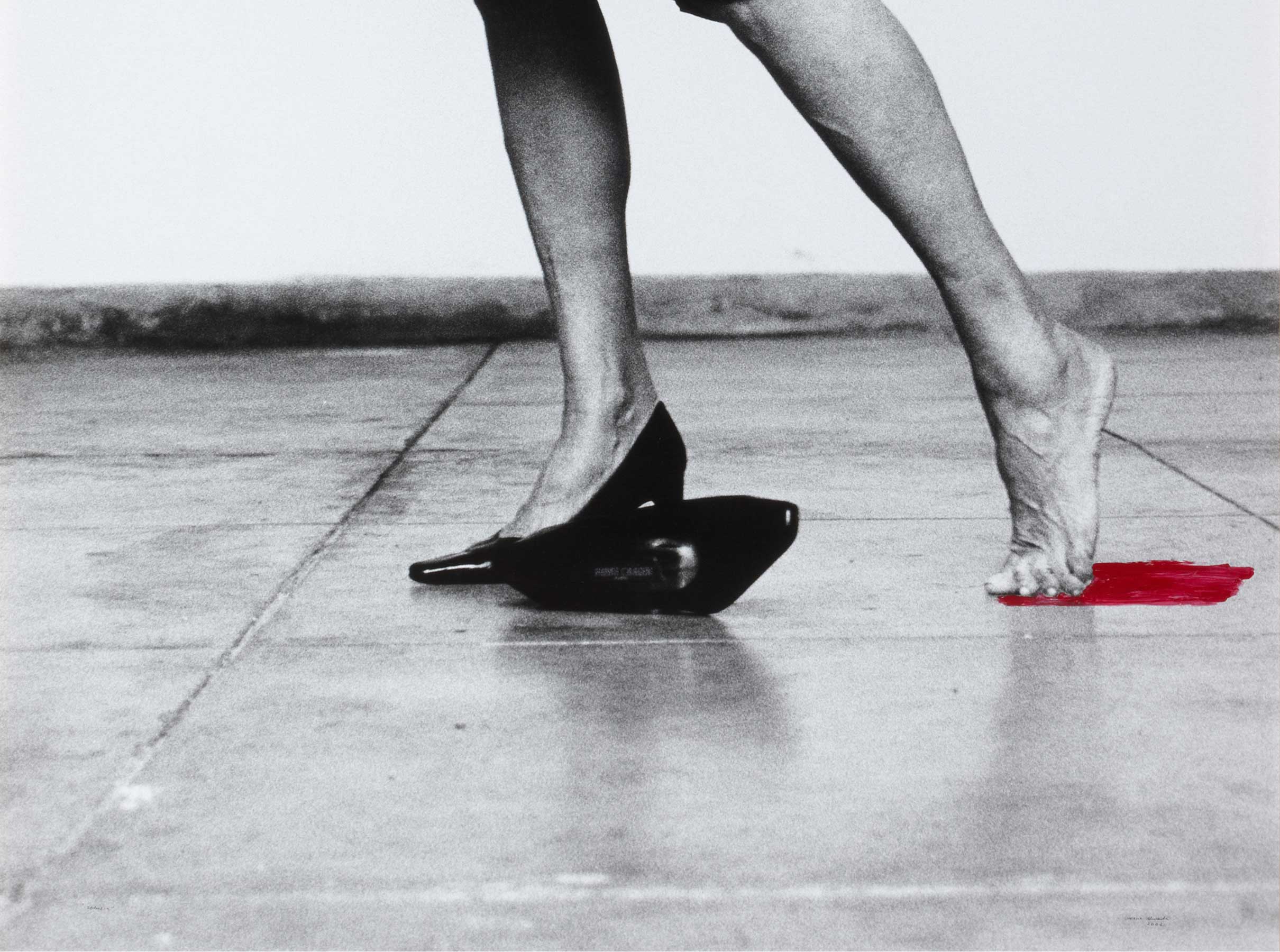
Sin titulo [Untitled]

Sin titulo [Untitled]

  • 1996
  • Mixed techniques on cardboard (collage with paper, acrylic, pencil and ink)
  • 20 x 15 cm
  • Cat. D_269
  • Acquired in 2004
By:
Carlos Martín

Juan Ugalde is a skilled communicator who uses highly original methods and was one of the first artists to point out the atmosphere of conformism and complacency that prevailed in Spain in the 1990s, following its consolidation as part of the Western bloc, with the celebrations of 1992 as the seal of approval for Spanish democracy, marking the 'normalisation' of the country. In a series of collages produced in 1995 and in Untitled, painted in 1994, there are significant references to developmentalism, tourism, the overdevelopment of coastal areas and the rise of the myth that 'Spain is different'. Using photos from the late 1960s and the 1970s, he introduces an element of nostalgia somewhere between family memories and a critique of a particular form of architectural development (the brutalist style of beach-front constructions and the price-capped social housing developments for workers harking back to the late Franco period) and of an system of upward mobility that combines the working-class, the petit bourgeoisie, an obsession with cars and the kitsch taste associated with new forms of leisure in which consumerism is encouraged as a political strategy.

Carlos Martín

 
By:
Beatriz Herráez
Juan Ugalde
Bilbao 1958

Juan Ugalde is one of the major figures of the past few decades in Spanish art. Since the 1980s he has been involved in numerous initiatives that go beyond his career as a painter. Stand-out exhibitions of his work in his early years were held at the Buades Gallery and he helped set up projects such as the Estrujenbank Group, which he founded in 1989 together with Patricia Gadea, Dionisio Cañas and Mariano Lozano. In the words of its members, this group 'pursued the sublimation of the everyday environment as the starting point for various social/decorative and political/cultural operations'. He staged exhibitions and actions with the group until 1993.

In all his output (comprising paintings, photos, drawings and collages), Juan Ugalde reflects from a committed viewpoint on the effects of uncontrolled urban development. His works typically show suburban landscapes, peripheral areas and dormitory towns on the edge of cities. They are scenes that lead observers to think about 'what it means to live in the time of the post-capitalist global village', as curator Dennys Matos puts it. In producing them, Ugalde never loses his sense of humour or the irony that he showed in his early works.

Projects on which Ugalde has collaborated include the SOS Emergen Sumergin Art magazine (2000-2007) and the 143 Delicias video festival, named after the address of the former base of operations of Estrujenbank in Madrid.

Solo exhibitions of his work have been staged at the Patio Herreriano Museum (Valladolid, 2003), the Santander Museum of Fine Arts (2009) and the Amós Salvador Gallery (Logroño, 2011). He has also taken part in group exhibitions at the Museo Reina Sofía (Madrid, 2013), the ICO Museum (Madrid, 2011), the Santander Museum of Fine Arts (2016) and the Esteban Vicente Museum (Segovia, 2016).

Ugalde has received several major grants, including a Fulbright Grant to further his training in New York from 1986 to 1989, the Marcelino Botín Grant (Santander, 1996) and a grant from the Banesto Foundation (1994). He also won First Prize at the 9th L’Oreal Painting Contest (1992) and the Altadis Prize (2000).

Beatriz Herráez


Vv.Aa. Colección Banco de España. Catálogo razonado, Madrid, Banco de España, 2019, vol. 3.