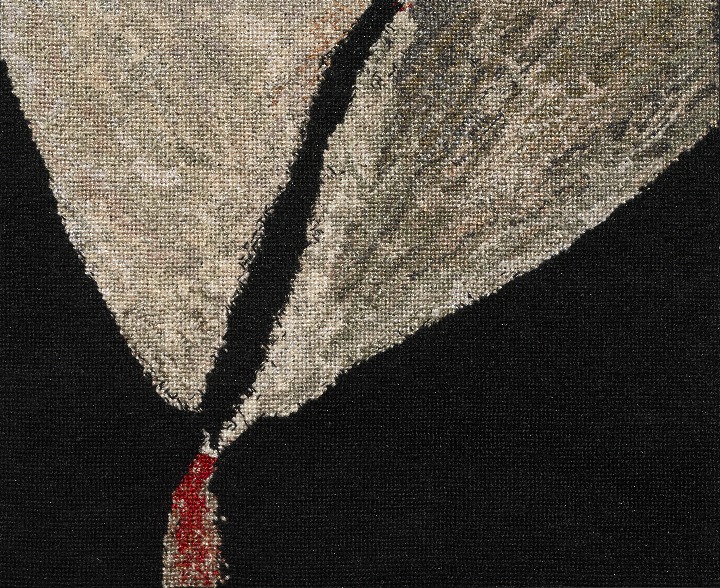
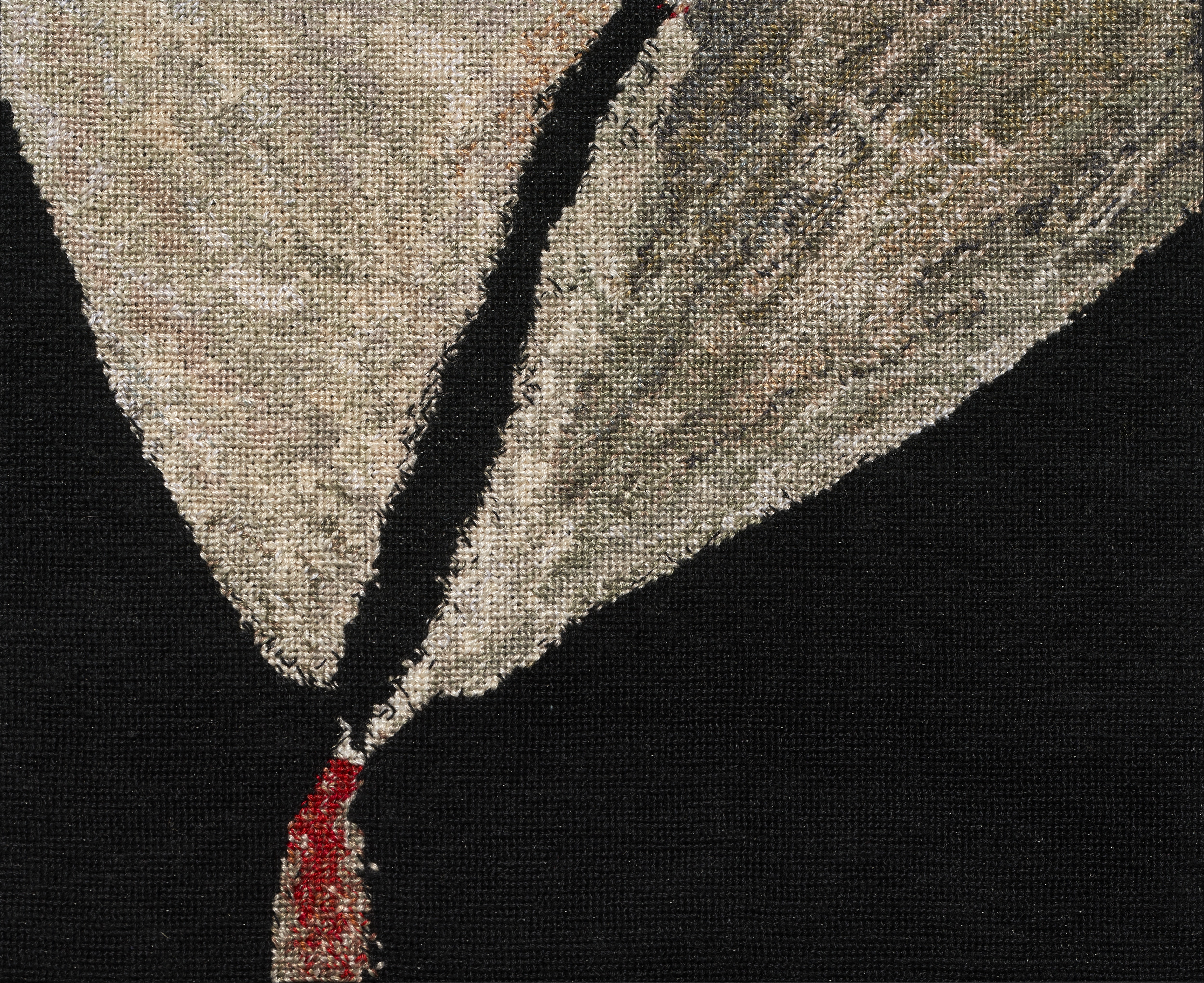
As Yet Untitled (José Guerrero, 1966), from the series "Flamenco primitivo" [Primitive Flemish]
- 2014
- Cotton and silk petit point rendition
- 14 x 17,5 cm
- Cat. T_106
- Acquired in 2026
It is best to approach this work by Narelle Jubelin from the perspective of an earlier show, Ungrammatical Landscape (Centro José Guerrero, Granada, 2006), where the artist proposed a revision of museum conventions when she placed Reconciliación [Reconciliation] (oil on canvas, 521 × 236 cm, 1991) by José Guerrero (1914–1991) directly on the floor so that it could be viewed from above, exactly as it was painted, establishing a connection to pictorial traditions in Australia. At the same time, by choosing to work with this specific piece at an institution dedicated to preserving and safeguarding the Granadan artist’s legacy, Jubelin highlighted the similarities with her home country, where reconciliation remains an unsettled political debt with Aboriginal communities. After fifteen years in New York, Guerrero was finally able to be reconciled with his country’s past, and with him Jubelin discovered the weight of the time that she herself had needed in order to comprehend Spain’s social and historical background, which in turn led to an understanding of her own displacement.
While doing research for this project, Jubelin came across La brecha de Víznar [The Gap of Víznar] (1966). When Guerrero returned to Spain in 1965, he came with his wife, the journalist Roxane Whittier Pollock, and the photographer David Lees, who were preparing a feature for Life magazine on the anniversary of Federico García Lorca’s death. And they visited the Víznar ravine, the place where the poet was murdered in 1936. He made several drawings there which became the basis of that painting and other versions. Narelle Jubelin retraced his steps: she went to the ravine and visited the village of Frigiliana, where Guerrero had built a family home (Bernard and Berta Rudofsky also built a house there, and the families of García Lorca and Jorge Guillén did the same in nearby Nerja). She felt they were relevant places for striking up a conversation with the artist.
Fast forward to 2014, when Jubelin made As Yet Untitled (José Guerrero, 1966). An exhibition was organised to mark the centenary of José Guerrero’s birth, The Presence of Black, 1950–1966, which the artist heard of through one of its curators, Yolanda Romero, and whose title she borrowed for a show of her own at The Commercial, Sydney, in 2019. That memorial exhibition included the aforementioned work by José Guerrero, an oil on canvas (196 × 238 cm) that Jubelin rendered in petit point with cotton thread on a silk ground (31 × 33 cm), rewriting abstraction into an agrammatical landscape: black, white and red; death, life and blood.
Narelle Jubelin’s body of work is characterised by the use of petit point (French for ‘small stitch’), a very fine, delicate style of embroidery with a labour-intensive process: a cotton thread is repeatedly passed through a silk ground with a needle to achieve a precise, highly detailed final result. This needlework condenses her critical and conceptual enquiry, producing work of such accuracy and flawless execution that both front and back reveal distinctly contemporary reformulations of the pictorial medium.
She chose this embroidery technique for its versatility, compact format and minimal scale, in contrast to the painterly semantics of her student years in Sydney. She resignifies this craft which, like weaving and sewing, is an activity associated with the domestic labour of women. And in doing so, she prompts a questioning of cultural codes steeped in social history.
Jubelin’s artistic practice has always proposed conversations with other women artists, other female voices, making dialogue central to her work. She invites us to reread and reinterpret the memories etched into artworks, objects and places by investigating their historical, cultural, political and social contexts.
Other works by Narelle Jubelin