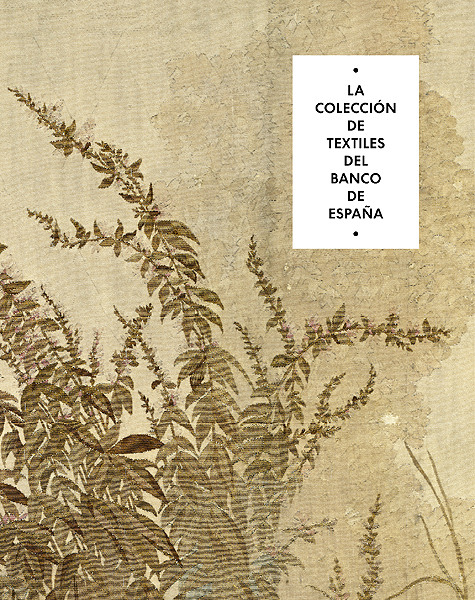
THE BANCO DE ESPAÑA'S TEXTILE COLLECTION
The Banco de España is pleased to present the catalogue raisonné of its textile collection, the first comprehensive study of all tapestries, carpets, armorial hangings and contemporary textiles in the bank’s possession.
The publication is the outcome of research led by Antonio Sama, one of Spain’s leading experts on the history of textiles. Dr Sama holds a PhD in art history and lectures at the Complutense University of Madrid. Working with the Banco de España’s Heritage and Collections Division, he has determined the provenance, uses, architectural contexts and historical significance of hundreds of pieces in the institution’s collections.
As well as their intrinsic artistic value, the textiles have also played an essential role in the bank’s architecture and its institutional life. Wall hangings have been used to enhance the acoustics of some larger public venues; carpets have added a sense of comfort and prestige to halls and offices and armorial hangings have served as symbols of corporate and ceremonial identity. They combine practicality, symbolism and beauty in a collection which, despite its essential role in shaping the material and symbolic identify of the Banco de España, has for decades gone largely unrecognised.
Over recent years, the bank has undertaken a programme of research, documentation and dissemination of its artistic heritage and this catalogue marks a fresh step in that process. The work has required help from a large, multidisciplinary team of curators, restorers, archivists, photographers and specialists. The key figure in the project, however, has been Antonio Sama. As well as spearheading the scientific research, Dr Sama authored the main studies on the historical collections of tapestries, carpets and wall hangings and wrote much of the documentary and reference material accompanying the publication. It is hoped that the catalogue will be an essential reference work for any study of Spain’s textile heritage.
As Yolanda Romero notes in her introductory essay, the words ‘text’ and ‘textile’ both derive from the Latin verb texere, to weave. The catalogue invites us to view the collection as a vast tapestry woven over time, in which people, buildings, techniques, institutions and memories are all intertwined. Its full significance can only be fully appreciated when it is researched, preserved and shared with society.