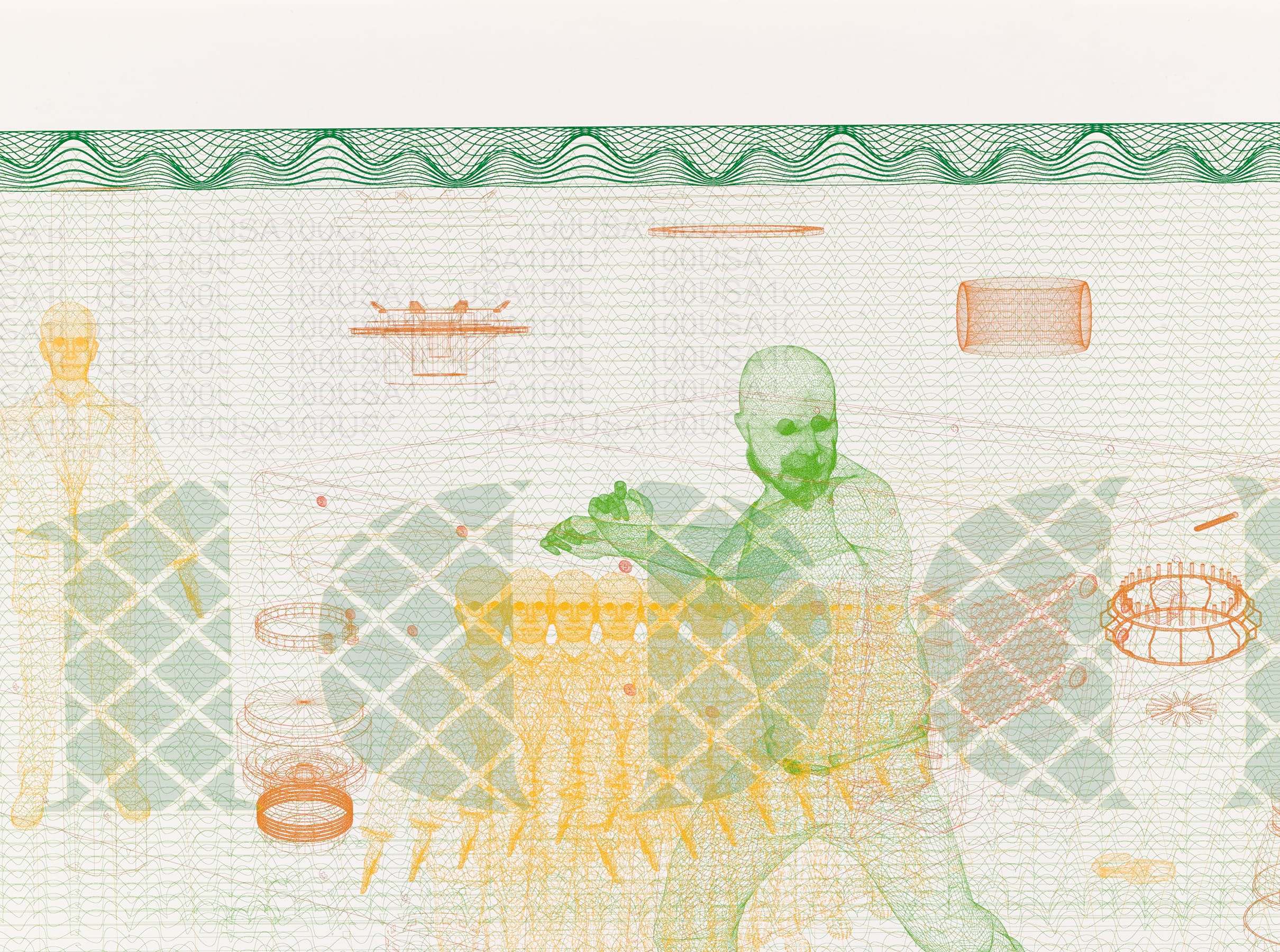
Death of Federico Guzmán, a key figure in the 'new Sevillian figuration' movement, which revolutionised Spanish art in the late 1980s
It was with great sorrow that we learnt this week of the death of the Sevillian artist Federico Guzmán (b. 1964). Guzmán viewed his work as an instrument of social transformation, a situated, hybrid, collaborative practice with an emphasis on the need to reclaim the harmony between humans and the natural environment.
In the mid-1980s, after completing his studies at the University of Seville's School of Fine Arts, 'Fede' – as he was known to his friends – embarked on his professional career. He joined what came to be known as the 'new Sevillian figuration', a movement that was at that time becoming prominent on the domestic and international art scene. During this early stage, Guzmán worked closely with the La Máquina Española gallery in Seville, where he staged his first solo show in 1987.
In the 1990s, he spent time in New York and Bogotá, where he became increasingly aware of the importance of the social context in which the artist operates. He began to centre his art on the idea that creativity must be placed at the service of community-building, (re)connection with nature and the preservation and renewal of the ancestral knowledge that has been hidden from view by the logic of capitalism and colonialism. This conviction was to mark all his subsequent output, including his most recent work, closely linked to the Sahara, through ARTifariti, the International Art and Human Rights Meeting in Western Sahara.
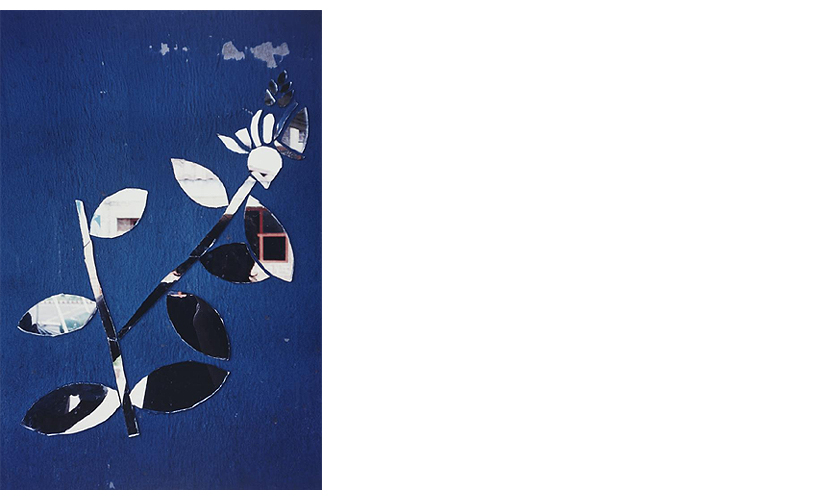 Federico Guzmán: Untitled (2001). Banco de España Collection
Roberto Díaz writes that in his drawings, paintings, sculptures, installations and performances, Guzmán uses a variety of techniques and materials that often reference the content of the works themselves — materials that have been transformed by humans and which the artist now returns to nature, with motifs in which 'natural elements (plants are a recurring motif), culture and intra-history are intertwined (...), presented with humour, optimism and irony through unusual associations and games of scale that draw on surrealist aesthetics'.
Solo exhibitions of Guzman's work have been held at the Museo Reina Sofía (Tuiza. Las culturas de la jaima. [Tuiza. The Cultures of the Bedouin Tent], 2015); Fundació Antoni Tàpies (Insideout = jardí del cambalache [Insideout = Swap Garden], 2001); the Andalusian Centre for Contemporary Art (Matitas divinas [Divine Shrubs], 2001 and, with Alonso Gil, Marhaba [Welcome], 2010), the Ibero-American Museum of Contemporary Art (La canción del tomaco [Tomacco Song], 2013); the San Telmo Museum (Entre arenas [Between Sands], 2016); the Valencian Institute of Modern Art (Al borde del mundo [At the Edge of the World], 2018); and the Centro de Creación Contemporánea de Andalucía (Sombra verde. Federico Guzmán y la carrera de las plantas [Green Shadow. Federico Guzman and the Way of Plants, 2023).
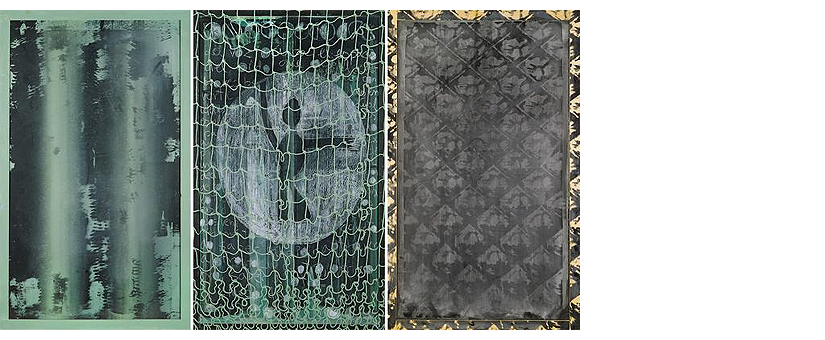 Federico Guzmán: Blackboard Jungle V, XI, I (1994). Banco de España Collection
His work has also been shown at numerous international events, including the Sydney (1990), Johannesburg (1995) and Istanbul (1997) biennials, and at group exhibitions in institutions such as the Museé d'Art Moderne de la Ville de Paris, the Kunsthalle Bern and the Fridericianum Kunsthalle in Kassel. Pieces by Guzmán also feature in the collections of galleries and museums across the world, including New York's MOMA, the Boymans Van Beuningen Museum in Rotterdam and – closer to home – the Barcelona Museum of Contemporary Art, the Castilla y León Museum of Contemporary Art and the Centre for Contemporary Art of Galicia.
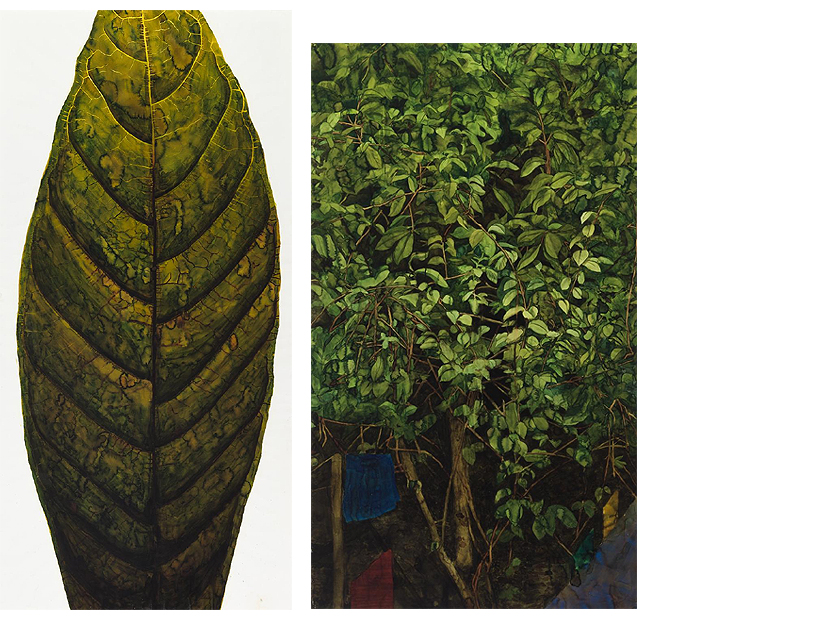 Federico Guzmán: Theobroma Cacao (2000) and Yagé (2000). Banco de España Collection
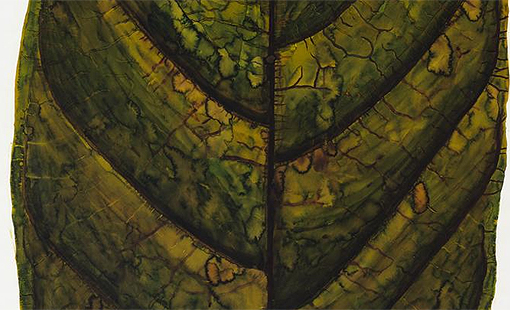
The Banco de España Collection possesses eight of the artist's works, one of which, Theobroma Cacao (2000), was included in Flowers and Fruits, an exhibition held at the Bank's head offices on Plaza Cibeles from 26 October 2022 to 25 February 2023. As Isabel Tejeda writes, it is a 'a scientific drawing with post-colonial overtones', in which the artist depicts not the fruit, but the leaf of the plant. Used in numerous religious rites in pre-Columbian cultures, the cacao plant has now been transformed into a globally-traded commodity, an example of the ways in which colonisation persists in modern guises.
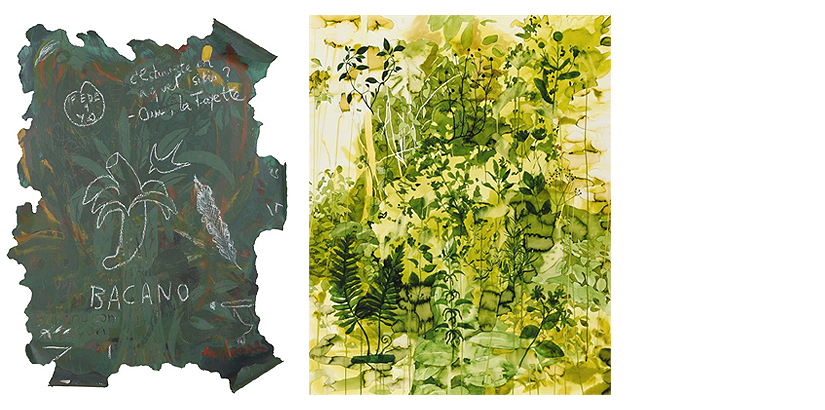 Federico Guzmán: Bacano (1998) and Medicinal Garden (2001). Banco de España Collection
Other works by Guzmán in the bank's collection include Yagé and the small psychedelic collage The Mistress of the Yucca, both painted in the same year as Theobroma Cacao. According to Tejada, the two works are linked to the ritual performed by the Mai Huna tribe to petition the gods for a good yucca (or cassava) harvest. Untitled (2001), Medicinal Garden (2001) and Hammock School (2004) also centre on the motif of the 'plant', a vehicular element in his art. The first depicts a plant, recreated from the shards of a broken mirror in which we intuit the reflection of the artist himself; the second shows his interest in the ancestral use of plants for medicinal purposes; and the third depicts dozens of leaves, apparently positioned on a colourful tapestry that is faintly reminiscent of a flag.
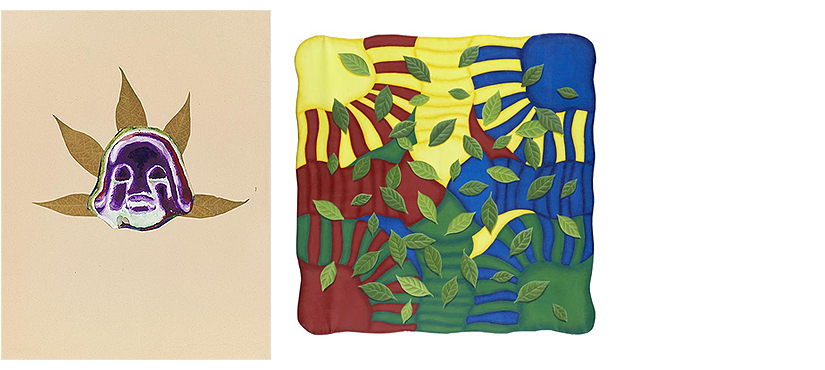 Federico Guzmán: The Mistress of the Yucca (2000) and Hammock School (2004). Banco de España Collection
Blackboard Jungle V, XI, I (1994) – Guzman's earliest work in the Collection – is a participatory piece. The title references Richard Brooks's 1955 film of the same name, which tells the story of a committed teacher's attempts to win the confidence of a group of disruptive public-school students. Guzmán's use of blackboards in this triptych is very typical of his work from the 1990s. There is also a blackboard in Bacano (1998), which features a metal background with jungle motifs on which are scribbled a set of drawings and texts referring to a place which the artist considered 'bacano' (‘great’ or ‘cool’ in colloquial Latin-American Spanish).